
Quote
template for Excel
A quote in Excel that does the sums for you: live formulas for each line, the subtotal and the total.
Download the quote template
Free, with no sign-up. Replace the words in square brackets with your own details.
The free quote generator makes a finished PDF with your details, logo and colours. Nothing is stored.
The Excel version of the quote template works as a calculator as well as a form. Type a quantity and a price and the line total, subtotal, VAT and total update on their own. This page explains how the formulas work, how to keep them safe, how to organise a year's worth of documents, and what a UK quote must show.
How the formulas work
Each line's amount is its quantity multiplied by its unit price, rounded to the penny: =ROUND(B12*D12,2). The subtotal adds up the amount column with SUM, the VAT line multiplies the subtotal by the VAT rate cell, and the total adds them together. Type only into the description, quantity, unit and price cells; the amount and total cells should be left alone. The empty rows below the example lines already contain the formula, and the money format shows nothing until you enter a quantity and price, so the sheet stays tidy.
Adding rows without breaking the totals
If you need more lines than the template provides, insert new rows in the middle of the lines (right-click a row number, Insert) rather than below the last one. Excel then extends the SUM range automatically. Copy the amount formula into the new row by dragging down from the row above. A quick way to check nothing is broken is to click the total cell and look at the formula bar: it should refer to the subtotal and VAT cells, not to a typed number.
Protecting the formulas
To stop a formula being typed over, lock the calculated cells. Select the cells you type into, choose Format Cells, Protection, and untick Locked; then choose Review, Protect Sheet. From then on only the input cells can be edited. Keep one workbook per year, and make a new sheet for each quote by right-clicking the sheet tab and choosing Move or Copy, Create a copy, naming each tab with its number.
Sending it
Send a PDF, not the spreadsheet. In Excel, choose File, Export, Create PDF/XPS (or Save As, PDF on a Mac), and select only the quote sheet. Check the print preview first: the template is set to fit one page wide, so it prints and exports cleanly on A4. Keep the workbook as your working record and the PDF as the copy you sent.
Changing the VAT rate
The VAT rate sits in its own cell next to the VAT line, formatted as a percentage, and the VAT and total formulas refer to it. If you are not VAT registered, delete the VAT row entirely (right-click the row number, Delete) and check the total now equals the subtotal: an unregistered business must not show VAT. If you charge 5% on some work, change the rate cell to 5%, or keep two quotes rather than mixing rates on one sheet, which is simpler to get right.
What the quote must show
Send a quote whenever you can price a job with confidence: a bathroom refit after a survey, a website with a defined scope, a catering order for a set number of guests, a batch of products. If you cannot know the final cost until the work is under way, such as a repair where the fault is hidden, give an estimate instead and say it is an estimate.
| What it shows | Why it matters |
|---|---|
| The word "Quote" or "Quotation", a number and the date | Identifies it and shows it is a fixed price |
| Your details and the customer's | Who is offering and to whom |
| A clear description of the work or goods, with quantities | Defines what the price covers |
| What is not included | Prevents disputes over extras |
| The price, and whether VAT is included | Consumers must be shown VAT-inclusive prices |
| How long the quote is valid | Protects you from price rises |
| Payment terms, deposit and timescale | Sets expectations before work starts |
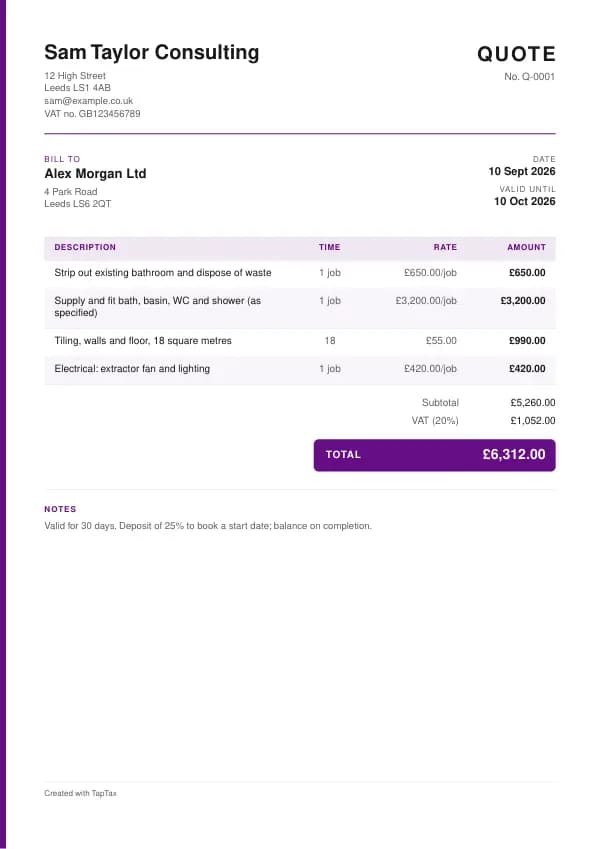
The template's example lines, which you replace with your own:
| Line | Quantity | Price | Amount |
|---|---|---|---|
| Strip out existing bathroom and dispose of waste | 1 job | £650.00 | £650.00 |
| Supply and fit bath, basin, WC and shower (as specified) | 1 job | £3,200.00 | £3,200.00 |
| Tiling, walls and floor, 18 square metres | 18 | £55.00 | £990.00 |
| Electrical: extractor fan and lighting | 1 job | £420.00 | £420.00 |
| Subtotal | £5,260.00 | ||
| VAT at 20% | £1,052.00 | ||
| Quote total | £6,312.00 |
Filling in the quote
- Visit or talk through the job, and write down exactly what the customer wants.
- Break the work into clear lines with quantities and prices.
- List anything not included, and any assumptions you made.
- Show VAT, and give consumers the VAT-inclusive total.
- Add validity, deposit, payment terms and a likely start date.
- Ask the customer to accept in writing, and keep the acceptance with the quote.
When a quote becomes binding
A quote is an offer. When the customer accepts it, by signing, by email or by telling you to go ahead, a contract exists on the terms in the quote. For consumers, the Consumer Rights Act 2015 makes what you say or write about the service binding if the customer relies on it, including the price and any timescales you gave. You cannot then charge more for the same work unless the quote allowed for it, for example a clearly stated provisional sum, or the customer agrees a change. If the customer asks for extra work, price it and get agreement before doing it.
UK VAT rates
- Standard rate20%
- Reduced rate5%
- Zero rate0%
Quote or estimate?
A quote is a fixed price for defined work. An estimate is an informed guess, which can change as the job goes on. Customers often treat an estimate as a promise, so label it clearly, and give a quote whenever you can. Our guide to quote vs estimate covers the difference.
Writing the scope
The scope is the part of the quote that prevents disputes. Describe the finished result, the materials and specifications you have allowed for (brands, sizes, finishes), and any work you are relying on others to do. Where the customer is supplying something, say so. Then list exclusions: making good, decoration, waste removal, permits, and anything hidden that you could not inspect. A customer who has read a clear scope is much less likely to be surprised by the final invoice.
Showing VAT on quotes
If you are VAT registered, show the price before VAT, the VAT and the total. When quoting consumers, the price they see must include VAT; quoting a figure "plus VAT" to a homeowner and adding it later is a common source of complaints and can be an unfair trading practice. Business customers are used to net prices, but still show the VAT. If you are not registered, say that no VAT is charged, and keep an eye on the £90,000 threshold: registering part way through a job changes what you must charge.
Validity and price rises
Give every quote an expiry date, often 30 days, so you are not held to an old price when materials go up. If the customer accepts after the date, re-check your costs and re-issue the quote if needed. For long jobs where material prices could move, you can include a clearly stated price adjustment clause for named materials, but for consumers it must be fair and transparent, so keep it simple and specific.
From quote to invoice
Once accepted, the quote is the basis of every invoice on the job. Quote its number on the deposit invoice, any stage payment invoices and the final invoice. If you use the quote generator, the same lines can be turned into an invoice, which keeps descriptions and prices consistent. Any variations are shown separately against the original quote.
Consumers' right to cancel
If you quote a consumer and the contract is made at their home or online, rather than at your premises, they usually have 14 days to cancel. You must give them information about that right and a cancellation form. If they want work to start within the 14 days, get their request in writing; if they then cancel, they pay for the work done up to that point. Failing to give the cancellation information can extend the cancellation period and leave you unable to charge for work done.
Common mistakes
- A vague scope. "Refit bathroom" invites argument; list what is and is not included.
- Quoting consumers a price plus VAT. Consumers must see the VAT-inclusive total.
- No expiry date. Without one, a customer may hold you to an old price months later.
- Typing over a formula. A typed number in a total cell stops updating; restore the formula or protect the sheet.
- Adding rows below the SUM range. Insert rows inside the lines, so the subtotal includes them.
Checklist before you send it
Before a quote goes out, check it against the list of what it must show:
- The word "Quote" or "Quotation", a number and the date is on it and correct.
- Your details and the customer's is on it and correct.
- A clear description of the work or goods, with quantities is on it and correct.
- What is not included is on it and correct.
- The price, and whether VAT is included is on it and correct.
- How long the quote is valid is on it and correct.
- Payment terms, deposit and timescale is on it and correct.
- A copy is saved with your records.
Keep a copy
You must keep your records for at least 5 years after the 31 January submission deadline of the relevant tax year.
Keep a copy of every quote you issue or receive, digital is fine, with the payments that relate to it. From 6 April 2026, sole traders and landlords with qualifying income over £50,000 must keep digital records and send HMRC quarterly updates under Making Tax Digital, falling to £30,000 from April 2027 and £20,000 from April 2028. The MTD requirement checker shows when it applies to you, and how long to keep invoices covers retention.
Other formats and the full guide
This page covers Excel. The quote template guide explains the document itself in full, and the same template is available in the other formats from there. To skip the download, the free quote generator makes a finished PDF online.
A TapTax account, free to start, creates and sends invoices, tracks which are paid, keeps receipts and bills with your records, and files your quarterly updates to HMRC from the same data.
Tools for this
Related guides and definitions
Frequently asked questions
Does the Excel quote template calculate totals?
Yes. Each line, the subtotal, the VAT and the total are formulas, so they update as you type quantities and prices.
Will it work in Google Sheets?
Yes. Upload the .xlsx file to Google Drive and open it with Google Sheets; the formulas carry over.
How do I stop the formulas being overwritten?
Unlock the cells you type into, then protect the sheet from the Review menu. Only the unlocked cells can then be edited.
Invoice, get paid, stay ready for HMRC.
TapTax creates and sends your invoices, tracks which ones are paid and files your quarterly updates to HMRC. Start on the free plan, no card needed.
Get started freeSources
The rules on this page come from official guidance.