
Estimate
template
An estimate that gives a realistic price range, says what could change it, and how you will keep the customer informed.
Download the estimate template
Free, with no sign-up. Replace the words in square brackets with your own details.
Some jobs cannot be priced exactly until you start: a leak behind a wall, an old car with unknown faults, a project whose scope will be discovered along the way. An estimate gives the customer a realistic figure without committing you to a fixed price. It works when it says clearly that it is an estimate, explains what could change it, and promises to warn the customer before the cost goes beyond an agreed limit. This template does all three.
- Estimate
- An approximate price for a job, based on the information available, which may change once the work starts. Unlike a quote, it is not a fixed price, but it should be a genuine, reasonable assessment.
When to use a estimate
Give an estimate when the cost depends on things you cannot know in advance: repairs and diagnostics, renovation of older properties, time-based creative or technical projects, or clearance jobs where volume is uncertain. If you can price the work with confidence, a quote is better for both of you. Many trades give an estimate first, then a firm quote after an inspection or the first stage of work.
What a estimate must show
| What it shows | Why it matters |
|---|---|
| The word "Estimate", a number and the date | Makes clear it is not a fixed price |
| Your details and the customer's | Who is estimating and for whom |
| The work covered, with the assumptions behind the figure | What the estimate is based on |
| The estimated price, or a range | The customer's budget guide |
| What could change the price | Explains the uncertainty |
| A limit above which you will ask before continuing | Protects the customer and you |
| VAT, and how the work will be charged | Time and materials, or a revised quote |
An example estimate
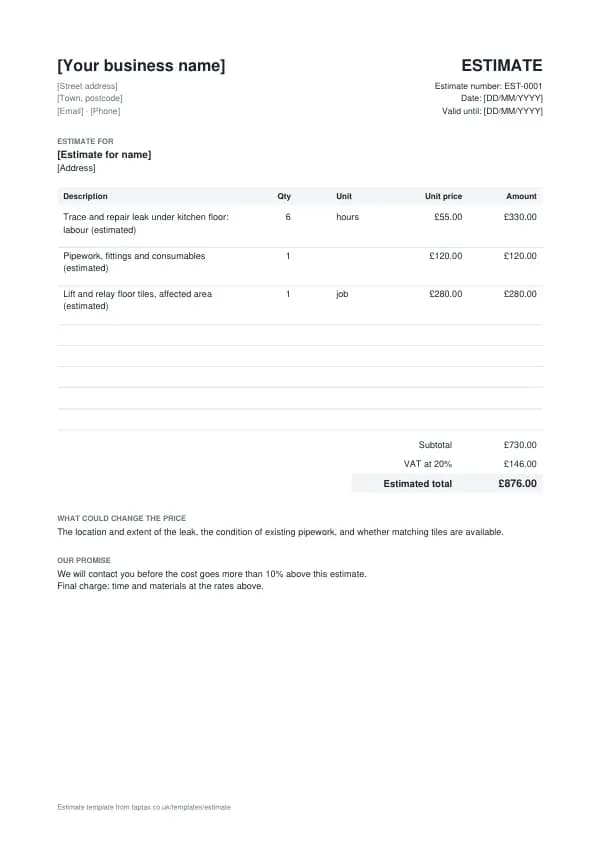
The template comes filled in with example lines like these, so you can see how each part works before replacing them with your own.
| Line | Quantity | Price | Amount |
|---|---|---|---|
| Trace and repair leak under kitchen floor: labour (estimated) | 6 hours | £55.00 | £330.00 |
| Pipework, fittings and consumables (estimated) | 1 | £120.00 | £120.00 |
| Lift and relay floor tiles, affected area (estimated) | 1 job | £280.00 | £280.00 |
| Subtotal | £730.00 | ||
| VAT at 20% | £146.00 | ||
| Estimated total | £876.00 |
Line by line: Trace and repair leak under kitchen floor: labour (estimated), 6 hours × £55.00 = £330.00; Pipework, fittings and consumables (estimated), 1 × £120.00 = £120.00; Lift and relay floor tiles, affected area (estimated), 1 job × £280.00 = £280.00. The subtotal is £730.00, VAT at 20% adds £146.00, and the estimated total is £876.00. The figures are illustrative; replace them with your own.
How to fill in the template
- Assess the job and note the assumptions you are making.
- Price each part on your best information, as a figure or range.
- Explain what could make the price go up or down.
- Set a limit, such as 10% above the estimate, beyond which you will ask first.
- Show VAT and how the final charge will be worked out.
- Keep the customer informed as the work reveals the real cost.
Give each estimate its own number in a single sequence, and never reuse one. A number lets you and your customer refer to the document without confusion, and an unbroken sequence shows your records are complete. The invoice number generator suggests a format that stays tidy for years.
How far can an estimate change?
An estimate is not binding in the way a quote is, but it is not a free pass either. Under the Consumer Rights Act 2015, information you give a consumer that they rely on can become part of the contract, and where no fixed price was agreed, the consumer must pay only a reasonable price. A final bill far above the estimate without warning is likely to be challenged. Agreeing a limit, and stopping to ask before exceeding it, keeps you on the right side of the law and of the customer. For business customers, the contract terms decide, but the same courtesy avoids disputes.
UK VAT rates
- Standard rate20%
- Reduced rate5%
- Zero rate0%
Estimate or quote?
An estimate is an informed guess; a quote is a fixed price. If the job allows it, give a quote. If not, give an estimate, then convert it to a quote once the unknowns are resolved. Our guide to quote vs estimate explains more.
Estimating accurately
Base the estimate on what you can see and on your records of similar jobs. Price labour in hours at your rate and materials at cost plus your mark-up, and add a contingency for the unknowns, stating that you have done so. A range, such as £850 to £1,100, often communicates uncertainty better than a single figure. Customers value honesty about the risks more than a low number that then climbs.
Keeping the customer informed
When the real cost starts to differ from the estimate, tell the customer straight away, explain why, and get their agreement before going further. A short message with a photo of the problem you found is often enough. Record their agreement. Customers who are kept informed rarely dispute the final bill, while those who are surprised often do, even when the extra work was necessary.
Invoicing against an estimate
The invoice should show the actual work and cost, referencing the estimate number. If the final figure differs from the estimate, add a line explaining why, and refer to the customer's agreement to any increase. If the final figure is lower, say so: it builds trust. Charge on the basis the estimate set out, such as time and materials at the stated rates, so the customer can see how the total was reached.
Estimates for business customers
Business customers often need a figure for a budget or purchase order. Give an estimate with clear assumptions and ask them to raise a purchase order for the upper end of the range, or agree how variations will be approved. That avoids work stopping while a new order is raised. Once the work is under way and the scope is clear, many businesses prefer to convert the estimate into a fixed quote for the remainder.
Charging for estimates
Most small jobs are estimated for free, but for complex jobs requiring investigation, such as diagnostics, surveys or design work, it is reasonable to charge for the estimate itself, or to charge and then deduct the fee from the job if the customer goes ahead. Say so before you start, and put it in writing, so there is no surprise invoice for the visit.
Common estimate mistakes
- Not labelling it as an estimate. Customers may then treat the figure as a fixed price.
- No limit for going over. Agree a threshold beyond which you ask before continuing.
- Surprising the customer with the final bill. Tell them as soon as the cost starts to move.
Checklist before you send it
Before a estimate goes out, check it against the list of what it must show:
- The word "Estimate", a number and the date is on it and correct.
- Your details and the customer's is on it and correct.
- The work covered, with the assumptions behind the figure is on it and correct.
- The estimated price, or a range is on it and correct.
- What could change the price is on it and correct.
- A limit above which you will ask before continuing is on it and correct.
- VAT, and how the work will be charged is on it and correct.
- A copy is saved with your records.
Sending it
Send the estimate as a PDF attached to an email, not as an editable file. In the email, say what it is, its number, the amount and any date that matters, so the reader can act without opening the attachment. Send it to the person or inbox that deals with it, which for a business is often an accounts address rather than the person you worked with, and keep a copy of the email and the PDF together in your records.
Keep a copy
You must keep your records for at least 5 years after the 31 January submission deadline of the relevant tax year.
Keep a copy of every estimate you issue or receive, digital is fine, with the payments that relate to it. From 6 April 2026, sole traders and landlords with qualifying income over £50,000 must keep digital records and send HMRC quarterly updates under Making Tax Digital, falling to £30,000 from April 2027 and £20,000 from April 2028. The MTD requirement checker shows when it applies to you, and how long to keep invoices covers retention.
Download the estimate template
The template comes as a Word document for Word, Google Docs and Pages, an Excel workbook for Excel and Google Sheets, and a print-ready PDF. Replace the words in square brackets with your own details. In the Excel version each line, the subtotal and the total are formulas, so the figures update as you type.
Related documents in the same family: the purchase order template and quote template. All of them follow the same numbering and record-keeping rules, and each page explains what that document must show.
A TapTax account, free to start, creates and sends invoices, tracks which are paid, keeps receipts and bills with your records, and files your quarterly updates to HMRC from the same data.
Tools for this
Related guides and definitions
Frequently asked questions
Is an estimate legally binding?
Not as a fixed price, but consumers can rely on what you told them, and must only pay a reasonable price. Big, unexplained increases are likely to be challenged.
How much can the final bill exceed an estimate?
There is no fixed legal percentage. Agree a limit, often 10% to 15%, and ask the customer before going beyond it.
Should I give a quote or an estimate?
Give a quote if you can price the job with confidence; give an estimate when the cost depends on things you cannot know yet.
Invoice, get paid, stay ready for HMRC.
TapTax creates and sends your invoices, tracks which ones are paid and files your quarterly updates to HMRC. Start on the free plan, no card needed.
Get started freeSources
The rules on this page come from official guidance.