
Stage payment invoice
template
An invoice for an agreed milestone, such as first fix or design sign-off, on a staged job.
Download the stage payment invoice template
Free, with no sign-up. Replace the words in square brackets with your own details.
The free invoice generator makes a finished PDF with your details, logo and colours. Nothing is stored.
Stage payments tie money to progress the customer can see. Each stage has a value agreed in advance, and when it is complete you invoice it. Customers like knowing exactly what they will pay and when; you get paid as the job moves forward instead of waiting until the end. This template shows the stage, its agreed value, the schedule so far and the balance still to come.
- Stage payment invoice
- An invoice for a fixed amount due when an agreed stage of a job is complete, such as foundations, first fix, or delivery of a design. The stages and their values are set in the contract or quote before work starts.
When to use a stage payment invoice
Use a stage payment invoice when your quote or contract sets out milestones with a price for each: an extension (foundations, walls to plate, roof, first fix, second fix, completion), a website (design, build, launch), or a bespoke product (deposit, sign-off, delivery). Issue each invoice when that stage is complete and, where the contract requires, signed off. If you bill by time rather than milestones, use an interim invoice instead.
What a stage payment invoice must show
| What it shows | Why it matters |
|---|---|
| A unique invoice number and date, and the job reference | Links the invoice to the job |
| Your details and the customer's | Who is billing and who pays |
| The stage completed, as named in the contract | What triggered this payment |
| The agreed value of the stage | The amount due now |
| The payment schedule: stages paid and still to come | Shows where the job stands |
| VAT if you are registered | Each stage has its own tax point |
| Payment terms and due date | When this stage must be paid |
An example stage payment invoice
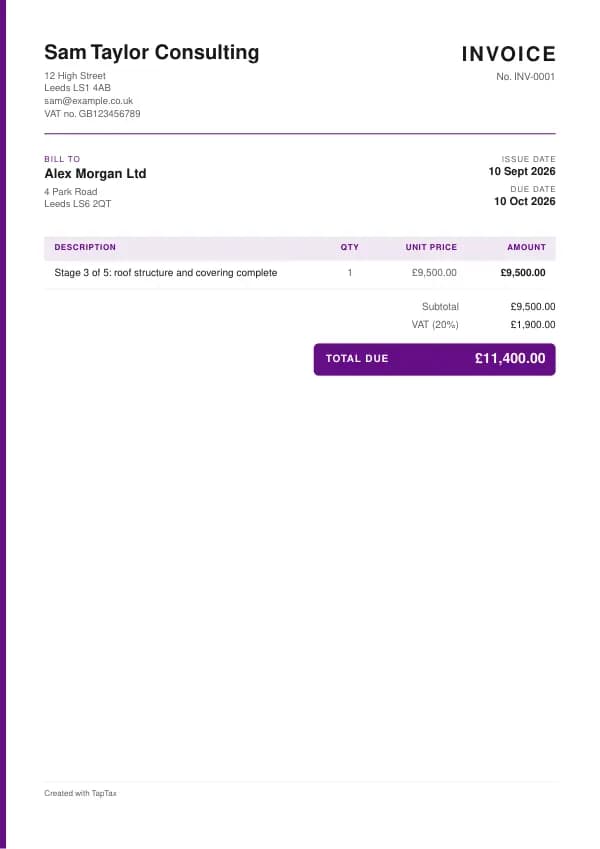
The template comes filled in with example lines like these, so you can see how each part works before replacing them with your own.
| Line | Quantity | Price | Amount |
|---|---|---|---|
| Stage 3 of 5: roof structure and covering complete | 1 | £9,500.00 | £9,500.00 |
| Subtotal | £9,500.00 | ||
| VAT at 20% | £1,900.00 | ||
| Stage payment due | £11,400.00 |
Line by line: Stage 3 of 5: roof structure and covering complete, 1 × £9,500.00 = £9,500.00. The subtotal is £9,500.00, VAT at 20% adds £1,900.00, and the stage payment due is £11,400.00. The figures are illustrative; replace them with your own.
How to fill in the template
- Set out the stages and their values in your quote or contract.
- When a stage is complete, confirm it with the customer if the contract requires sign-off.
- Invoice the agreed value of that stage.
- Show the full payment schedule, marking stages paid and still to come.
- Add VAT if you are registered and a due date.
- Do not start the next stage until you are comfortable with payment, if your terms allow.
Number every stage payment invoice in sequence and never reuse a number, even when a document is cancelled. Numbers make documents easy to find and to match against payments, and they show HMRC and your customers that nothing is missing. For a numbering format, try the invoice number generator.
Designing a fair stage schedule
Stage values should roughly track the cost and effort of each stage, so neither side carries too much risk. Front-loading payments beyond the work done can put off customers and, for consumers, may be challenged as unfair; back-loading leaves you funding the job. Define each stage by a clear, checkable event, such as "roof watertight" rather than "roofing progress". Keep the final stage large enough to motivate completion but not so large that a dispute over snagging leaves you badly out of pocket. Write the stages, values and payment terms into the contract before work begins.
Fixed compensation for a late business payment
- Debt up to £999.99£40
- £1,000 to £9,999.99£70
- £10,000 or more£100
Stage payment or interim invoice?
Stage payment invoices bill a fixed amount at each milestone. Interim invoices bill the value of work done over a period. Milestones suit jobs with clear phases and a fixed price; interim billing suits work with steady progress or changing scope.
VAT and stage payments
For construction services supplied under a contract with stage payments, the tax point for each stage is the earlier of receiving the payment or issuing a VAT invoice. That means VAT is accounted for stage by stage, not all at the end. If you would rather not pay VAT to HMRC before the customer pays you, send a request for payment first and issue the VAT invoice on receipt. The same principle applies to other services billed by milestone under a continuous-supply contract.
Variations and extras
Extras the customer asks for part way through should be priced and agreed in writing before you do them, and either added to a stage or invoiced separately. Do not quietly add them to the next stage payment: customers reject invoices that do not match the agreed schedule. Keep a variations log with the date, description, price and customer's agreement, and carry the total onto the final invoice.
When a stage is disputed
If a customer says a stage is not complete, meet on site or on a call and agree a snagging list, then invoice once it is cleared, or invoice the agreed stage less a fair holdback for the items outstanding. Staying in writing protects both sides. For construction contracts covered by the Construction Act, the payer must serve a pay less notice in time if they intend to pay less than the invoice, so read the contract's notice timetable. Our guide to invoice disputes sets out the steps.
Stage payments for homeowners
Homeowners are not covered by the Construction Act's payment rules, so a clear written schedule is your main protection. Agree the stages in the quote, keep each stage payment proportionate to the work, and never ask for a large payment far ahead of the work. Consumer protection law treats disproportionate advance payments as a warning sign, and trade associations advise homeowners to avoid them, so a fair schedule helps you win work.
Tracking stages in your records
Keep a simple schedule for each job with the stages, values, invoice numbers, dates paid and any variations. It makes the final invoice easy, answers customer questions quickly, and gives you the figures for your tax return. With Making Tax Digital, each stage invoice goes into your digital records as it is issued or paid, so the running totals are already there.
Worked example
A builder quotes £36,000 plus VAT for a single-storey extension, paid in five stages: foundations £6,000, walls to plate £8,500, roof £9,500, first fix £7,000 and completion £5,000. When the roof is watertight, they issue a stage invoice for £9,500 plus £1,900 VAT, showing the two stages already paid and the two still to come. The homeowner pays within the agreed 7 days. A variation for an extra window, agreed in writing at £650, is added to the completion invoice rather than slipped into a stage. Every invoice ties back to the schedule in the quote.
Common stage payment invoice mistakes
- Stages defined vaguely. Use checkable events, such as "roof watertight", not "roofing progress".
- Adding unagreed extras to a stage invoice. Agree variations in writing first and show them separately.
- Payments far ahead of the work. Keep each stage proportionate, especially for homeowners.
Checklist before you send it
A quick check of every stage payment invoice before you send it:
- A unique invoice number and date, and the job reference is on it and correct.
- Your details and the customer's is on it and correct.
- The stage completed, as named in the contract is on it and correct.
- The agreed value of the stage is on it and correct.
- The payment schedule: stages paid and still to come is on it and correct.
- VAT if you are registered is on it and correct.
- Payment terms and due date is on it and correct.
- A copy is saved with your records.
Sending it
Email the stage payment invoice as a PDF with a short, specific message: the document number, the amount, and what you need the reader to do. Address it to whoever processes it, often an accounts team, and copy your usual contact if that helps. File the sent PDF with its number in the file name, so you can find it in seconds if there is ever a question.
Keep a copy
You must keep your records for at least 5 years after the 31 January submission deadline of the relevant tax year.
Business documents are records, and records have to be kept. Save every stage payment invoice in one place, ideally digitally, so you can find it if a customer or HMRC asks. Making Tax Digital for Income Tax makes digital records compulsory from 6 April 2026 for qualifying income over £50,000, from April 2027 over £30,000 and from April 2028 over £20,000; check your date with the MTD requirement checker.
Download the stage payment invoice template
Download it as a Word document, an Excel workbook or a PDF, whichever suits the way you work. The Word file opens in Google Docs too, and the Excel file in Google Sheets. The Excel totals are live formulas. Or fill it in online with the free invoice generator, which makes a finished PDF with your details, in your colours.
Related documents in the same family: the deposit invoice template, interim invoice template, final invoice template, retainer invoice template and hourly invoice template. All of them follow the same numbering and record-keeping rules, and each page explains what that document must show.
If you would rather not manage documents by hand, a TapTax account, free to start, keeps your invoices, receipts and bank transactions together and files your Making Tax Digital quarterly updates to HMRC.
Tools for this
Related guides and definitions
Frequently asked questions
What is a stage payment invoice?
An invoice for a fixed amount due when an agreed milestone of a job is complete.
When is VAT due on a stage payment?
For construction services under a contract with stage payments, when the payment is received or the VAT invoice issued, whichever is first.
Can a customer refuse to pay a stage?
If the stage is genuinely incomplete, they can hold back fairly. Under the Construction Act they must serve a pay less notice in time; otherwise, it depends on your contract.
Invoice, get paid, stay ready for HMRC.
TapTax creates and sends your invoices, tracks which ones are paid and files your quarterly updates to HMRC. Start on the free plan, no card needed.
Get started freeSources
The rules on this page come from official guidance.