
Deposit invoice
template
An invoice for a deposit before work starts, with the balance and VAT treatment spelled out.
Download the deposit invoice template
Free, with no sign-up. Replace the words in square brackets with your own details.
The free invoice generator makes a finished PDF with your details, logo and colours. Nothing is stored.
A deposit protects you from customers who cancel after you have turned other work away or bought materials. A deposit invoice makes the request formal: it states the amount, what it is for, whether it is refundable, and how it will be deducted from the final bill. For VAT-registered businesses, most deposits are advance payments with their own tax point, so the deposit invoice is usually a proper VAT invoice. This template covers all of that.
- Deposit invoice
- An invoice for part of the price, paid before the work is done or the goods are delivered. It secures the booking or covers upfront costs, and the rest is invoiced later on a balance or final invoice.
When to use a deposit invoice
Use a deposit invoice when you want part of the price before you start: a builder buying materials, a wedding photographer holding a date, a furniture maker starting a commission, a caterer booking an event, or a web designer starting a project. It is also right when a customer's finance team needs an invoice to release money. If you want the whole price in advance, a pro forma invoice followed by a real invoice is often simpler. If the money is a returnable security, such as a deposit on hired equipment, it is not an advance payment and does not need VAT.
What a deposit invoice must show
| What it shows | Why it matters |
|---|---|
| The heading "Deposit invoice" and a unique invoice number | In your normal invoice sequence |
| Your details and the customer's | Who is asking and who is paying |
| What the deposit is for, with the total job price | Puts the deposit in context |
| The deposit amount, as a figure or percentage of the total | What is due now |
| VAT on the deposit, if you are registered | Most deposits create a tax point when received |
| Whether the deposit is refundable, and when | Avoids disputes if the customer cancels |
| How the balance will be invoiced and when | Sets expectations for the final bill |
An example deposit invoice
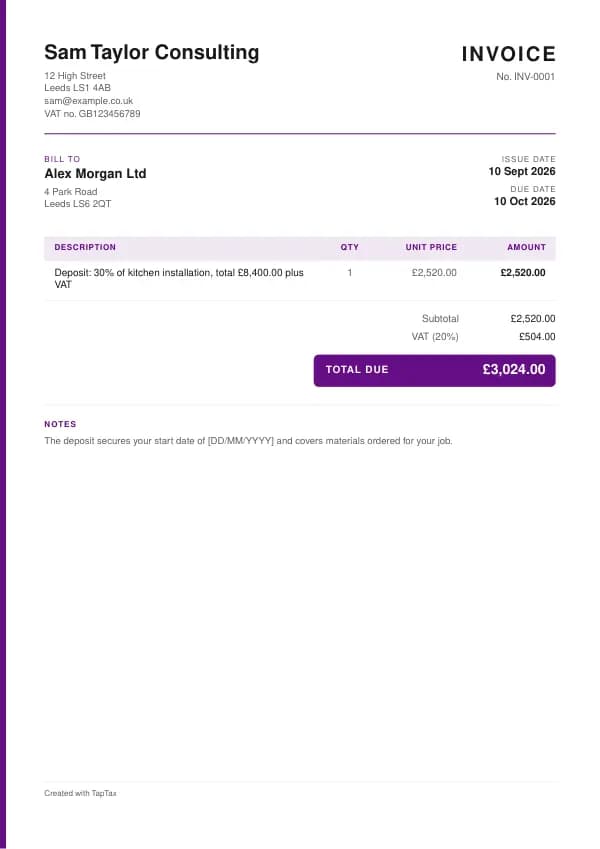
The template comes filled in with example lines like these, so you can see how each part works before replacing them with your own.
| Line | Quantity | Price | Amount |
|---|---|---|---|
| Deposit: 30% of kitchen installation, total £8,400.00 plus VAT | 1 | £2,520.00 | £2,520.00 |
| Subtotal | £2,520.00 | ||
| VAT at 20% | £504.00 | ||
| Deposit due | £3,024.00 |
Line by line: Deposit: 30% of kitchen installation, total £8,400.00 plus VAT, 1 × £2,520.00 = £2,520.00. The subtotal is £2,520.00, VAT at 20% adds £504.00, and the deposit due is £3,024.00. The figures are illustrative; replace them with your own.
How to fill in the template
- Agree the total price and the deposit in writing first, usually in the quote.
- Raise the deposit invoice with the next number in your invoice sequence.
- State what the deposit is for, the total job price and the amount due now.
- Add VAT on the deposit if you are registered.
- Set out your refund terms and when the balance will be invoiced.
- On the final invoice, deduct the deposit already paid.
Give each deposit invoice its own number in a single sequence, and never reuse one. A number lets you and your customer refer to the document without confusion, and an unbroken sequence shows your records are complete. The invoice number generator suggests a format that stays tidy for years.
VAT on deposits
For VAT, most deposits are advance payments for a supply, and receiving one creates a tax point for the amount received. That means VAT is due on the deposit in the VAT period you receive it, and a VAT-registered business should issue a VAT invoice for it within 30 days. The rest of the price has its own tax point later. A deposit that is only a security, refunded when hired goods come back safely or kept only to cover loss or damage, is not payment for a supply, so no VAT is due on it. If a deposit is later kept because the customer cancels, the VAT position depends on whether any supply was made, so check HMRC's guidance on cancellation charges before adjusting.
UK VAT rates
- Standard rate20%
- Reduced rate5%
- Zero rate0%
Deposit invoice or pro forma invoice?
A deposit invoice is a real invoice for part of the price, recorded as a sale and carrying VAT. A pro forma invoice is a preliminary request that is not a VAT invoice and is replaced by a real invoice once paid. Use a deposit invoice when you are taking part of the price and want the paperwork settled now.
How much deposit to ask for
There is no legal limit on deposits between businesses, but consumers can challenge a deposit that is out of proportion to your costs if they cancel. A common approach is to ask for enough to cover materials or costs you commit to up front, and your lost opportunity for a booked date. Trades often take 10% to 30%, event suppliers 25% to 50%, and bespoke makers up to half. State the percentage and what it covers in your quote, so the deposit invoice holds no surprises.
Refunds and consumer rights
Consumers who book services at a distance or off premises, such as online or in their own home, usually have a 14-day right to cancel, and a deposit may have to be refunded if they cancel in time, less the value of any work done at their request during that period. A deposit described as non-refundable can still be challenged as an unfair term if it goes beyond your actual losses. Set refund terms that match your real costs, and put them in writing before you take the money.
Recording deposits in your accounts
On the cash basis, most sole traders record the deposit as income when it is received. On the traditional basis, a deposit for work not yet done is a payment in advance, and the income belongs to the period in which you do the work. Either way, keep the deposit invoice and the final invoice linked, so the total income on the job is counted once. Your records need to show the deposit, the final invoice and the balance paid.
The balance invoice
When the work is finished, issue a final invoice for the full price, showing the deposit already paid and the balance due. If you are VAT registered, VAT on the final invoice is charged only on the balance, because VAT on the deposit was already accounted for. Quote the deposit invoice number so the customer can match both. Many customers pay the balance faster when the final invoice clearly shows what they already paid.
Deposits for materials in construction
Builders and fitters often take deposits to buy materials. For CIS work for a contractor, the deposit invoice should still split labour and materials, because the contractor deducts CIS from labour only. For homeowners, CIS does not apply. Where the work is zero-rated, such as building a new home or installing energy-saving materials, the deposit carries the same rate as the work. The CIS calculator and VAT calculator help check the figures.
Common deposit invoice mistakes
- Not charging VAT on a deposit. Most deposits are advance payments with their own tax point.
- Charging VAT on the whole job again at the end. VAT on the final invoice applies only to the balance.
- Vague refund terms. Say in writing whether and when the deposit is refundable.
Checklist before you send it
Before a deposit invoice goes out, check it against the list of what it must show:
- The heading "Deposit invoice" and a unique invoice number is on it and correct.
- Your details and the customer's is on it and correct.
- What the deposit is for, with the total job price is on it and correct.
- The deposit amount, as a figure or percentage of the total is on it and correct.
- VAT on the deposit, if you are registered is on it and correct.
- Whether the deposit is refundable, and when is on it and correct.
- How the balance will be invoiced and when is on it and correct.
- A copy is saved with your records.
Sending it
Send the deposit invoice as a PDF attached to an email, not as an editable file. In the email, say what it is, its number, the amount and any date that matters, so the reader can act without opening the attachment. Send it to the person or inbox that deals with it, which for a business is often an accounts address rather than the person you worked with, and keep a copy of the email and the PDF together in your records.
Keep a copy
You must keep your records for at least 5 years after the 31 January submission deadline of the relevant tax year.
Keep a copy of every deposit invoice you issue or receive, digital is fine, with the payments that relate to it. From 6 April 2026, sole traders and landlords with qualifying income over £50,000 must keep digital records and send HMRC quarterly updates under Making Tax Digital, falling to £30,000 from April 2027 and £20,000 from April 2028. The MTD requirement checker shows when it applies to you, and how long to keep invoices covers retention.
Download the deposit invoice template
The template comes as a Word document for Word, Google Docs and Pages, an Excel workbook for Excel and Google Sheets, and a print-ready PDF. Replace the words in square brackets with your own details. In the Excel version each line, the subtotal and the total are formulas, so the figures update as you type. Or fill it in online with the free invoice generator, which makes a finished PDF with your details, in your colours.
Related documents in the same family: the interim invoice template, stage payment invoice template, final invoice template, retainer invoice template and hourly invoice template. All of them follow the same numbering and record-keeping rules, and each page explains what that document must show.
A TapTax account, free to start, creates and sends invoices, tracks which are paid, keeps receipts and bills with your records, and files your quarterly updates to HMRC from the same data.
Tools for this
Related guides and definitions
Frequently asked questions
Do I charge VAT on a deposit?
Usually yes. Most deposits are advance payments and create a tax point when received. Security deposits that are refundable are not.
How do I show a deposit on the final invoice?
Show the full price, deduct the deposit already paid, and charge VAT only on the balance.
Is a deposit refundable?
It depends on your terms and the law. Consumers often have a 14-day right to cancel, and a deposit beyond your real losses can be challenged.
Invoice, get paid, stay ready for HMRC.
TapTax creates and sends your invoices, tracks which ones are paid and files your quarterly updates to HMRC. Start on the free plan, no card needed.
Get started freeSources
The rules on this page come from official guidance.