
Pro forma invoice
template
An advance bill for payment up front, or a quote in invoice form, marked clearly as not a VAT invoice.
Download the pro forma invoice template
Free, with no sign-up. Replace the words in square brackets with your own details.
The free pro forma invoice generator makes a finished PDF with your details, logo and colours. Nothing is stored.
A pro forma invoice lets you ask for payment before you supply, which protects you with new customers, custom orders and one-off jobs. It looks like an invoice, but its legal effect is different: it does not create a debt the way a sales invoice does, and it must not be used to reclaim VAT. This template is marked "Pro forma" and carries HMRC's wording that it is not a VAT invoice, so there is no confusion later.
- Pro forma invoice
- A preliminary bill sent before goods or services are supplied, setting out what the final invoice will be. It asks for payment in advance or confirms terms, but it is not a VAT invoice, and the customer cannot reclaim VAT on it.
When to use a pro forma invoice
Use a pro forma invoice to ask a new customer to pay before you start, to confirm the price and terms of an order before it ships, to give an overseas buyer the value of goods for their import licence or letter of credit, or to let a customer's purchasing team raise a payment against a document. Once the customer pays or you supply the goods or services, issue a proper invoice, or a VAT invoice if you are registered, within 30 days. If you only need the customer to agree a price, a quote is simpler.
What a pro forma invoice must show
| What it shows | Why it matters |
|---|---|
| The heading "Pro forma invoice" | Shows it is not a final invoice |
| Your name and address, and your VAT number if registered | Who is asking to be paid |
| The customer's name and address | Who is paying |
| A pro forma reference number and date | Lets you match the payment later |
| A description, quantity and price of what will be supplied | The basis of the final invoice |
| The statement "This is not a VAT invoice" | Required by HMRC on pro formas from registered businesses |
| The date by which payment is needed | When you will supply once paid |
HMRC says that if you issue a pro forma invoice it must be clearly marked "This is not a VAT invoice". The customer cannot use it to reclaim VAT; they reclaim from the VAT invoice you issue when you are paid or when you supply.
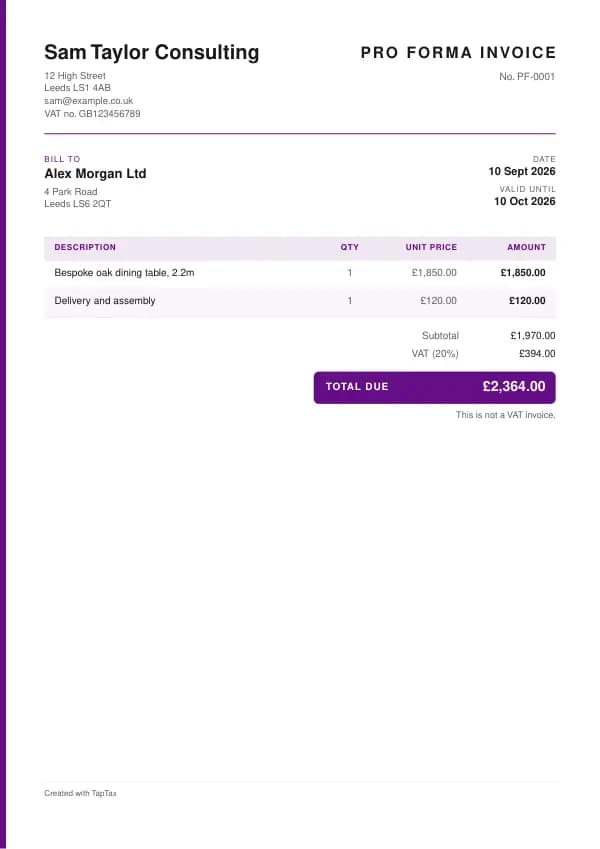
An example pro forma invoice
The template comes filled in with example lines like these, so you can see how each part works before replacing them with your own.
| Line | Quantity | Price | Amount |
|---|---|---|---|
| Bespoke oak dining table, 2.2m | 1 | £1,850.00 | £1,850.00 |
| Delivery and assembly | 1 | £120.00 | £120.00 |
| Subtotal | £1,970.00 | ||
| VAT at 20% | £394.00 | ||
| Amount required in advance | £2,364.00 |
Line by line: Bespoke oak dining table, 2.2m, 1 × £1,850.00 = £1,850.00; Delivery and assembly, 1 × £120.00 = £120.00. The subtotal is £1,970.00, VAT at 20% adds £394.00, and the amount required in advance is £2,364.00. The figures are illustrative; replace them with your own.
How to fill in the template
- Head the document "Pro forma invoice" and give it its own reference number, separate from your invoice sequence.
- Add your details and the customer's.
- List what you will supply, with prices and VAT if you are registered.
- Add "This is not a VAT invoice" and the date payment is needed by.
- Send it, and once paid or supplied, issue the real invoice within 30 days.
- Record the payment against the real invoice, not the pro forma.
Give each pro forma invoice its own number in a single sequence, and never reuse one. A number lets you and your customer refer to the document without confusion, and an unbroken sequence shows your records are complete. The invoice number generator suggests a format that stays tidy for years.
Tax points and pro formas
A pro forma invoice does not create a tax point. If the customer pays in advance, the payment itself creates a tax point for the amount paid, and a VAT-registered supplier must then account for the VAT and issue a VAT invoice within 30 days. If the customer does not pay in advance, the tax point is normally when the goods are supplied or the services performed. For Income Tax, the sale is recorded when the real invoice is issued (on the traditional basis) or when the money is received (on the cash basis). Either way, the pro forma is not your sales record; the invoice is.
UK VAT rates
- Standard rate20%
- Reduced rate5%
- Zero rate0%
Pro forma invoice or deposit invoice?
A pro forma asks for the whole amount before supply and is replaced by the real invoice. A deposit invoice is a real invoice for part of the price, usually a VAT invoice with its own tax point. If you want a deposit rather than full payment up front, use a deposit invoice. Our guide to pro forma vs invoice covers the difference in more detail.
Pro formas for exports
Overseas buyers often ask for a pro forma to arrange an import licence, a letter of credit or foreign currency from their bank. For that, add the details a customs officer or bank will look for: the full description of each item, the commodity code, the country of origin, the weight, the Incoterms rule (such as EXW or DAP), and the currency. The pro forma should match the commercial invoice that goes with the goods; if the two disagree, customs can hold the shipment.
Numbering pro formas
Give pro formas their own number sequence, such as PF-0001, separate from your sales invoices. Pro formas are often issued for orders that never go ahead, and cancelling one should not leave a gap in your invoice sequence. Quote the pro forma number on the real invoice so the payment can be matched. The invoice number generator suggests formats for both sequences.
When the order changes or is cancelled
If the order changes before payment, issue a revised pro forma with a new number or a revision suffix, and ask the customer to disregard the old one. If the customer pays and then cancels, the pro forma is not the document to adjust: once you have been paid, you issue a real invoice for the payment, then a credit note and refund if the order is cancelled. Keeping to that order keeps your VAT and income records straight.
Pro formas for services
Pro formas are not just for goods. Consultants, event suppliers and training providers use them to secure payment before a date is booked, and some public bodies and large companies need a pro forma to raise a purchase order and payment. The content is the same: what will be supplied, when, the price and VAT, and the "not a VAT invoice" line. When the payment arrives, issue the invoice promptly so the customer can reclaim VAT.
Getting paid on a pro forma
Put a clear pay-by date and your bank details on the pro forma, and say what happens if payment is late, such as the order being released or the date not being held. Consider offering card or instant bank payment for small amounts. Do not start work until the payment has cleared if the whole point of the pro forma was to protect you from non-payment, especially for bespoke goods you could not sell to someone else.
Common pro forma invoice mistakes
- Leaving off "This is not a VAT invoice". Without it, customers may reclaim VAT on a document that does not support it.
- Treating the pro forma as the sale. Issue a real invoice once you are paid or have supplied, and record that.
- Using the invoice number sequence for pro formas. Cancelled pro formas then leave gaps in your invoices.
Checklist before you send it
Before a pro forma invoice goes out, check it against the list of what it must show:
- The heading "Pro forma invoice" is on it and correct.
- Your name and address, and your VAT number if registered is on it and correct.
- The customer's name and address is on it and correct.
- A pro forma reference number and date is on it and correct.
- A description, quantity and price of what will be supplied is on it and correct.
- The statement "This is not a VAT invoice" is on it and correct.
- The date by which payment is needed is on it and correct.
- A copy is saved with your records.
Sending it
Send the pro forma invoice as a PDF attached to an email, not as an editable file. In the email, say what it is, its number, the amount and any date that matters, so the reader can act without opening the attachment. Send it to the person or inbox that deals with it, which for a business is often an accounts address rather than the person you worked with, and keep a copy of the email and the PDF together in your records.
Keep a copy
You must keep your records for at least 5 years after the 31 January submission deadline of the relevant tax year.
Keep a copy of every pro forma invoice you issue or receive, digital is fine, with the payments that relate to it. From 6 April 2026, sole traders and landlords with qualifying income over £50,000 must keep digital records and send HMRC quarterly updates under Making Tax Digital, falling to £30,000 from April 2027 and £20,000 from April 2028. The MTD requirement checker shows when it applies to you, and how long to keep invoices covers retention.
Download the pro forma invoice template
The template comes as a Word document for Word, Google Docs and Pages, an Excel workbook for Excel and Google Sheets, and a print-ready PDF. Replace the words in square brackets with your own details. In the Excel version each line, the subtotal and the total are formulas, so the figures update as you type. Or fill it in online with the free pro forma invoice generator, which makes a finished PDF with your details, in your colours.
Related documents in the same family: the invoice template, self-billing invoice template, commercial invoice template, export invoice template and e-invoice template. All of them follow the same numbering and record-keeping rules, and each page explains what that document must show.
A TapTax account, free to start, creates and sends invoices, tracks which are paid, keeps receipts and bills with your records, and files your quarterly updates to HMRC from the same data.
Tools for this
Related guides and definitions
Frequently asked questions
Is a pro forma invoice a real invoice?
No. It is a preliminary bill. The customer cannot reclaim VAT on it, and you still issue a real invoice once you are paid or supply the goods or services.
What should a pro forma invoice say about VAT?
It must be clearly marked "This is not a VAT invoice".
When do I issue the real invoice?
When you are paid in advance or when you supply. For VAT-registered businesses, the VAT invoice is due within 30 days of the tax point.
Invoice, get paid, stay ready for HMRC.
TapTax creates and sends your invoices, tracks which ones are paid and files your quarterly updates to HMRC. Start on the free plan, no card needed.
Get started freeSources
The rules on this page come from official guidance.