
Commercial invoice
template
The invoice that travels with exported goods, giving customs the value, origin and commodity code.
Download the commercial invoice template
Free, with no sign-up. Replace the words in square brackets with your own details.
When you send goods abroad, the commercial invoice is the document customs look at first. It tells them what the goods are, what they are worth, where they were made and who is buying them, so duty and import VAT can be charged correctly. A vague description or a missing commodity code is the most common reason parcels and pallets get held. This template lays out every field customs and couriers expect.
- Commercial invoice
- An invoice that accompanies goods being exported, used by customs in the destination country to assess import duty and taxes. It describes the goods, their value, origin and commodity code, and the terms of sale.
When to use a commercial invoice
Use a commercial invoice for any sale of goods leaving Great Britain, whether you ship by courier, post or freight forwarder, including to the EU. Couriers and postal services will ask for it, often in three copies, and most will also want it uploaded electronically. It is usually also your sales invoice for the goods, zero-rated for UK VAT as an export if you keep the evidence. For goods sent without a sale, such as samples or returns, use a pro forma or customs invoice marked with the reason and a value for customs purposes. Sending goods from Northern Ireland to the EU follows different rules.
What a commercial invoice must show
| What it shows | Why it matters |
|---|---|
| Your name, address, and EORI number | Customs identify the exporter by EORI |
| The buyer and, if different, the consignee (who receives the goods) | Who is importing |
| Invoice number, date, and the currency of sale | Identifies the sale and its value |
| A clear description of each item, with quantity and unit value | Vague descriptions cause delays |
| The commodity code and country of origin for each item | Determine the duty rate |
| Weights, number of packages and Incoterms rule | Shows what is in the shipment and who pays what |
| The reason for export and a signed declaration | Confirms the information is true |
An example commercial invoice
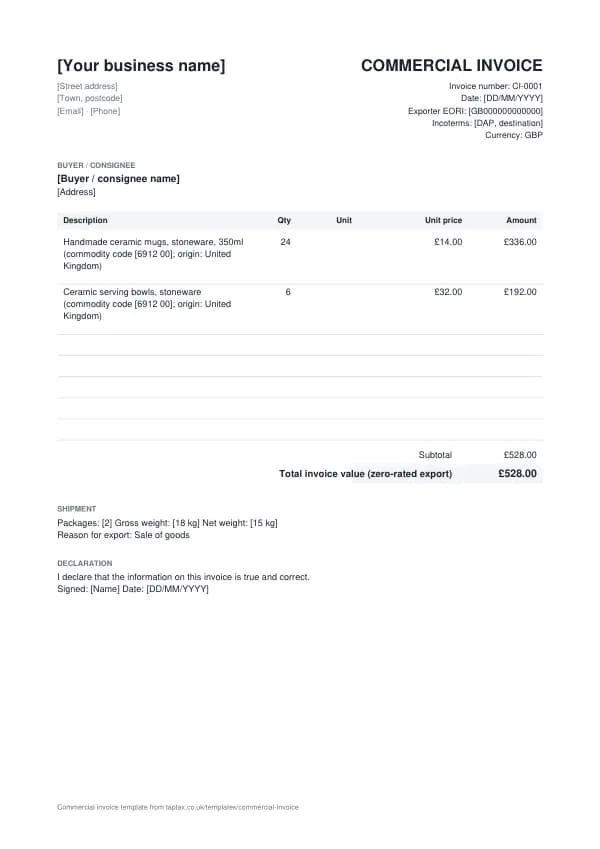
The template comes filled in with example lines like these, so you can see how each part works before replacing them with your own.
| Line | Quantity | Price | Amount |
|---|---|---|---|
| Handmade ceramic mugs, stoneware, 350ml (commodity code [6912 00]; origin: United Kingdom) | 24 | £14.00 | £336.00 |
| Ceramic serving bowls, stoneware (commodity code [6912 00]; origin: United Kingdom) | 6 | £32.00 | £192.00 |
| Subtotal | £528.00 | ||
| Total invoice value (zero-rated export) | £528.00 |
Line by line: Handmade ceramic mugs, stoneware, 350ml (commodity code [6912 00]; origin: United Kingdom), 24 × £14.00 = £336.00; Ceramic serving bowls, stoneware (commodity code [6912 00]; origin: United Kingdom), 6 × £32.00 = £192.00. The subtotal is £528.00, which is also the total invoice value (zero-rated export) because no VAT is charged. The figures are illustrative; replace them with your own.
How to fill in the template
- Add your details and EORI number, and the buyer's and consignee's details.
- Describe each item precisely, with material and use, not just "gifts" or "parts".
- Add the commodity code, country of origin, quantity and unit value for each line.
- Add the currency, Incoterms rule, number of packages and weights.
- State the reason for export and sign the declaration.
- Print copies for the courier and keep proof of export for your VAT records.
Give each commercial invoice its own number in a single sequence, and never reuse one. A number lets you and your customer refer to the document without confusion, and an unbroken sequence shows your records are complete. The invoice number generator suggests a format that stays tidy for years.
Zero-rating exports for UK VAT
Goods exported from Great Britain to a destination outside the UK can be zero-rated for VAT, but only if you meet the conditions in VAT Notice 703 and keep evidence that the goods left the UK. For a direct export, you generally need that evidence within three months of the supply. Official evidence comes from the export declaration; commercial evidence includes the courier's or freight forwarder's proof of shipment, alongside your commercial invoice, the customer's order and payment records. Without the evidence, you must account for UK VAT as if the goods had been sold in the UK.
UK VAT rates
- Standard rate20%
- Reduced rate5%
- Zero rate0%
Commercial invoice or export invoice?
In practice they are often the same document. The commercial invoice is the customs view, with commodity codes, origin and weights. An export invoice is the sales and VAT view, showing the sale is zero-rated as an export. Many small exporters use one document that does both, as this template does.
Commodity codes
A commodity code classifies goods for duty and statistics. The first six digits are the same worldwide; exports from the UK usually need eight digits, and imports into the UK ten. Look codes up in the UK Integrated Online Tariff using what the goods are made of and what they are for, and use the same code on your customs declaration. Getting the code wrong can mean the buyer pays the wrong duty, or customs holds the goods while they check. If you are unsure, HMRC's guidance on finding commodity codes explains how to classify goods, and you can ask for a binding ruling.
Incoterms: who pays what
An Incoterms rule states which of you arranges and pays for carriage, insurance and import duties. Common ones for small sellers are EXW (ex works: the buyer collects and handles everything), DAP (delivered at place: you deliver, the buyer pays import duty and taxes) and DDP (delivered duty paid: you pay everything, including the buyer's import VAT). Put the rule and the named place on the invoice. Many unhappy overseas customers are buyers who did not expect to pay duty and VAT on delivery, so be clear in your listing and on the invoice.
EORI numbers
You need an Economic Operator Registration and Identification (EORI) number starting with GB to export goods from Great Britain. It is free to apply online and usually arrives quickly. Couriers will ask for it before shipping. Moving goods to or from Northern Ireland may need an XI EORI as well. Put the number on every commercial invoice.
Values and currencies
State the price actually paid, in the currency of the sale. If you invoice in euros or dollars, you still need the sterling value for your own VAT and Income Tax records, using a consistent exchange rate, such as HMRC's monthly rates or your bank's rate on the day. For gifts and samples with no sale, give a realistic commercial value for customs purposes and mark them as such; "no commercial value" is not accepted by most customs authorities. Our guide to invoicing in a foreign currency explains the conversion.
Selling to consumers abroad
When you sell to consumers in the EU, the buyer's country may charge import VAT and duty on delivery, or you can register for an import scheme such as the EU Import One Stop Shop for low-value consignments, and charge VAT at checkout instead. The commercial invoice still goes with the goods. Other countries have similar schemes and thresholds, so check the destination before you start selling there regularly.
Common commercial invoice mistakes
- Vague descriptions such as "gifts" or "parts". Customs need to know what the goods are and what they are made of.
- Leaving off the commodity code or country of origin. Both decide the duty, and missing them delays clearance.
- Zero-rating without proof of export. Keep the courier or forwarder's evidence, or UK VAT is due.
Checklist before you send it
Before a commercial invoice goes out, check it against the list of what it must show:
- Your name, address, and EORI number is on it and correct.
- The buyer and, if different, the consignee (who receives the goods) is on it and correct.
- Invoice number, date, and the currency of sale is on it and correct.
- A clear description of each item, with quantity and unit value is on it and correct.
- The commodity code and country of origin for each item is on it and correct.
- Weights, number of packages and Incoterms rule is on it and correct.
- The reason for export and a signed declaration is on it and correct.
- A copy is saved with your records.
Sending it
Send the commercial invoice as a PDF attached to an email, not as an editable file. In the email, say what it is, its number, the amount and any date that matters, so the reader can act without opening the attachment. Send it to the person or inbox that deals with it, which for a business is often an accounts address rather than the person you worked with, and keep a copy of the email and the PDF together in your records.
Keep a copy
You must keep your records for at least 5 years after the 31 January submission deadline of the relevant tax year.
Keep a copy of every commercial invoice you issue or receive, digital is fine, with the payments that relate to it. From 6 April 2026, sole traders and landlords with qualifying income over £50,000 must keep digital records and send HMRC quarterly updates under Making Tax Digital, falling to £30,000 from April 2027 and £20,000 from April 2028. The MTD requirement checker shows when it applies to you, and how long to keep invoices covers retention.
Download the commercial invoice template
The template comes as a Word document for Word, Google Docs and Pages, an Excel workbook for Excel and Google Sheets, and a print-ready PDF. Replace the words in square brackets with your own details. In the Excel version each line, the subtotal and the total are formulas, so the figures update as you type.
Related documents in the same family: the invoice template, self-billing invoice template, pro forma invoice template, export invoice template and e-invoice template. All of them follow the same numbering and record-keeping rules, and each page explains what that document must show.
A TapTax account, free to start, creates and sends invoices, tracks which are paid, keeps receipts and bills with your records, and files your quarterly updates to HMRC from the same data.
Tools for this
Related guides and definitions
Frequently asked questions
What is a commercial invoice used for?
Customs in the destination country use it to identify the goods and assess duty and import VAT. It is usually also your sales invoice for the export.
Do I need a commercial invoice to send goods to the EU?
Yes. Goods sent from Great Britain to the EU are exports and need customs paperwork, including a commercial invoice.
Do I charge VAT on exported goods?
Exports of goods from Great Britain can be zero-rated if you meet the conditions and keep evidence that the goods left the UK.
Invoice, get paid, stay ready for HMRC.
TapTax creates and sends your invoices, tracks which ones are paid and files your quarterly updates to HMRC. Start on the free plan, no card needed.
Get started freeSources
The rules on this page come from official guidance.