
Self-billing invoice
template
An invoice the customer raises on the supplier's behalf, under a written self-billing agreement.
Download the self-billing invoice template
Free, with no sign-up. Replace the words in square brackets with your own details.
Self-billing suits relationships where the customer knows the amount first: a haulier paying owner drivers by the mile, a publisher paying royalties, a platform paying its sellers, a dairy paying farmers by the litre. It saves the supplier paperwork and the customer from chasing invoices. For VAT it comes with rules: a written agreement, the words "self-billing" on the invoice, and a recommended statement about output tax. This template has all three.
- Self-billing invoice
- An invoice prepared by the customer instead of the supplier, under a written self-billing agreement. The customer works out what is owed, raises the invoice and sends a copy to the supplier with the payment.
When to use a self-billing invoice
Use a self-billing invoice when you are the customer and have a written self-billing agreement with the supplier, and you are the one who calculates what you owe, such as from deliveries received, miles driven or sales made. If you are the supplier, you do not raise invoices for supplies covered by the agreement: you receive the self-billed invoice, check it, and keep it as your sales record. Without an agreement, stick to normal invoices raised by the supplier. Self-billing works for suppliers who are not VAT registered too, but the VAT rules only bite where the supplier is registered.
What a self-billing invoice must show
| What it shows | Why it matters |
|---|---|
| The words "Self-billing" | Shows the customer raised it under an agreement |
| The supplier's name, address and VAT number if registered | The invoice is the supplier's sales invoice |
| The customer's name and address | The business raising and paying the invoice |
| A unique invoice number in a sequence for that supplier | Identifies each self-billed invoice |
| The date and description of the supplies, quantities and prices | What is being paid for |
| The VAT rate and amount, where the supplier is registered | The supplier's output VAT |
| The statement "The VAT shown is your output tax due to HMRC" | Recommended by HMRC so the supplier does not reclaim it |
An example self-billing invoice
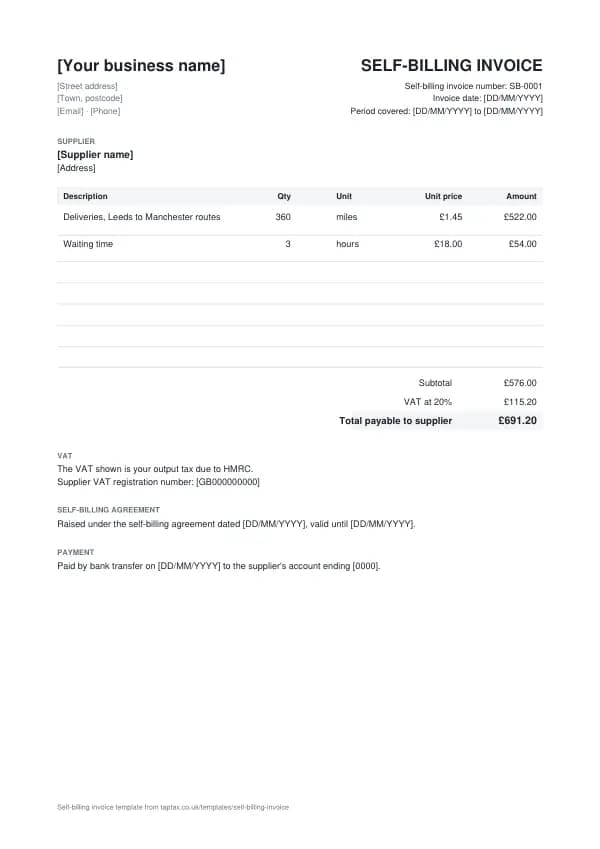
The template comes filled in with example lines like these, so you can see how each part works before replacing them with your own.
| Line | Quantity | Price | Amount |
|---|---|---|---|
| Deliveries, Leeds to Manchester routes | 360 miles | £1.45 | £522.00 |
| Waiting time | 3 hours | £18.00 | £54.00 |
| Subtotal | £576.00 | ||
| VAT at 20% | £115.20 | ||
| Total payable to supplier | £691.20 |
Line by line: Deliveries, Leeds to Manchester routes, 360 miles × £1.45 = £522.00; Waiting time, 3 hours × £18.00 = £54.00. The subtotal is £576.00, VAT at 20% adds £115.20, and the total payable to supplier is £691.20. The figures are illustrative; replace them with your own.
How to fill in the template
- Put a written self-billing agreement in place with the supplier before the first invoice.
- Head the invoice "Self-billing" and add the supplier's details and VAT number.
- Give it the next number in that supplier's sequence.
- List the supplies for the period with quantities and prices, and add VAT if the supplier is registered.
- Add the output tax statement and a reference to the agreement.
- Send a copy to the supplier with the payment and keep your copy.
Give each self-billing invoice its own number in a single sequence, and never reuse one. A number lets you and your customer refer to the document without confusion, and an unbroken sequence shows your records are complete. The invoice number generator suggests a format that stays tidy for years.
The self-billing agreement
For VAT, a self-billing agreement must be in writing and in place before self-billing starts. It records that the supplier agrees to you raising invoices for their supplies, that they will not issue their own VAT invoices for those supplies, and that they will accept each self-billed invoice you create. It needs a start date and an expiry date, which can be tied to the length of the contract, and the supplier should agree to tell you if their VAT registration changes. HMRC advises reviewing agreements every 12 months, and you must keep a list of every supplier you self-bill with their VAT numbers and agreement dates.
UK VAT rates
- Standard rate20%
- Reduced rate5%
- Zero rate0%
Self-billing invoice or normal invoice?
With a normal invoice, the supplier works out the amount and sends it to the customer. With self-billing, the customer does and sends it to the supplier. The legal effect is the same: it is the supplier's sales invoice, and the supplier accounts for the income and any VAT on it.
Checking a self-billed invoice as the supplier
If a customer self-bills you, check every invoice against your own records of what you supplied: deliveries, hours, miles or sales. Mistakes are the customer's to correct, by a new self-billed invoice or a credit note under the same agreement, but it is your income and your VAT, so do not let errors run on. Keep each invoice as your sales record for your tax return and, if you are registered, include the VAT on your VAT return as output tax. Do not also issue your own invoice for the same supply, or the income and VAT will be counted twice.
When the supplier is not VAT registered
Self-billing is common with small suppliers who are not VAT registered, such as sole trader drivers or crafters selling through a platform. The invoice then carries no VAT and no output tax statement, but it is still the supplier's sales record, so it must be accurate. The supplier must tell the customer if they register for VAT, so the customer can start adding VAT to the invoices from the date of registration. A supplier near the £90,000 threshold should watch their turnover closely, because the customer's invoices are what add up to it.
Common self-billing arrangements
Self-billing is widespread in haulage and courier work, where the customer records miles and drops; in agriculture, where a processor weighs or measures produce; in publishing and music, for royalties calculated from sales reports; in scrap metal and recycling; and on marketplaces and gig platforms that pay sellers and drivers on a statement. In each case the customer holds the data that fixes the price, so it makes sense for them to raise the invoice.
Tax and records for both sides
For the customer, a self-billed invoice is a purchase record like any other: keep it with the payment, and reclaim the VAT on it if you are registered and the supply is for your business. For the supplier, it is a sales invoice. Both sides should keep the agreement itself, the list of self-billed suppliers the customer must maintain, and the invoices, for at least as long as normal business records. Under Making Tax Digital, self-billed invoices go into digital records in the same way as any others.
Ending a self-billing arrangement
An agreement ends on its expiry date, when either side ends the contract, or when the supplier's VAT registration changes and a new agreement is needed. From that point the supplier must raise their own invoices again. Make the change clean: agree a last self-billed invoice date, tell the supplier which number sequence to use from then on, and do not overlap the two, so no supply is invoiced twice or not at all.
Common self-billing invoice mistakes
- Self-billing without a written agreement. Without one, the invoices are not valid VAT invoices.
- The supplier also issuing their own invoice. That double counts the income and the VAT.
- Leaving off the words "self-billing". It is one of the details a self-billed VAT invoice must carry.
Checklist before you send it
Before a self-billing invoice goes out, check it against the list of what it must show:
- The words "Self-billing" is on it and correct.
- The supplier's name, address and VAT number if registered is on it and correct.
- The customer's name and address is on it and correct.
- A unique invoice number in a sequence for that supplier is on it and correct.
- The date and description of the supplies, quantities and prices is on it and correct.
- The VAT rate and amount, where the supplier is registered is on it and correct.
- The statement "The VAT shown is your output tax due to HMRC" is on it and correct.
- A copy is saved with your records.
Sending it
Send the self-billing invoice as a PDF attached to an email, not as an editable file. In the email, say what it is, its number, the amount and any date that matters, so the reader can act without opening the attachment. Send it to the person or inbox that deals with it, which for a business is often an accounts address rather than the person you worked with, and keep a copy of the email and the PDF together in your records.
Keep a copy
You must keep your records for at least 5 years after the 31 January submission deadline of the relevant tax year.
Keep a copy of every self-billing invoice you issue or receive, digital is fine, with the payments that relate to it. From 6 April 2026, sole traders and landlords with qualifying income over £50,000 must keep digital records and send HMRC quarterly updates under Making Tax Digital, falling to £30,000 from April 2027 and £20,000 from April 2028. The MTD requirement checker shows when it applies to you, and how long to keep invoices covers retention.
Download the self-billing invoice template
The template comes as a Word document for Word, Google Docs and Pages, an Excel workbook for Excel and Google Sheets, and a print-ready PDF. Replace the words in square brackets with your own details. In the Excel version each line, the subtotal and the total are formulas, so the figures update as you type.
Related documents in the same family: the invoice template, pro forma invoice template, commercial invoice template, export invoice template and e-invoice template. All of them follow the same numbering and record-keeping rules, and each page explains what that document must show.
A TapTax account, free to start, creates and sends invoices, tracks which are paid, keeps receipts and bills with your records, and files your quarterly updates to HMRC from the same data.
Tools for this
Related guides and definitions
Frequently asked questions
What is a self-billing invoice?
An invoice raised by the customer on the supplier's behalf, under a written agreement, usually because the customer knows the amount owed first.
What must a self-billing invoice show?
The words "self-billing", the normal VAT invoice details for the supplier, and ideally the statement "The VAT shown is your output tax due to HMRC".
How long does a self-billing agreement last?
It must have a start and an expiry date, which can be tied to the contract. HMRC advises reviewing agreements every 12 months.
Invoice, get paid, stay ready for HMRC.
TapTax creates and sends your invoices, tracks which ones are paid and files your quarterly updates to HMRC. Start on the free plan, no card needed.
Get started freeSources
The rules on this page come from official guidance.