
VAT invoice
template
A full VAT invoice with every detail HMRC requires, so your VAT-registered customers can reclaim the VAT.
Download the VAT invoice template
Free, with no sign-up. Replace the words in square brackets with your own details.
The free invoice generator makes a finished PDF with your details, logo and colours. Nothing is stored.
Once your business is VAT registered, the invoices you send to other VAT-registered businesses are more than requests for payment: they are the evidence your customer needs to reclaim the VAT you charged. HMRC sets out exactly what a full VAT invoice must show in VAT Notice 700, and a missing detail can mean your customer cannot reclaim, which quickly becomes your problem. This template includes every required field.
- VAT invoice
- An invoice issued by a VAT-registered business that shows the VAT charged in the form HMRC requires. A VAT-registered customer needs a valid VAT invoice to reclaim the VAT as input tax.
When to use a VAT invoice
Issue a full VAT invoice whenever you are VAT registered and supply goods or services to another VAT-registered business in the UK at the standard or reduced rate. You must normally issue it within 30 days of the tax point, which is usually the date of supply or the date you are paid, whichever is earlier. For retail sales of £250 or less, a simplified VAT invoice will do; for sales only of exempt or zero-rated items within the UK, no VAT invoice is required, although many businesses issue one anyway so every customer gets the same document. If you are not VAT registered, you must not issue a VAT invoice or show VAT at all.
What a VAT invoice must show
| What it shows | Why it matters |
|---|---|
| A sequential invoice number | Uniquely identifies the invoice in one or more series |
| The time of supply (tax point) | The date that fixes which VAT return the VAT belongs to |
| The date of issue, if different from the tax point | When the invoice was actually raised |
| Your name, address and VAT registration number | Proves you can charge VAT; use your registered name somewhere on the invoice |
| Your customer's name and address | Who the supply was made to |
| A description, quantity or extent, unit price and VAT rate for each item | So each line can be checked |
| The total excluding VAT, the total VAT in sterling, and any cash discount rate | The figures the customer reclaims from |
You can invoice in a foreign currency, but the total VAT must be shown in sterling. Where an invoice mixes standard-rated items with zero-rated or exempt ones, the zero-rated and exempt items must clearly show no VAT is payable and have their own total.
An example VAT invoice
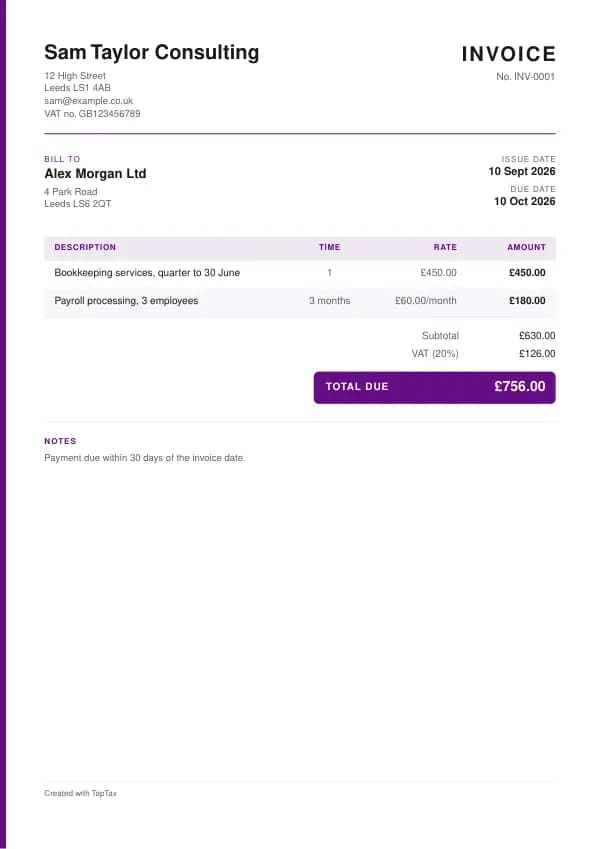
The template comes filled in with example lines like these, so you can see how each part works before replacing them with your own.
| Line | Quantity | Price | Amount |
|---|---|---|---|
| Bookkeeping services, quarter to 30 June | 1 | £450.00 | £450.00 |
| Payroll processing, 3 employees | 3 months | £60.00 | £180.00 |
| Subtotal | £630.00 | ||
| VAT at 20% | £126.00 | ||
| Total due | £756.00 |
Line by line: Bookkeeping services, quarter to 30 June, 1 × £450.00 = £450.00; Payroll processing, 3 employees, 3 months × £60.00 = £180.00. The subtotal is £630.00, VAT at 20% adds £126.00, and the total due is £756.00. The figures are illustrative; replace them with your own.
How to fill in the template
- Add your business name, address and VAT registration number; if you trade under another name, make sure your registered name also appears.
- Add your customer's name and address.
- Use the next number in your sequence, and enter both the tax point and the invoice date.
- List each item with a description, quantity, unit price and VAT rate.
- Check the subtotal, the VAT in sterling and the total.
- Send it within 30 days of the tax point, and keep a copy for your VAT records.
Number every VAT invoice in sequence and never reuse a number, even when a document is cancelled. Numbers make documents easy to find and to match against payments, and they show HMRC and your customers that nothing is missing. For a numbering format, try the invoice number generator.
Tax points and the 30-day rule
The tax point, or time of supply, decides which VAT return the VAT goes on. For goods it is normally when they are delivered or made available; for services, when the work is completed. If you are paid or issue a VAT invoice before then, that earlier date becomes the tax point. And if you issue the VAT invoice within 14 days after the basic tax point, the invoice date becomes the tax point instead. HMRC expects a VAT invoice within 30 days of the tax point, with extensions possible in some cases. Get the tax point right on the invoice, because it is what your customer uses to reclaim in the right period, and what you use to account for the VAT.
UK VAT rates
- Standard rate20%
- Reduced rate5%
- Zero rate0%
Full, simplified or modified VAT invoice?
A full VAT invoice is the default. A simplified VAT invoice is allowed for supplies of £250 or less including VAT, showing VAT-inclusive totals by rate. A modified VAT invoice lets a retailer show VAT-inclusive values for a larger sale when the customer asks. If you are not VAT registered, you need an invoice without VAT instead.
Zero-rated and exempt items on a VAT invoice
A VAT invoice can include items at different rates. Zero-rated items, such as most food and children's clothing, are taxable at 0% and are shown with a 0% rate. Exempt items, such as most insurance and some medical care, are outside the VAT charge entirely. When an invoice mixes these with standard-rated items, show each rate clearly, total the zero-rated and exempt values separately, and make it obvious that no VAT is due on them. Many businesses find separate invoices simpler for exempt supplies.
When the customer is outside the UK
For services to a business customer outside the UK, the general rule is that the supply takes place where the customer belongs, so UK VAT is not charged; the invoice should show the customer's country and say that the supply is outside the scope of UK VAT, or that the customer accounts for any VAT under the reverse charge. Goods exported from Great Britain can be zero-rated when you hold evidence of export. The rules for Northern Ireland and EU trade differ; check VAT Notice 700 and the export notices before invoicing cross-border.
Correcting a VAT invoice
Never alter a VAT invoice once it is issued. If the price was wrong or goods come back, issue a credit note that references the original invoice number and date and shows the VAT being credited, then a new invoice if needed. Your customer adjusts their reclaimed VAT by the same amount, and both sets of records stay consistent.
Common VAT invoice mistakes
- Leaving out the tax point. A VAT invoice needs the time of supply as well as the invoice date, or the customer may reclaim in the wrong period.
- Showing VAT only as a single total. Each line needs its VAT rate, and the invoice needs the total excluding VAT and the total VAT.
- Issuing a VAT invoice before registration is confirmed. Until HMRC confirms your VAT number, issue invoices without VAT and reissue VAT invoices within 30 days of getting the number.
Checklist before you send it
A quick check of every VAT invoice before you send it:
- A sequential invoice number is on it and correct.
- The time of supply (tax point) is on it and correct.
- The date of issue, if different from the tax point is on it and correct.
- Your name, address and VAT registration number is on it and correct.
- Your customer's name and address is on it and correct.
- A description, quantity or extent, unit price and VAT rate for each item is on it and correct.
- The total excluding VAT, the total VAT in sterling, and any cash discount rate is on it and correct.
- A copy is saved with your records.
Sending it
Email the VAT invoice as a PDF with a short, specific message: the document number, the amount, and what you need the reader to do. Address it to whoever processes it, often an accounts team, and copy your usual contact if that helps. File the sent PDF with its number in the file name, so you can find it in seconds if there is ever a question.
Keep a copy
You must keep your records for at least 5 years after the 31 January submission deadline of the relevant tax year.
Business documents are records, and records have to be kept. Save every VAT invoice in one place, ideally digitally, so you can find it if a customer or HMRC asks. Making Tax Digital for Income Tax makes digital records compulsory from 6 April 2026 for qualifying income over £50,000, from April 2027 over £30,000 and from April 2028 over £20,000; check your date with the MTD requirement checker.
Download the VAT invoice template
Download it as a Word document, an Excel workbook or a PDF, whichever suits the way you work. The Word file opens in Google Docs too, and the Excel file in Google Sheets. The Excel totals are live formulas. Or fill it in online with the free invoice generator, which makes a finished PDF with your details, in your colours.
Related documents in the same family: the zero-rated invoice template, VAT-exempt invoice template, flat rate scheme invoice template, reverse charge invoice template and simplified VAT invoice template. All of them follow the same numbering and record-keeping rules, and each page explains what that document must show.
If you would rather not manage documents by hand, a TapTax account, free to start, keeps your invoices, receipts and bank transactions together and files your Making Tax Digital quarterly updates to HMRC.
Tools for this
Related guides and definitions
Frequently asked questions
What is the difference between an invoice and a VAT invoice?
A VAT invoice is issued by a VAT-registered business and must show extra details, including the VAT number, tax point and VAT for each rate, so the customer can reclaim VAT.
How long do I have to issue a VAT invoice?
Normally within 30 days of the tax point, which is usually the date of supply or payment, whichever is earlier.
Can I issue a VAT invoice in euros?
Yes, but the total VAT must also be shown in sterling.
Invoice, get paid, stay ready for HMRC.
TapTax creates and sends your invoices, tracks which ones are paid and files your quarterly updates to HMRC. Start on the free plan, no card needed.
Get started freeSources
The rules on this page come from official guidance.