
VAT-exempt invoice
template
An invoice for exempt services such as medical care, tuition or insurance, stating the exemption clearly.
Download the VAT-exempt invoice template
Free, with no sign-up. Replace the words in square brackets with your own details.
Some services are exempt from VAT by law: medical care by registered health professionals, private tuition in school and university subjects, insurance and many financial services, burial and cremation, and some supplies of land and buildings. An invoice for exempt services shows no VAT and should say why. This template does that, so neither your customer nor HMRC is left wondering whether VAT was forgotten.
- VAT-exempt invoice
- An invoice for goods or services that are exempt from VAT. Exempt supplies are outside the VAT charge altogether: no VAT is charged, and they do not count towards the VAT registration threshold.
When to use a VAT-exempt invoice
Use a VAT-exempt invoice when everything on the invoice is exempt, for example a physiotherapist invoicing an insurer, an independent tutor invoicing a parent, or an insurance intermediary invoicing a client. HMRC does not require a VAT invoice for supplies that are only exempt, but an invoice is still how you ask to be paid. If you also make taxable supplies, keep exempt items on separate invoices or clearly separated with their own total and a note that no VAT is due.
What a VAT-exempt invoice must show
| What it shows | Why it matters |
|---|---|
| A unique invoice number | Identifies the invoice |
| Your name and address, and your professional registration where relevant | Who supplied the service; registration can be what makes it exempt |
| Your customer's name and address | Who was supplied |
| The date of supply and invoice date | When the service was given |
| A description of each service and its price | So the service can be identified as exempt |
| A statement that the service is exempt from VAT | Explains why no VAT is shown |
An example VAT-exempt invoice
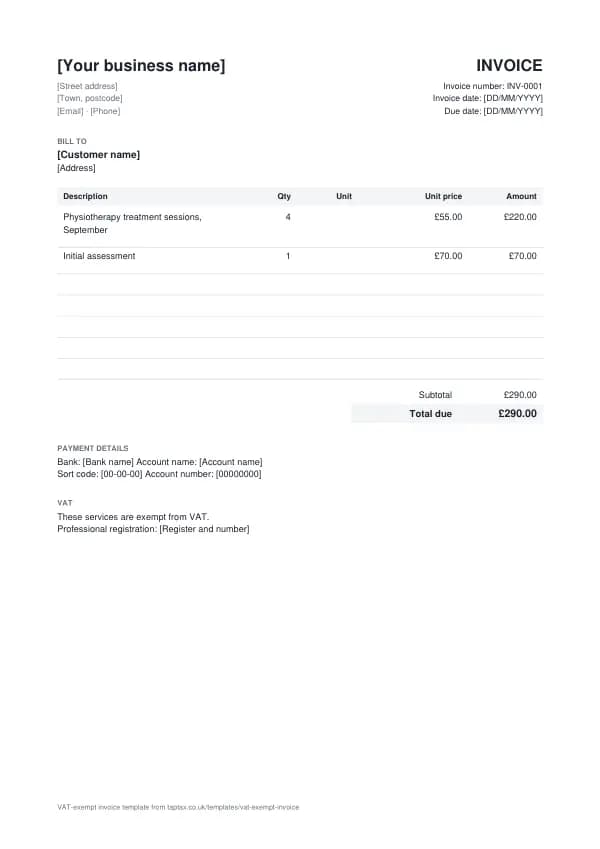
The template comes filled in with example lines like these, so you can see how each part works before replacing them with your own.
| Line | Quantity | Price | Amount |
|---|---|---|---|
| Physiotherapy treatment sessions, September | 4 | £55.00 | £220.00 |
| Initial assessment | 1 | £70.00 | £70.00 |
| Subtotal | £290.00 | ||
| Total due | £290.00 |
Line by line: Physiotherapy treatment sessions, September, 4 × £55.00 = £220.00; Initial assessment, 1 × £70.00 = £70.00. The subtotal is £290.00, which is also the total due because no VAT is charged. The figures are illustrative; replace them with your own.
How to fill in the template
- Add your name, address and, where the exemption depends on it, your professional registration.
- Add your customer's details, the invoice number and dates.
- Describe each service in terms that show why it is exempt, such as the treatment or tuition given.
- Show the prices and total with no VAT.
- Add a line stating the services are exempt from VAT.
- Send it and keep a copy.
Number every VAT-exempt invoice in sequence and never reuse a number, even when a document is cancelled. Numbers make documents easy to find and to match against payments, and they show HMRC and your customers that nothing is missing. For a numbering format, try the invoice number generator.
What makes a supply exempt
Exemption depends on what the supply is and, often, who makes it. Medical care is exempt when given by a health professional on a statutory register; the same treatment given by someone who is not registered is standard-rated. Private tuition is exempt when given by an individual teacher acting independently in a subject ordinarily taught in schools or universities. Insurance, many financial services, and some property lettings are exempt by their nature. Because exemption is a matter of law, not choice, describe the service precisely on the invoice, and keep evidence of the registration or conditions that make it exempt.
UK VAT rates
- Standard rate20%
- Reduced rate5%
- Zero rate0%
Exempt invoice or zero-rated invoice?
A zero-rated invoice covers taxable supplies at 0%, which count towards the VAT threshold. An exempt invoice covers supplies outside the VAT charge, which do not. The labels are not interchangeable: calling exempt services zero-rated can make your turnover look taxable when it is not.
Exempt supplies and VAT registration
Exempt income does not count towards the £90,000 VAT registration threshold. A business that makes only exempt supplies cannot register for VAT, and cannot reclaim VAT on its costs, so VAT on purchases is a real cost to be built into prices. A business with both exempt and taxable sales counts only the taxable ones towards the threshold, which is why keeping exempt work on separate, clearly labelled invoices makes your turnover easy to measure.
Partial exemption for registered businesses
A VAT-registered business that also makes exempt supplies is partly exempt: it can usually reclaim VAT only on costs linked to its taxable supplies, with shared costs apportioned. There are de minimis limits that let small amounts of exempt-related VAT be reclaimed in full. If this applies to you, keep exempt and taxable sales clearly separated in your records, because the apportionment is calculated from them.
Common exempt services for small businesses
For sole traders, the exemptions that come up most are medical care by registered health professionals (physiotherapists, osteopaths, chiropractors, podiatrists and others on statutory registers), independent private tuition, some childcare and welfare services by regulated providers, arranging insurance and credit, and some letting of residential property. Cosmetic treatments, wellbeing therapies by unregistered practitioners and adult hobby classes are usually not exempt, even though they can look similar.
Insurers and third-party payers
When an insurer, employer or public body pays for an exempt service, invoice them with their reference, the patient or learner reference where appropriate, and the exemption statement. They will not expect VAT and may reject an invoice that shows it. Keep confidential details, such as the reason for treatment, off the invoice.
Writing the exemption statement
There is no prescribed wording, but the statement should be short and specific. "These services are exempt from VAT" is enough for most invoices. Health professionals often add the register they belong to, such as the Health and Care Professions Council, and their registration number, because that is what makes the treatment exempt. Independent tutors may add the subject taught. Avoid phrases such as "no VAT" or "VAT: n/a", which do not tell the reader whether the supply is exempt, zero-rated, or simply from a business that is not registered. Clear wording saves your customer's bookkeeper a query and keeps your own records consistent if HMRC ever asks why no VAT was charged.
When a business is not registered at all
A sole trader who is not VAT registered cannot charge VAT on anything, whether the supply is exempt, zero-rated or standard-rated. The exemption statement is still useful on their invoices when the service is genuinely exempt, because it shows the income will not count towards the VAT threshold. Where the service would be standard-rated if the business were registered, use an invoice for a business that is not VAT registered instead, and keep an eye on taxable turnover. Mixing up the two can mean registering late, and HMRC can then charge the VAT that should have been accounted for from the date registration was due, with penalties on top.
Common VAT-exempt invoice mistakes
- Charging VAT on exempt services. Exempt supplies never carry VAT; showing it misleads the customer.
- Assuming a service is exempt because it sounds medical. Exemption often depends on statutory registration; check before relying on it.
- Counting exempt income towards the threshold. Exempt sales do not count; track taxable sales separately.
Checklist before you send it
A quick check of every VAT-exempt invoice before you send it:
- A unique invoice number is on it and correct.
- Your name and address, and your professional registration where relevant is on it and correct.
- Your customer's name and address is on it and correct.
- The date of supply and invoice date is on it and correct.
- A description of each service and its price is on it and correct.
- A statement that the service is exempt from VAT is on it and correct.
- A copy is saved with your records.
Sending it
Email the VAT-exempt invoice as a PDF with a short, specific message: the document number, the amount, and what you need the reader to do. Address it to whoever processes it, often an accounts team, and copy your usual contact if that helps. File the sent PDF with its number in the file name, so you can find it in seconds if there is ever a question.
Keep a copy
You must keep your records for at least 5 years after the 31 January submission deadline of the relevant tax year.
Business documents are records, and records have to be kept. Save every VAT-exempt invoice in one place, ideally digitally, so you can find it if a customer or HMRC asks. Making Tax Digital for Income Tax makes digital records compulsory from 6 April 2026 for qualifying income over £50,000, from April 2027 over £30,000 and from April 2028 over £20,000; check your date with the MTD requirement checker.
Download the VAT-exempt invoice template
Download it as a Word document, an Excel workbook or a PDF, whichever suits the way you work. The Word file opens in Google Docs too, and the Excel file in Google Sheets. The Excel totals are live formulas.
Related documents in the same family: the zero-rated invoice template, flat rate scheme invoice template, reverse charge invoice template, VAT invoice template and simplified VAT invoice template. All of them follow the same numbering and record-keeping rules, and each page explains what that document must show.
If you would rather not manage documents by hand, a TapTax account, free to start, keeps your invoices, receipts and bank transactions together and files your Making Tax Digital quarterly updates to HMRC.
Tools for this
Related guides and definitions
Frequently asked questions
What should a VAT-exempt invoice say?
That the services are exempt from VAT, alongside the usual invoice details and, where it matters, your professional registration.
Do exempt sales count towards the VAT threshold?
No. Only taxable sales, including zero-rated ones, count towards the £90,000 threshold.
Can I register for VAT if all my sales are exempt?
No. A business that makes only exempt supplies cannot register, and cannot reclaim VAT on its costs.
Invoice, get paid, stay ready for HMRC.
TapTax creates and sends your invoices, tracks which ones are paid and files your quarterly updates to HMRC. Start on the free plan, no card needed.
Get started freeSources
The rules on this page come from official guidance.