
Zero-rated invoice
template
An invoice for zero-rated goods and services, showing the 0% rate so there is no doubt about the VAT.
Download the zero-rated invoice template
Free, with no sign-up. Replace the words in square brackets with your own details.
Zero-rated is not the same as exempt. Zero-rated goods and services, such as most food, children's clothing, books, and building a new home, are taxable at 0%. A VAT-registered business selling them charges no VAT, but can reclaim the VAT on its own costs, and the sales count towards the VAT threshold. This template shows the 0% rate clearly, which answers the question every customer's bookkeeper will otherwise ask.
- Zero-rated invoice
- An invoice for supplies that are taxable at the zero rate of VAT. The supplies are still VAT-taxable, just at 0%, so no VAT is charged, but they count towards a business's taxable turnover.
When to use a zero-rated invoice
Use a zero-rated invoice when everything on it is zero-rated, for example a food wholesaler supplying shops, a builder constructing a new dwelling, or a publisher selling books. HMRC does not require a VAT invoice for supplies that are only zero-rated or exempt within the UK, but a clear invoice showing the 0% rate is still good practice, and some customers need it. When an invoice mixes zero-rated and standard-rated items, use a full VAT invoice with each line's rate and a separate total for the zero-rated items. If you are not VAT registered, zero-rated sales still count towards the £90,000 threshold.
What a zero-rated invoice must show
| What it shows | Why it matters |
|---|---|
| A unique invoice number | Identifies the invoice |
| Your name, address and, if registered, your VAT number | Who is supplying |
| Your customer's name and address | Who is being supplied |
| The date of supply and invoice date | When the supply took place |
| A description of each item, its quantity and price | So each line can be checked |
| The VAT rate, 0%, for each line | Shows the supply is zero-rated, not exempt or forgotten |
| The total, with VAT shown as £0.00 | Removes any doubt about VAT |
An example zero-rated invoice
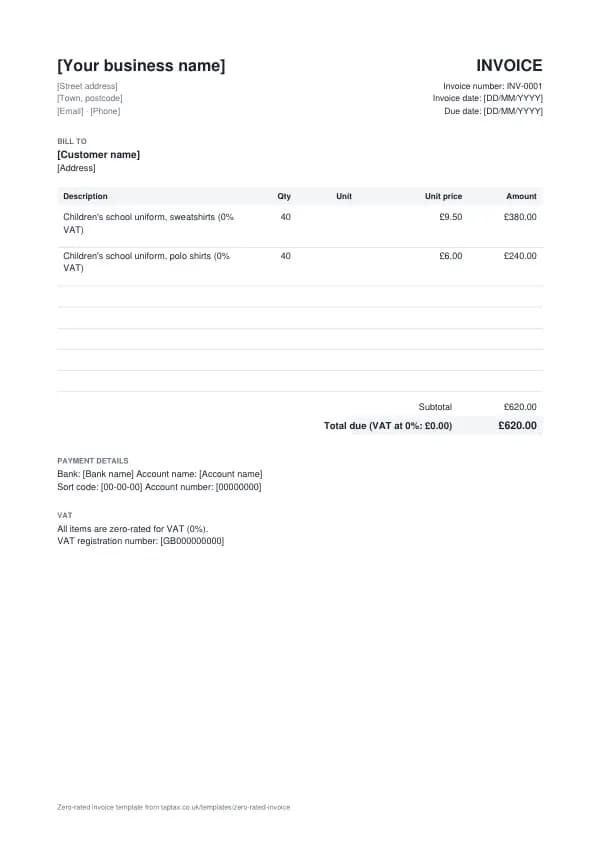
The template comes filled in with example lines like these, so you can see how each part works before replacing them with your own.
| Line | Quantity | Price | Amount |
|---|---|---|---|
| Children's school uniform, sweatshirts (0% VAT) | 40 | £9.50 | £380.00 |
| Children's school uniform, polo shirts (0% VAT) | 40 | £6.00 | £240.00 |
| Subtotal | £620.00 | ||
| Total due (VAT at 0%: £0.00) | £620.00 |
Line by line: Children's school uniform, sweatshirts (0% VAT), 40 × £9.50 = £380.00; Children's school uniform, polo shirts (0% VAT), 40 × £6.00 = £240.00. The subtotal is £620.00, which is also the total due (vat at 0%: £0.00) because no VAT is charged. The figures are illustrative; replace them with your own.
How to fill in the template
- Add your business details and, if you are registered, your VAT number.
- Add your customer's details, the invoice number and dates.
- List each item with its quantity and price, and mark each line 0%.
- Show VAT as £0.00 and the total.
- Add a line confirming the items are zero-rated.
- Send it and keep a copy.
Number every zero-rated invoice in sequence and never reuse a number, even when a document is cancelled. Numbers make documents easy to find and to match against payments, and they show HMRC and your customers that nothing is missing. For a numbering format, try the invoice number generator.
Zero-rated, exempt or outside the scope?
Zero-rated supplies are taxable at 0%: they count towards the VAT threshold, and a registered business can reclaim VAT on its costs. Exempt supplies are not taxable at all: they do not count towards the threshold, and VAT on the costs of making them usually cannot be reclaimed. Outside-the-scope supplies, such as many services to overseas business customers or statutory fees, are not UK supplies for VAT. The difference matters for your VAT return and for registration, so check each item against HMRC's list of VAT rates before invoicing.
UK VAT rates
- Standard rate20%
- Reduced rate5%
- Zero rate0%
Zero-rated invoice or VAT-exempt invoice?
Both show no VAT, but for different reasons. A zero-rated invoice shows a 0% rate on taxable supplies. A VAT-exempt invoice covers supplies outside the VAT charge, such as insurance or some medical care, and should say they are exempt. Getting the label wrong can mislead your customer and put your own VAT return wrong.
Common zero-rated goods and services
The zero rate covers most food (but not catering, hot takeaway food, confectionery, crisps or alcohol), children's clothing and footwear, books, newspapers and magazines, public transport in vehicles with 10 or more seats, the construction of new homes, and certain goods for disabled people. Energy-saving materials installed in homes are zero-rated until 31 March 2027. The detail matters: a chocolate-covered biscuit and a plain one are treated differently, and so is a cold sandwich eaten on or off the premises in some cases.
Registering when most sales are zero-rated
Businesses whose sales are mostly zero-rated often reclaim more VAT than they pay, because they pay VAT on their costs but charge none. That makes registration attractive even below the threshold. If your sales are wholly or mainly zero-rated and you would normally be repaid, you can instead apply for exemption from registration, but you then cannot reclaim VAT on your costs. Weigh the admin against the repayments.
Mixed invoices
A shop supplying both food and household goods, or a builder working on a new home and an extension, will often invoice at more than one rate. Use a full VAT invoice showing each line's rate, with the zero-rated lines totalled separately and clearly showing no VAT payable, or issue separate invoices for each rate if that is simpler for your customers.
Evidence for the zero rate
Some zero-rating depends on evidence: a certificate from a charity for certain building work, an eligibility declaration for goods for disabled people, or proof of export for goods leaving the UK. Keep that evidence with the invoice. If HMRC later disagrees that the zero rate applied, the VAT is due from you, so the paperwork is worth getting right at the time.
Zero-rated sales and your VAT return
On a VAT return, zero-rated sales go in box 6, total sales excluding VAT, but add nothing to box 1, the VAT due on sales. The VAT you paid on the costs of making them goes in box 4 as usual, which is why wholly zero-rated businesses often receive a repayment rather than making a payment. HMRC checks repayment returns more closely, so keep the invoices and evidence behind them easy to find. If you use Making Tax Digital software, the rate on each invoice line flows straight into the right boxes, which is one more reason to mark every line 0% rather than leaving the rate blank or describing the supply as having no VAT.
Common zero-rated invoice mistakes
- Describing zero-rated sales as exempt. They are different: zero-rated sales count towards the VAT threshold and allow VAT reclaims on costs.
- Leaving the rate blank. Show 0% on each line so customers know the VAT was considered.
- Zero-rating without evidence. Where the relief depends on a certificate or declaration, keep it with the invoice.
Checklist before you send it
A quick check of every zero-rated invoice before you send it:
- A unique invoice number is on it and correct.
- Your name, address and, if registered, your VAT number is on it and correct.
- Your customer's name and address is on it and correct.
- The date of supply and invoice date is on it and correct.
- A description of each item, its quantity and price is on it and correct.
- The VAT rate, 0%, for each line is on it and correct.
- The total, with VAT shown as £0.00 is on it and correct.
- A copy is saved with your records.
Sending it
Email the zero-rated invoice as a PDF with a short, specific message: the document number, the amount, and what you need the reader to do. Address it to whoever processes it, often an accounts team, and copy your usual contact if that helps. File the sent PDF with its number in the file name, so you can find it in seconds if there is ever a question.
Keep a copy
You must keep your records for at least 5 years after the 31 January submission deadline of the relevant tax year.
Business documents are records, and records have to be kept. Save every zero-rated invoice in one place, ideally digitally, so you can find it if a customer or HMRC asks. Making Tax Digital for Income Tax makes digital records compulsory from 6 April 2026 for qualifying income over £50,000, from April 2027 over £30,000 and from April 2028 over £20,000; check your date with the MTD requirement checker.
Download the zero-rated invoice template
Download it as a Word document, an Excel workbook or a PDF, whichever suits the way you work. The Word file opens in Google Docs too, and the Excel file in Google Sheets. The Excel totals are live formulas.
Related documents in the same family: the VAT-exempt invoice template, flat rate scheme invoice template, reverse charge invoice template, VAT invoice template and simplified VAT invoice template. All of them follow the same numbering and record-keeping rules, and each page explains what that document must show.
If you would rather not manage documents by hand, a TapTax account, free to start, keeps your invoices, receipts and bank transactions together and files your Making Tax Digital quarterly updates to HMRC.
Tools for this
Related guides and definitions
Frequently asked questions
Do zero-rated sales count towards the VAT threshold?
Yes. Zero-rated sales are taxable at 0% and count towards the £90,000 threshold; exempt sales do not.
Do I need to issue a VAT invoice for zero-rated sales?
HMRC does not require one for supplies that are only zero-rated within the UK, but an invoice showing the 0% rate is good practice.
What is the difference between zero-rated and exempt?
Zero-rated supplies are taxable at 0% and let you reclaim VAT on costs. Exempt supplies are outside the VAT charge, and VAT on related costs usually cannot be reclaimed.
Invoice, get paid, stay ready for HMRC.
TapTax creates and sends your invoices, tracks which ones are paid and files your quarterly updates to HMRC. Start on the free plan, no card needed.
Get started freeSources
The rules on this page come from official guidance.