
Invoice without VAT
template
An invoice for businesses below the VAT threshold: every detail a valid invoice needs, and no VAT.
Download the invoice without VAT template
Free, with no sign-up. Replace the words in square brackets with your own details.
The free invoice generator makes a finished PDF with your details, logo and colours. Nothing is stored.
Most sole traders start out, and many stay, below the £90,000 VAT registration threshold. Their invoices look simpler: no VAT line, no VAT number, just the price. That is not a shortcut; it is the law. A business that is not registered must not charge VAT or suggest that it does. This template is set up without VAT, with everything else a valid UK invoice needs.
- Invoice without VAT
- An invoice issued by a business that is not VAT registered. It must not show VAT or a VAT number, because only a VAT-registered business can charge VAT.
When to use a invoice without VAT
Use this template whenever you are not VAT registered, whether you are just starting out, below the £90,000 threshold, or trading only in exempt supplies. Keep an eye on your taxable turnover: you must register when it goes over £90,000 in any rolling 12 months, or when you expect it to go over in the next 30 days alone. From your registration date, switch to a VAT invoice. If a customer asks you to "add VAT", explain that you are not registered and cannot.
What a invoice without VAT must show
| What it shows | Why it matters |
|---|---|
| A unique invoice number | Identifies the invoice |
| Your name or business name and an address | Where legal documents can be delivered |
| Your customer's name and address | Who owes the money |
| A clear description of what you are charging for | So it can be checked |
| The date of supply and the invoice date | When the work was done and invoiced |
| The amounts and the total owed | With no VAT added |
You do not need to write "not VAT registered" on the invoice, but many businesses add a short line such as "No VAT is charged: [business name] is not VAT registered" to answer the question before a customer asks it.
An example invoice without VAT
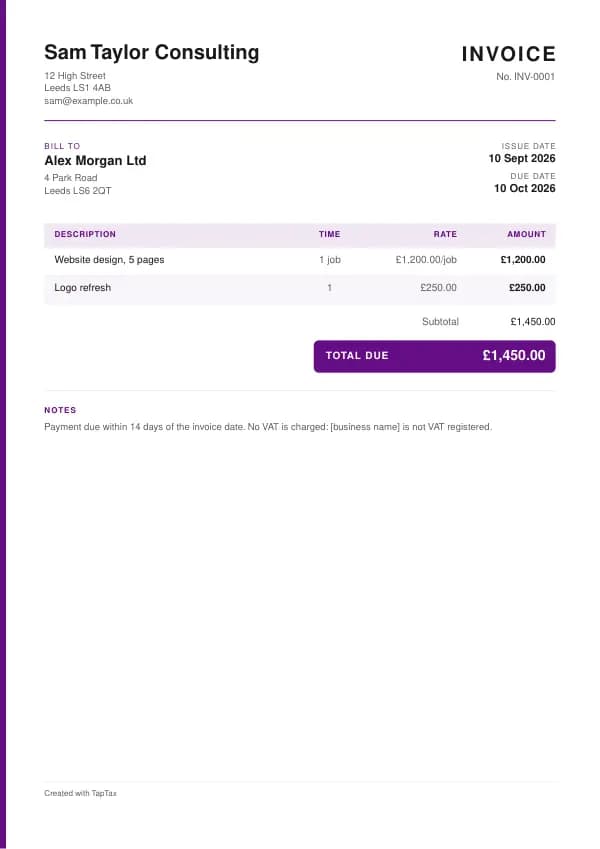
The template comes filled in with example lines like these, so you can see how each part works before replacing them with your own.
| Line | Quantity | Price | Amount |
|---|---|---|---|
| Website design, 5 pages | 1 job | £1,200.00 | £1,200.00 |
| Logo refresh | 1 | £250.00 | £250.00 |
| Subtotal | £1,450.00 | ||
| Total due | £1,450.00 |
Line by line: Website design, 5 pages, 1 job × £1,200.00 = £1,200.00; Logo refresh, 1 × £250.00 = £250.00. The subtotal is £1,450.00, which is also the total due because no VAT is charged. The figures are illustrative; replace them with your own.
How to fill in the template
- Add your name or business name and address.
- Add your customer's name and address.
- Number the invoice and add the invoice date and due date.
- Describe each piece of work with its price; do not add VAT.
- Add your bank details and payment terms.
- Send it as a PDF and keep a copy.
Give each invoice without VAT its own number in a single sequence, and never reuse one. A number lets you and your customer refer to the document without confusion, and an unbroken sequence shows your records are complete. The invoice number generator suggests a format that stays tidy for years.
The VAT threshold and voluntary registration
You must register for VAT if your taxable turnover in the last 12 months is over £90,000, or if you expect it to exceed £90,000 in the next 30 days alone. The test is rolling, month by month, not per tax year, so a strong few months can take you over. You can also register voluntarily below the threshold, which can make sense if most of your customers are VAT registered and can reclaim the VAT, or if you buy a lot of equipment. The VAT registration checker tracks your turnover against the threshold.
Income thresholds that change your paperwork
- Trading allowance£1,000
- MTD from April 2028£20,000
- MTD from April 2027£30,000
- MTD from April 2026£50,000
- VAT registration£90,000
Invoice without VAT or VAT invoice?
A VAT invoice is only for VAT-registered businesses and must show the VAT number and VAT details. An invoice without VAT is for everyone else. Showing VAT when you are not registered is not a harmless formatting choice: HMRC can recover VAT you charged without being registered, and customers who reclaimed it may have to repay.
Invoicing while waiting for a VAT number
If you have applied to register and are waiting for your VAT number, you cannot show VAT on your invoices yet. HMRC allows you to increase your prices to account for the VAT you will have to pay, but you must not show it as VAT. Once your number arrives, you issue VAT invoices within 30 days for supplies made since your registration date, and your customers can then reclaim.
Pricing when you are below the threshold
Being unregistered can be an advantage when selling to the public or to businesses that cannot reclaim VAT, because your prices are 20% lower than a registered competitor's for the same net income. When you approach the threshold, plan ahead: registering adds VAT to your prices or comes out of your margin, depending on who your customers are. The VAT calculator shows the effect on any price.
Tracking your turnover
Keep a running total of your taxable turnover for the last 12 months, updated every month. Taxable turnover includes standard, reduced and zero-rated sales, but not exempt ones or sales outside the scope of UK VAT. A simple spreadsheet, or software that totals your invoices, makes it easy to see when you are getting close.
Exempt businesses and the threshold
Some businesses never need to register because their sales are exempt, for example most health professionals giving medical care or independent tutors teaching school subjects. Exempt sales do not count towards the £90,000 threshold at all. A business with a mix of exempt and taxable sales counts only the taxable part. Invoices for exempt work should not show VAT, and it helps to state that the service is exempt from VAT, so customers understand why.
Buying from VAT-registered suppliers
When you are not VAT registered, the VAT your suppliers charge you is simply part of the cost: you cannot reclaim it, so record purchases at their VAT-inclusive price in your accounts and claim that full amount as an expense for Income Tax. This is one reason businesses with high purchase costs sometimes register voluntarily. Once registered, you can reclaim VAT on purchases, and on some goods and services bought before registration, within HMRC's time limits.
Common invoice without VAT mistakes
- Adding VAT when not registered. You cannot charge VAT without a VAT number, and customers cannot reclaim it.
- Missing the threshold. Check your rolling 12-month turnover every month, not just at the tax year end.
- Leaving out the invoice basics. A non-VAT invoice still needs a number, dates, both parties' details and a clear description.
Checklist before you send it
Before a invoice without VAT goes out, check it against the list of what it must show:
- A unique invoice number is on it and correct.
- Your name or business name and an address is on it and correct.
- Your customer's name and address is on it and correct.
- A clear description of what you are charging for is on it and correct.
- The date of supply and the invoice date is on it and correct.
- The amounts and the total owed is on it and correct.
- A copy is saved with your records.
Sending it
Send the invoice without VAT as a PDF attached to an email, not as an editable file. In the email, say what it is, its number, the amount and any date that matters, so the reader can act without opening the attachment. Send it to the person or inbox that deals with it, which for a business is often an accounts address rather than the person you worked with, and keep a copy of the email and the PDF together in your records.
Keep a copy
You must keep your records for at least 5 years after the 31 January submission deadline of the relevant tax year.
Keep a copy of every invoice without VAT you issue or receive, digital is fine, with the payments that relate to it. From 6 April 2026, sole traders and landlords with qualifying income over £50,000 must keep digital records and send HMRC quarterly updates under Making Tax Digital, falling to £30,000 from April 2027 and £20,000 from April 2028. The MTD requirement checker shows when it applies to you, and how long to keep invoices covers retention.
Download the invoice without VAT template
The template comes as a Word document for Word, Google Docs and Pages, an Excel workbook for Excel and Google Sheets, and a print-ready PDF. Replace the words in square brackets with your own details. In the Excel version each line, the subtotal and the total are formulas, so the figures update as you type. Or fill it in online with the free invoice generator, which makes a finished PDF with your details, in your colours.
Related documents in the same family: the zero-rated invoice template, VAT-exempt invoice template, flat rate scheme invoice template, reverse charge invoice template and VAT invoice template. All of them follow the same numbering and record-keeping rules, and each page explains what that document must show.
A TapTax account, free to start, creates and sends invoices, tracks which are paid, keeps receipts and bills with your records, and files your quarterly updates to HMRC from the same data.
Tools for this
Related guides and definitions
Frequently asked questions
Can I issue invoices if I am not VAT registered?
Yes. Your invoice must not show VAT or a VAT number, but it needs everything else a valid invoice includes.
Do I have to write "not VAT registered" on my invoice?
No, but a short line saying no VAT is charged because you are not registered avoids questions.
When must I register for VAT?
When your taxable turnover over the last 12 months passes £90,000, or when you expect to pass it within the next 30 days.
Invoice, get paid, stay ready for HMRC.
TapTax creates and sends your invoices, tracks which ones are paid and files your quarterly updates to HMRC. Start on the free plan, no card needed.
Get started freeSources
The rules on this page come from official guidance.