
Deposit receipt
template
A receipt for a deposit, stating what it secures, whether it is refundable, and how it will be returned or used.
Download the deposit receipt template
Free, with no sign-up. Replace the words in square brackets with your own details.
The free receipt generator makes a finished PDF with your details, logo and colours. Nothing is stored.
Deposits cause more disputes than almost any other payment, because the two sides often understand them differently. A deposit receipt settles that at the moment the money changes hands: what the deposit secures, whether it is part payment or a returnable security, and the conditions for getting it back. This template works for trade and booking deposits, and for tenancy deposits with the protection details landlords must give.
- Deposit receipt
- A receipt confirming a deposit has been received, stating what it is for, the amount, and the terms on which it will be refunded, kept, or deducted from the final price.
When to use a deposit receipt
Use a deposit receipt when you take a deposit to book a date, order materials, reserve an item or secure a tenancy. For trades and services, the deposit is usually a part payment, deducted from the final invoice; if you are VAT registered, you may also need a deposit invoice for VAT. For hired equipment, the deposit is usually a returnable security. For tenancies in England and Wales, the landlord must protect the deposit in a government-backed scheme and give the tenant the prescribed information.
What a deposit receipt must show
| What it shows | Why it matters |
|---|---|
| The words "Deposit receipt", a number and the date | Identifies the receipt |
| Your details and the payer's | Who received it and who paid |
| What the deposit secures | The booking, order, item or tenancy |
| The amount and payment method | Proof of payment |
| Whether it is part payment or a returnable security | Decides how it is treated |
| The refund terms and conditions | When it is returned or can be kept |
| For tenancies: the protection scheme and reference | Required by law for most tenancies |
An example deposit receipt
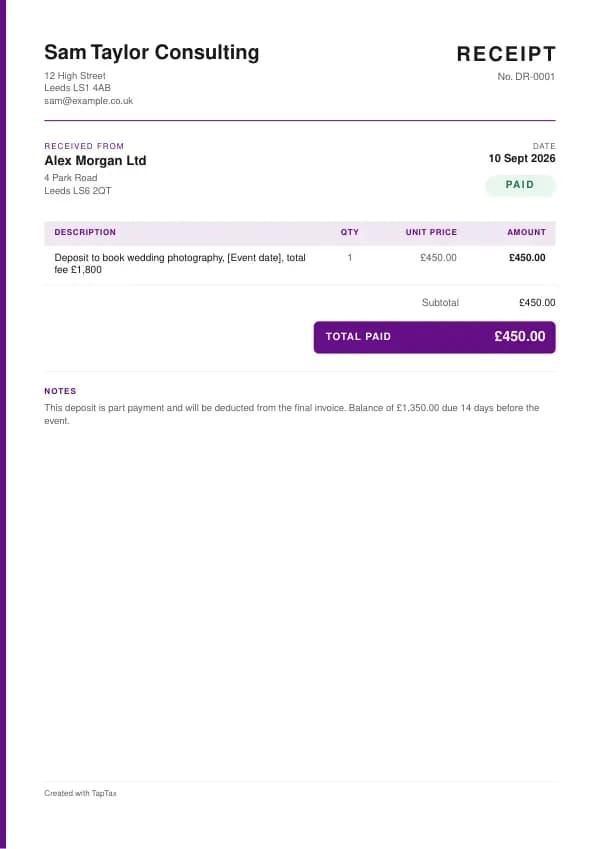
The template comes filled in with example lines like these, so you can see how each part works before replacing them with your own.
| Line | Quantity | Price | Amount |
|---|---|---|---|
| Deposit to book wedding photography, [Event date], total fee £1,800 | 1 | £450.00 | £450.00 |
| Subtotal | £450.00 | ||
| Deposit received | £450.00 |
Line by line: Deposit to book wedding photography, [Event date], total fee £1,800, 1 × £450.00 = £450.00. The subtotal is £450.00, which is also the deposit received because no VAT is charged. The figures are illustrative; replace them with your own.
How to fill in the template
- Agree the deposit and its terms in writing before taking payment.
- Record what the deposit secures and the total price.
- State whether it is part payment or a returnable security.
- Set out the refund terms clearly.
- For a tenancy, add the protection scheme and reference once protected.
- Give the payer a copy and keep yours.
Number every deposit receipt in sequence and never reuse a number, even when a document is cancelled. Numbers make documents easy to find and to match against payments, and they show HMRC and your customers that nothing is missing. For a numbering format, try the invoice number generator.
Tenancy deposits
Landlords in England and Wales must protect a tenancy deposit in a government-backed tenancy deposit protection scheme within 30 days of receiving it, and give the tenant the prescribed information about the scheme within the same period. The schemes are the Deposit Protection Service, MyDeposits and the Tenancy Deposit Scheme. At the end of the tenancy, the deposit must be returned within 10 days of agreeing how much the tenant will get back. Deposits in England are capped at five weeks’ rent where the annual rent is under £50,000. Failing to protect a deposit can lead to a penalty of up to three times the deposit and restrictions on ending the tenancy.
Income thresholds that change your paperwork
- Trading allowance£1,000
- MTD from April 2028£20,000
- MTD from April 2027£30,000
- MTD from April 2026£50,000
- VAT registration£90,000
Deposit receipt or deposit invoice?
A deposit receipt confirms the deposit was paid. A deposit invoice asks for it, and for VAT-registered businesses it is usually the VAT invoice for the advance payment. Many businesses send a deposit invoice first, then confirm payment with a receipt.
Part payment or security?
The difference matters for tax and for refunds. A part payment towards a job or booking is income, and for VAT-registered businesses it usually creates a tax point. A returnable security, such as a deposit on hired equipment or a tenancy deposit, is not income while you hold it, because it belongs to the payer unless you have grounds to keep it. State which it is on the receipt, and keep securities separate from your takings.
Keeping a deposit after cancellation
If a customer cancels, whether you can keep the deposit depends on your terms and the law. For consumers, a deposit that is out of proportion to your actual loss can be an unfair term, and consumers who book at a distance or off premises usually have a 14-day right to cancel. Keeping a deposit that covers costs you have genuinely incurred, such as materials ordered or a date you cannot rebook, is more likely to be fair. Write the terms down before taking the money.
Deposits on goods
When a customer reserves an item or orders something made to measure, the deposit receipt should describe the item, the total price, the balance and when it is due, and how long you will hold the item. For bespoke goods, say that the deposit covers materials and work started. Consumers' cancellation rights do not apply to goods made to their specifications, but your terms still need to be fair.
Holding deposits for tenancies
In England, a holding deposit to reserve a property before a tenancy is agreed is capped at one week’s rent, and must usually be returned or put towards the first rent or deposit within set deadlines. Give a separate receipt for a holding deposit, stating the deadline for agreement, the conditions on which it could be kept, and how it will be applied.
Recording deposits
Record part-payment deposits as income when received if you use the cash basis, and link them to the final invoice so the job's income is not counted twice. Record security deposits and tenancy deposits separately, as money held on behalf of the payer, not as income, unless and until you are entitled to keep some of it. Deductions you keep from a tenancy deposit, such as for damage, are then income or offset repair costs.
Worked example
A wedding photographer charges £1,800 and takes a £450 deposit to hold the date. The receipt says the deposit is part payment, deducted from the final invoice, with the £1,350 balance due 14 days before the wedding. It sets out that the deposit is refunded in full if the couple cancel within 14 days of booking, and otherwise only if the date can be rebooked. The photographer records the £450 as income on the cash basis and quotes the receipt number on the balance invoice. When a different couple later cancels eight months out and the date is rebooked, the photographer refunds the deposit as promised, with no dispute.
Common deposit receipt mistakes
- Not saying whether the deposit is refundable. Unclear terms are the main cause of deposit disputes.
- Mixing security deposits with income. Keep returnable deposits separate until you are entitled to them.
- Missing the 30-day tenancy deposit deadline. Protect it and give the prescribed information in time.
Checklist before you send it
A quick check of every deposit receipt before you send it:
- The words "Deposit receipt", a number and the date is on it and correct.
- Your details and the payer's is on it and correct.
- What the deposit secures is on it and correct.
- The amount and payment method is on it and correct.
- Whether it is part payment or a returnable security is on it and correct.
- The refund terms and conditions is on it and correct.
- For tenancies: the protection scheme and reference is on it and correct.
- A copy is saved with your records.
Sending it
Email the deposit receipt as a PDF with a short, specific message: the document number, the amount, and what you need the reader to do. Address it to whoever processes it, often an accounts team, and copy your usual contact if that helps. File the sent PDF with its number in the file name, so you can find it in seconds if there is ever a question.
Keep a copy
You must keep your records for at least 5 years after the 31 January submission deadline of the relevant tax year.
Business documents are records, and records have to be kept. Save every deposit receipt in one place, ideally digitally, so you can find it if a customer or HMRC asks. Making Tax Digital for Income Tax makes digital records compulsory from 6 April 2026 for qualifying income over £50,000, from April 2027 over £30,000 and from April 2028 over £20,000; check your date with the MTD requirement checker.
Download the deposit receipt template
Download it as a Word document, an Excel workbook or a PDF, whichever suits the way you work. The Word file opens in Google Docs too, and the Excel file in Google Sheets. The Excel totals are live formulas. Or fill it in online with the free receipt generator, which makes a finished PDF with your details, in your colours.
Related documents in the same family: the receipt template, sales receipt template, cash receipt template and rent receipt template. All of them follow the same numbering and record-keeping rules, and each page explains what that document must show.
If you would rather not manage documents by hand, a TapTax account, free to start, keeps your invoices, receipts and bank transactions together and files your Making Tax Digital quarterly updates to HMRC.
Tools for this
Related guides and definitions
Frequently asked questions
What should a deposit receipt include?
What the deposit secures, the amount, whether it is part payment or a returnable security, and the refund terms.
When must a landlord protect a tenancy deposit?
In England and Wales, within 30 days of receiving it, with the prescribed information given to the tenant in the same period.
Can I keep a deposit if the customer cancels?
It depends on your terms and the law. Keeping more than your genuine loss can be unfair for consumers.
Invoice, get paid, stay ready for HMRC.
TapTax creates and sends your invoices, tracks which ones are paid and files your quarterly updates to HMRC. Start on the free plan, no card needed.
Get started freeSources
The rules on this page come from official guidance.