
Cash receipt
template
A receipt for cash payments, with the details that make cash income easy to evidence.
Download the cash receipt template
Free, with no sign-up. Replace the words in square brackets with your own details.
The free receipt generator makes a finished PDF with your details, logo and colours. Nothing is stored.
Cash leaves no bank trail on its own, so the receipt is the evidence. For the customer, it proves they paid; for you, it is the record that ties cash to a sale when you bank it or when HMRC asks. This template adds what a cash receipt needs beyond a standard receipt: the amount in words and figures, the name of the person who took the money, and a signature.
- Cash receipt
- A receipt confirming a payment made in cash, recording the amount, date, who paid and what for, and signed by the person who received it.
When to use a cash receipt
Use a cash receipt whenever you are paid in notes and coins: a tradesperson paid at the end of a job, a tutor paid by a parent, a landlord collecting rent in cash, a private sale of goods, or a market trader's larger sales. Give one even if the customer does not ask, and keep your copy. If you regularly take cash, keep a daily takings record as well, and bank cash regularly so your bank statements back up your receipts.
What a cash receipt must show
| What it shows | Why it matters |
|---|---|
| The words "Cash receipt", a number and the date | Identifies the receipt |
| Your name or business name and address | Who received the cash |
| The payer's name | Who paid |
| What the payment is for | Links cash to a sale |
| The amount in figures and words | Prevents alteration |
| The name and signature of the person who received it | Confirms receipt |
| The balance still owed, if it was a part payment | Shows where the account stands |
An example cash receipt
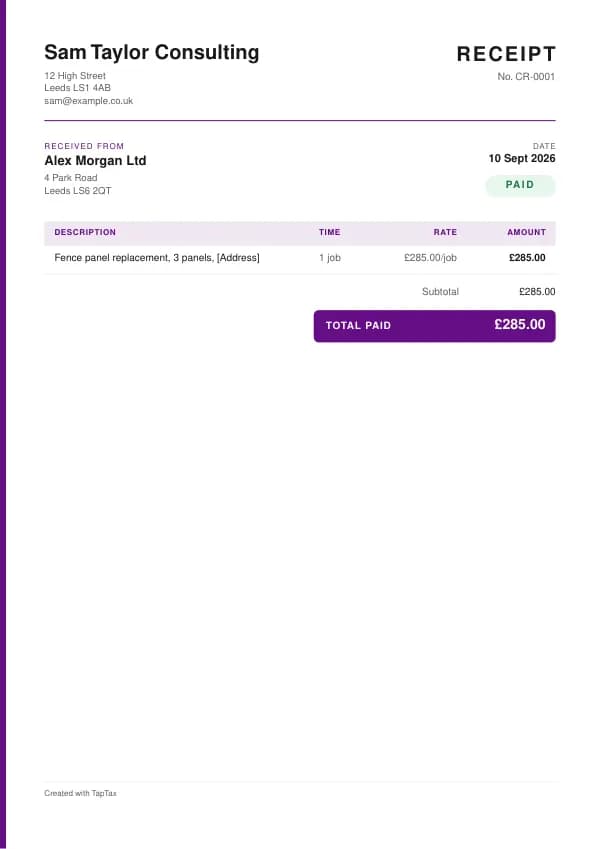
The template comes filled in with example lines like these, so you can see how each part works before replacing them with your own.
| Line | Quantity | Price | Amount |
|---|---|---|---|
| Fence panel replacement, 3 panels, [Address] | 1 job | £285.00 | £285.00 |
| Subtotal | £285.00 | ||
| Cash received | £285.00 |
Line by line: Fence panel replacement, 3 panels, [Address], 1 job × £285.00 = £285.00. The subtotal is £285.00, which is also the cash received because no VAT is charged. The figures are illustrative; replace them with your own.
How to fill in the template
- Count the cash in front of the customer.
- Write the amount in figures and in words.
- Describe what the payment is for, and any invoice it settles.
- Sign it and write your name.
- Show any balance still owed.
- Give the customer the top copy and keep yours with your takings record.
Give each cash receipt its own number in a single sequence, and never reuse one. A number lets you and your customer refer to the document without confusion, and an unbroken sequence shows your records are complete. The invoice number generator suggests a format that stays tidy for years.
Cash and money laundering rules
Businesses that accept, in cash, payments of €10,000 or more (or the sterling equivalent) for goods, in a single transaction or linked transactions, must register with HMRC as high value dealers under the money laundering regulations before doing so, and carry out checks on customers. Most small businesses never approach this, but it matters for car traders, jewellers, and anyone selling high-value goods. If you do not want to register, do not accept cash payments at that level. Separate rules apply to letting agents and art market participants.
Income thresholds that change your paperwork
- Trading allowance£1,000
- MTD from April 2028£20,000
- MTD from April 2027£30,000
- MTD from April 2026£50,000
- VAT registration£90,000
Cash receipt or standard receipt?
A receipt works for any payment method. A cash receipt adds the amount in words, a signature and the balance owed, because cash payments have no other trail. For card and bank payments, a standard receipt is enough.
Recording cash income for tax
All cash you receive for your business is income and must be recorded, whether or not you bank it. Keep a daily takings record showing the total cash taken, alongside your receipt copies, and record any cash you use to pay business expenses. HMRC compares the lifestyle and bank records of cash businesses with their declared income, so accurate records are your best protection. If you spend some takings before banking them, record that too.
Banking cash
Bank cash regularly, ideally weekly, and bank it in full rather than netting off expenses. Your bank statements then back up your takings record, and the cash is safer. Many banks charge business customers for paying in cash, so check your account terms. The Post Office offers cash deposits for many business accounts.
Part payments and instalments
When a customer pays in instalments, give a receipt for each payment showing the amount received, the total due and the balance outstanding. That avoids disputes about how much has been paid, and your records show exactly what is owed. Once the balance is paid, the last receipt should show a nil balance.
Keeping receipts safe
Use a duplicate receipt book with numbered pages, or a receipt app that records each cash payment, so every receipt has a copy. Never tear out and throw away spoiled receipts: mark them void and keep them in the book. A complete numbered sequence shows your records are complete.
Cash and Making Tax Digital
Under Making Tax Digital for Income Tax, your records must be digital once it applies to you: from April 2026 for qualifying income over £50,000, from April 2027 over £30,000, and from April 2028 over £20,000. Cash receipts can still be on paper, but the takings need entering into your digital records, at least in daily totals. Receipt apps that capture cash sales directly save retyping.
Worked example
A fencer replaces three panels and is paid £285 in cash by the homeowner. They count the notes in front of the customer, write cash receipt CR-0017 with "Two hundred and eighty-five pounds" in words, sign it, and show a nil balance. That night they enter £285 in their takings record. On the way home they spent £40 of the cash on posts for the next job, so they record the £285 as income and the £40 as an expense, and bank the remaining £245. Their bank statement, takings record and receipt book now tell the same story, which is exactly what HMRC looks for in a cash business.
Cash payments from customers who are businesses
Business customers who pay in cash need a receipt to claim the cost as an expense, and if you are VAT registered, a valid VAT invoice or simplified VAT invoice to reclaim the VAT. Add your VAT number and the rate to the cash receipt for sales up to £250, or issue a full VAT invoice for larger amounts and mark it as paid in cash. Keep the invoice number on the receipt so both documents link together.
Common cash receipt mistakes
- Not recording cash that was spent before banking. All cash taken is income.
- Amount only in figures. Add words too, so the amount cannot be altered.
- No copy kept. Use a duplicate book or an app so every receipt has a record.
Checklist before you send it
Before a cash receipt goes out, check it against the list of what it must show:
- The words "Cash receipt", a number and the date is on it and correct.
- Your name or business name and address is on it and correct.
- The payer's name is on it and correct.
- What the payment is for is on it and correct.
- The amount in figures and words is on it and correct.
- The name and signature of the person who received it is on it and correct.
- The balance still owed, if it was a part payment is on it and correct.
- A copy is saved with your records.
Sending it
Send the cash receipt as a PDF attached to an email, not as an editable file. In the email, say what it is, its number, the amount and any date that matters, so the reader can act without opening the attachment. Send it to the person or inbox that deals with it, which for a business is often an accounts address rather than the person you worked with, and keep a copy of the email and the PDF together in your records.
Keep a copy
You must keep your records for at least 5 years after the 31 January submission deadline of the relevant tax year.
Keep a copy of every cash receipt you issue or receive, digital is fine, with the payments that relate to it. From 6 April 2026, sole traders and landlords with qualifying income over £50,000 must keep digital records and send HMRC quarterly updates under Making Tax Digital, falling to £30,000 from April 2027 and £20,000 from April 2028. The MTD requirement checker shows when it applies to you, and how long to keep invoices covers retention.
Download the cash receipt template
The template comes as a Word document for Word, Google Docs and Pages, an Excel workbook for Excel and Google Sheets, and a print-ready PDF. Replace the words in square brackets with your own details. In the Excel version each line, the subtotal and the total are formulas, so the figures update as you type. Or fill it in online with the free receipt generator, which makes a finished PDF with your details, in your colours.
Related documents in the same family: the receipt template, sales receipt template, rent receipt template and deposit receipt template. All of them follow the same numbering and record-keeping rules, and each page explains what that document must show.
A TapTax account, free to start, creates and sends invoices, tracks which are paid, keeps receipts and bills with your records, and files your quarterly updates to HMRC from the same data.
Tools for this
Related guides and definitions
Frequently asked questions
What should a cash receipt include?
The date, your details, the payer, what the payment is for, the amount in figures and words, your signature, and any balance still owed.
Do I have to declare cash payments?
Yes. All business income is taxable, whatever form it is paid in.
Is there a limit on cash payments?
Businesses accepting cash of €10,000 or more for goods must register with HMRC as high value dealers first.
Invoice, get paid, stay ready for HMRC.
TapTax creates and sends your invoices, tracks which ones are paid and files your quarterly updates to HMRC. Start on the free plan, no card needed.
Get started freeSources
The rules on this page come from official guidance.