
Sales receipt
template
An itemised sales receipt for goods sold, with quantities, prices, VAT and returns information.
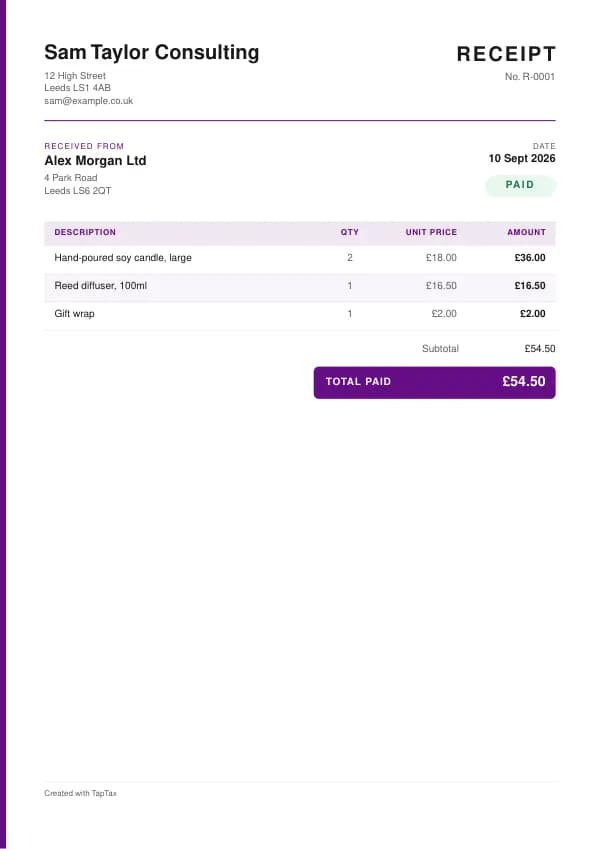
Download the sales receipt template
Free, with no sign-up. Replace the words in square brackets with your own details.
The free receipt generator makes a finished PDF with your details, logo and colours. Nothing is stored.
A sales receipt does more than confirm a payment: it lists what the customer bought, so they can return an item, claim it as a business expense, or check the price. For you, it is an itemised record of stock sold. This template lists each product line with its quantity and price, shows VAT if you are registered, and includes your returns information, which is where most customer questions come from.
- Sales receipt
- A receipt that lists each item sold, with quantity and price, confirming the customer has paid. It is the standard receipt for shops, market stalls, online sellers and makers selling in person.
When to use a sales receipt
Use a sales receipt for sales of goods where the customer pays at the time of sale: a market stall, a pop-up shop, craft fairs, a farm shop, collection sales from your workshop, or goods sold at the end of a job. For online orders, email the same details as an order confirmation and receipt. If a business customer needs to reclaim VAT on a sale over £250, give a full VAT invoice instead.
What a sales receipt must show
| What it shows | Why it matters |
|---|---|
| Your business name, address and contact details | Who sold the goods |
| A receipt number and the date and time of sale | Identifies the sale |
| Each item with quantity, unit price and line total | An itemised record |
| Any discount applied | Shows how the total was reached |
| The total paid and payment method | Proof of payment |
| VAT number and rate for each item, if registered | Needed for a simplified VAT invoice |
| Your returns policy, briefly | Answers the most common question |
An example sales receipt
The template comes filled in with example lines like these, so you can see how each part works before replacing them with your own.
| Line | Quantity | Price | Amount |
|---|---|---|---|
| Hand-poured soy candle, large | 2 | £18.00 | £36.00 |
| Reed diffuser, 100ml | 1 | £16.50 | £16.50 |
| Gift wrap | 1 | £2.00 | £2.00 |
| Subtotal | £54.50 | ||
| Total paid | £54.50 |
Line by line: Hand-poured soy candle, large, 2 × £18.00 = £36.00; Reed diffuser, 100ml, 1 × £16.50 = £16.50; Gift wrap, 1 × £2.00 = £2.00. The subtotal is £54.50, which is also the total paid because no VAT is charged. The figures are illustrative; replace them with your own.
How to fill in the template
- Set up your receipt with your business details and returns policy.
- Record each item sold with quantity and price.
- Apply any discount as its own line.
- Show the total and payment method.
- Add your VAT number and each item's VAT rate if you are registered.
- Hand over or email the receipt, and keep a copy for your records.
Number every sales receipt in sequence and never reuse a number, even when a document is cancelled. Numbers make documents easy to find and to match against payments, and they show HMRC and your customers that nothing is missing. For a numbering format, try the invoice number generator.
Mixed VAT rates on one receipt
Shops and stalls often sell goods at different VAT rates on one receipt: a farm shop selling zero-rated vegetables and standard-rated soft drinks, or a baker selling cold bread (zero-rated) and hot pies (standard-rated). If you are VAT registered, each line should carry its rate, or a code linked to a rate key on the receipt, so the VAT can be worked out. Most till systems and card-reader apps do this for you once products are set up with the right rate. HMRC's list of VAT rates is the reference for which rate applies.
Income thresholds that change your paperwork
- Trading allowance£1,000
- MTD from April 2028£20,000
- MTD from April 2027£30,000
- MTD from April 2026£50,000
- VAT registration£90,000
Sales receipt or invoice?
A sales receipt records a sale that has been paid for on the spot. An invoice requests payment for a sale that will be paid later. For goods sold and paid for together, a sales receipt is enough; for trade customers on credit, send an invoice.
Returns and consumer rights
Consumers have statutory rights that sit alongside your returns policy. Faulty goods can be rejected for a full refund within 30 days, and after that the consumer can ask for a repair or replacement. For goods sold online or by phone, consumers normally have 14 days to cancel after receiving the goods, whether or not they are faulty. For in-person sales, a change-of-mind returns policy is voluntary, but if you offer one, honour it. Printing "This does not affect your statutory rights" is common good practice.
Selling at markets and fairs
Card readers make receipts easy at markets: they can email or text a receipt, and they record each sale with the time. If you take cash as well, keep a simple takings sheet for each event, and offer handwritten receipts from a numbered book. Your sales for the day are income, and any pitch fees, stock and travel are expenses, so keep the receipts for both.
Stock records
Itemised receipts tell you what sells. Reviewing them by product shows which lines to restock and which to drop. For tax, if you use the traditional basis of accounting, you value your stock at the end of the year; if you use the cash basis, you do not, but you still need records of purchases and sales. Either way, receipts linked to products make the year-end much easier.
Selling online
For online sales, the order confirmation email is often the receipt. It should show your business name and geographic address, each item and its price including VAT, delivery charges, the total, and information about the right to cancel. Marketplaces often generate this for you. If you sell through platforms, their payout statements are also part of your records, alongside your own receipts.
Discounts, vouchers and gift cards
Show discounts as separate lines so both you and the customer can see the original and discounted price. For VAT, the VAT is due on the price actually paid after a discount. Gift vouchers are more complicated: for single-purpose vouchers, VAT is due when the voucher is sold; for multi-purpose vouchers, when it is redeemed. Show voucher redemptions on the receipt as a payment method rather than a discount.
Worked example
A candle maker selling at a Saturday market takes card payments on a phone reader and cash from a float. A customer buys two large candles at £18, a diffuser at £16.50 and gift wrap at £2, paying £54.50 by card. The reader emails a sales receipt listing each item, the total and the returns line. At the end of the day, the maker exports the reader's sales report, adds the cash takings from the float count, and records the day's total as income, with the pitch fee as an expense. The itemised receipts show that diffusers outsold candles, which shapes the next stock order.
Common sales receipt mistakes
- No returns information. Customers then have to ask, and disputes are more likely.
- One VAT rate for mixed goods. Each item needs its own rate if the goods are taxed differently.
- Discounts hidden in the price. Show them as their own line so the receipt adds up.
Checklist before you send it
A quick check of every sales receipt before you send it:
- Your business name, address and contact details is on it and correct.
- A receipt number and the date and time of sale is on it and correct.
- Each item with quantity, unit price and line total is on it and correct.
- Any discount applied is on it and correct.
- The total paid and payment method is on it and correct.
- VAT number and rate for each item, if registered is on it and correct.
- Your returns policy, briefly is on it and correct.
- A copy is saved with your records.
Sending it
Email the sales receipt as a PDF with a short, specific message: the document number, the amount, and what you need the reader to do. Address it to whoever processes it, often an accounts team, and copy your usual contact if that helps. File the sent PDF with its number in the file name, so you can find it in seconds if there is ever a question.
Keep a copy
You must keep your records for at least 5 years after the 31 January submission deadline of the relevant tax year.
Business documents are records, and records have to be kept. Save every sales receipt in one place, ideally digitally, so you can find it if a customer or HMRC asks. Making Tax Digital for Income Tax makes digital records compulsory from 6 April 2026 for qualifying income over £50,000, from April 2027 over £30,000 and from April 2028 over £20,000; check your date with the MTD requirement checker.
Download the sales receipt template
Download it as a Word document, an Excel workbook or a PDF, whichever suits the way you work. The Word file opens in Google Docs too, and the Excel file in Google Sheets. The Excel totals are live formulas. Or fill it in online with the free receipt generator, which makes a finished PDF with your details, in your colours.
Related documents in the same family: the receipt template, cash receipt template, rent receipt template and deposit receipt template. All of them follow the same numbering and record-keeping rules, and each page explains what that document must show.
If you would rather not manage documents by hand, a TapTax account, free to start, keeps your invoices, receipts and bank transactions together and files your Making Tax Digital quarterly updates to HMRC.
Tools for this
Related guides and definitions
Frequently asked questions
What is a sales receipt?
An itemised receipt for goods paid for at the time of sale, listing each item, quantity and price.
Do I need to show VAT on a sales receipt?
If you are VAT registered and the receipt is to serve as a simplified VAT invoice, show your VAT number and the rate for each item.
Can customers return goods without a receipt?
They need proof of purchase, which can be a bank or card statement. Statutory rights for faulty goods apply regardless of your policy.
Invoice, get paid, stay ready for HMRC.
TapTax creates and sends your invoices, tracks which ones are paid and files your quarterly updates to HMRC. Start on the free plan, no card needed.
Get started freeSources
The rules on this page come from official guidance.