
Payment reminder letter
template
A polite first reminder for an overdue invoice, firm on the date and easy to pay.
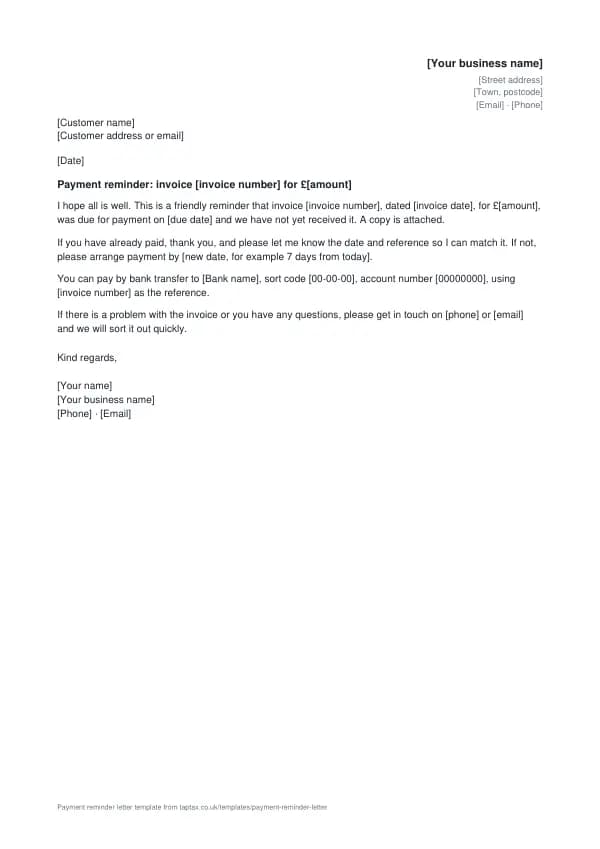
Download the payment reminder letter template
Free, with no sign-up. Replace the words in square brackets with your own details.
Most late payments are not deliberate: the invoice was missed, sat in someone's inbox, or was waiting for approval. A clear, friendly reminder fixes most of them. This template is the first step in chasing: it assumes good faith, gives every detail the customer needs to pay straight away, and sets a new date, without threats that would sour the relationship.
- Payment reminder letter
- A short, polite letter or email reminding a customer that an invoice is due or overdue, with the invoice details, the amount and how to pay.
When to use a payment reminder letter
Send a payment reminder a few days after the due date passes, or a few days before it for customers who are often late. Send it to the person who handles payment, copying your contact if different. If there is no response after 7 to 14 days, follow up by phone, then send a final demand letter. For business customers, you can mention your right to statutory interest in the reminder, but many businesses save that for the second letter.
What a payment reminder letter must show
| What it shows | Why it matters |
|---|---|
| The invoice number, date and amount | So the customer can find it |
| The original due date | Shows how overdue it is |
| A polite request to pay | Assumes good faith |
| How to pay: bank details and reference | Removes any excuse for delay |
| A new date to pay by | A clear next step |
| A contact for queries | Surfaces any dispute early |
| A copy of the invoice attached | In case it was lost |
The letter
The template's wording, with the parts to fill in shown in square brackets. Keep it factual, and change anything that does not fit your situation.
Payment reminder: invoice [invoice number] for £[amount]
I hope all is well. This is a friendly reminder that invoice [invoice number], dated [invoice date], for £[amount], was due for payment on [due date] and we have not yet received it. A copy is attached.
If you have already paid, thank you, and please let me know the date and reference so I can match it. If not, please arrange payment by [new date, for example 7 days from today].
You can pay by bank transfer to [Bank name], sort code [00-00-00], account number [00000000], using [invoice number] as the reference.
If there is a problem with the invoice or you have any questions, please get in touch on [phone] or [email] and we will sort it out quickly.
How to fill in the template
- Check the invoice really is unpaid and was sent to the right person.
- Fill in the invoice number, date, amount and due date.
- Set a new date to pay by, usually 7 days away.
- Add your bank details and reference.
- Attach a copy of the invoice and send by email.
- Diary a follow-up call for the day after the new date.
Give each payment reminder letter its own number in a single sequence, and never reuse one. A number lets you and your customer refer to the document without confusion, and an unbroken sequence shows your records are complete. The invoice number generator suggests a format that stays tidy for years.
Your rights if a business pays late
If a business customer pays late, the Late Payment of Commercial Debts (Interest) Act 1998 lets you claim statutory interest at 8% a year above the Bank of England base rate, plus fixed compensation of £40 for debts under £1,000, £70 for £1,000 to £9,999.99, and £100 for £10,000 or more, per invoice. If no payment date was agreed, payment is due 30 days after the later of delivery or the invoice. These rights do not apply to consumers; for them, interest is only payable if your terms say so and the terms are fair. You do not have to claim in the first reminder, and the right does not disappear if you wait.
Fixed compensation for a late business payment
- Debt up to £999.99£40
- £1,000 to £9,999.99£70
- £10,000 or more£100
Reminder, final demand or letter before action?
A reminder is friendly and assumes a mistake. A final demand is firmer and warns of next steps. A letter before action is the formal step before court. Move through them in order, a week or two apart, unless the customer has already refused to pay.
Timing reminders
Send the first reminder within a few days of the due date; the sooner you ask, the sooner you are paid, and the less likely the invoice is to be forgotten. For regular late payers, a reminder a few days before the due date, framed as a courtesy, often avoids lateness altogether. Automate reminders if your invoicing software offers it, but check each one before it goes if the customer is sensitive.
Tone
Keep the first reminder short and friendly, and assume the customer intends to pay. Avoid threats, capital letters or legal language at this stage: they rarely speed up payment and can damage a relationship that is worth more than one invoice. Be specific, though: the invoice number, amount and a date. A vague "just checking in" is easy to ignore.
Phone first, then write
A short phone call alongside the reminder is often more effective than the letter alone. Ask whether the invoice was received, whether it is approved, and when it will be paid. Record the answer and confirm it by email. If there is a dispute, you will hear about it on the phone before it becomes an excuse for months of silence.
When the customer disputes the invoice
If the reminder brings a complaint, stop chasing that invoice as a debt and deal with the dispute. Ask for the specific problem in writing, respond with evidence, and offer a fix if the complaint is valid, such as a credit note for part of the invoice. Undisputed parts should still be paid. Our guide to invoice disputes explains how to handle them.
Worked example
A graphic designer's £1,200 invoice to a small agency was due on the 30th. On the 3rd, they email a reminder with the invoice attached, asking for payment by the 10th. The agency replies that the invoice went to a former employee's inbox, approves it, and pays on the 8th. No interest is claimed, the relationship is intact, and the designer updates the agency's contact for future invoices.
Preventing late payment
Clear terms help: agree payment terms before the work starts, put the due date on every invoice, and invoice promptly. Offer easy ways to pay, such as bank transfer details and a card link. For new customers, consider a deposit. And make sure you know who approves and pays invoices at each customer, so invoices go to the right person first time.
Common payment reminder letter mistakes
- Waiting weeks to send the first reminder. Send it within a few days of the due date.
- Threatening legal action in the first letter. Save that for later; assume a mistake first.
- No new date. Always give a specific date to pay by.
Checklist before you send it
Before a payment reminder letter goes out, check it against the list of what it must show:
- The invoice number, date and amount is on it and correct.
- The original due date is on it and correct.
- A polite request to pay is on it and correct.
- How to pay: bank details and reference is on it and correct.
- A new date to pay by is on it and correct.
- A contact for queries is on it and correct.
- A copy of the invoice attached is on it and correct.
- A copy is saved with your records.
Sending it
Send the letter to the person or business that owes you, at the address on your contract or invoice, and to their email address as well. Post it by a tracked or signed-for service and keep the proof of posting with a copy of the letter; if you later go to court, you will need to show when it was sent and received. Keep the tone factual: state the debt, the history and the deadline, without threats or personal remarks.
Keep a copy
You must keep your records for at least 5 years after the 31 January submission deadline of the relevant tax year.
Keep a copy of every payment reminder letter you issue or receive, digital is fine, with the payments that relate to it. From 6 April 2026, sole traders and landlords with qualifying income over £50,000 must keep digital records and send HMRC quarterly updates under Making Tax Digital, falling to £30,000 from April 2027 and £20,000 from April 2028. The MTD requirement checker shows when it applies to you, and how long to keep invoices covers retention.
Download the payment reminder letter template
Download the letter as a Word document, which opens in Microsoft Word, Google Docs and Pages, or as a PDF. Replace the words in square brackets, check every date and amount against your records, and send it by post and email so you can prove it was received.
Related documents in the same family: the letter before action template, final demand letter template and overdue invoice email template. All of them follow the same numbering and record-keeping rules, and each page explains what that document must show.
A TapTax account, free to start, creates and sends invoices, tracks which are paid, keeps receipts and bills with your records, and files your quarterly updates to HMRC from the same data.
Tools for this
Related guides and definitions
Frequently asked questions
When should I send a payment reminder?
A few days after the due date, or a few days before for customers who are often late.
What should a payment reminder say?
The invoice number, date, amount and due date, a polite request to pay, a new date, and how to pay.
Can I charge interest on a late invoice?
From business customers, yes: statutory interest at 8% above base rate plus fixed compensation. From consumers, only if your terms allow it.
Invoice, get paid, stay ready for HMRC.
TapTax creates and sends your invoices, tracks which ones are paid and files your quarterly updates to HMRC. Start on the free plan, no card needed.
Get started freeSources
The rules on this page come from official guidance.