
Final demand letter
template
A firm final demand for an unpaid invoice, with interest, compensation and a clear deadline.
Download the final demand letter template
Free, with no sign-up. Replace the words in square brackets with your own details.
When friendly reminders have not worked, a final demand changes the tone. It states the debt, the reminders already sent, any interest and compensation you are now claiming, and a firm deadline, and it says what you will do next. Many customers pay at this stage, because the letter shows you are organised and serious. This template sets out each of those points without overstating your position.
- Final demand letter
- A firm letter sent after reminders have failed, demanding payment of an overdue invoice by a final deadline and stating what will happen if it is not paid, such as a claim for interest and compensation or a letter before action.
When to use a final demand letter
Send a final demand when an invoice is still unpaid after at least one reminder and a follow-up call, typically two to four weeks after the due date. Do not send one while a genuine dispute is unresolved. If the final demand deadline passes, the next step is a formal letter before action, which is required before court proceedings. For debts owed by individuals, including sole traders, the pre-action protocol for debt claims sets out what that letter must contain.
What a final demand letter must show
| What it shows | Why it matters |
|---|---|
| The heading "Final demand" and the date | Signals a change of tone |
| The invoice number, date, amount and original due date | The debt |
| The reminders already sent, with dates | Shows you have been reasonable |
| Statutory interest and compensation claimed, for business debts | What is now owed in total |
| A firm deadline, usually 7 days | The last chance to pay |
| What happens next if unpaid | Letter before action and court |
| How to pay | Removes any excuse |
The letter
The template's wording, with the parts to fill in shown in square brackets. Keep it factual, and change anything that does not fit your situation.
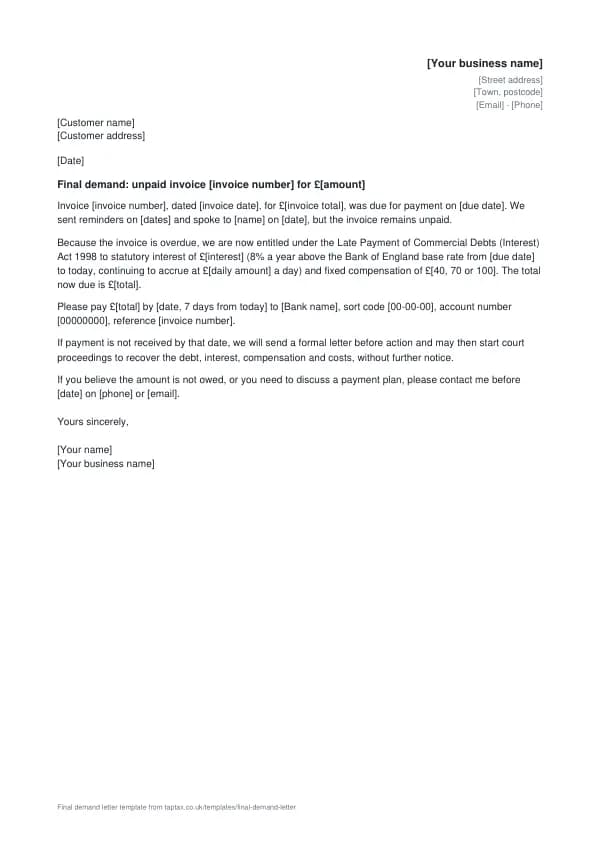
Final demand: unpaid invoice [invoice number] for £[amount]
Invoice [invoice number], dated [invoice date], for £[invoice total], was due for payment on [due date]. We sent reminders on [dates] and spoke to [name] on [date], but the invoice remains unpaid.
Because the invoice is overdue, we are now entitled under the Late Payment of Commercial Debts (Interest) Act 1998 to statutory interest of £[interest] (8% a year above the Bank of England base rate from [due date] to today, continuing to accrue at £[daily amount] a day) and fixed compensation of £[40, 70 or 100]. The total now due is £[total].
Please pay £[total] by [date, 7 days from today] to [Bank name], sort code [00-00-00], account number [00000000], reference [invoice number].
If payment is not received by that date, we will send a formal letter before action and may then start court proceedings to recover the debt, interest, compensation and costs, without further notice.
If you believe the amount is not owed, or you need to discuss a payment plan, please contact me before [date] on [phone] or [email].
How to fill in the template
- Check reminders were sent and there is no open dispute.
- Work out statutory interest and compensation if the customer is a business.
- Fill in the invoice details, reminder dates and the total now due.
- Set a deadline 7 days away.
- Send by email and by post, and keep proof of sending.
- Diary the deadline, and prepare the letter before action if it passes.
Number every final demand letter in sequence and never reuse a number, even when a document is cancelled. Numbers make documents easy to find and to match against payments, and they show HMRC and your customers that nothing is missing. For a numbering format, try the invoice number generator.
Stating your rights accurately
A final demand should be firm but accurate. Statutory interest and fixed compensation apply to debts between businesses, including sole traders selling to businesses, under the Late Payment of Commercial Debts (Interest) Act 1998. For consumers, you can only claim interest your terms allow, and a court may award interest on a claim. Do not threaten action you do not intend to take, claim amounts you are not entitled to, or contact a consumer's employer or family: that can amount to harassment or unfair practice. The late payment interest calculator works out the interest and compensation.
Fixed compensation for a late business payment
- Debt up to £999.99£40
- £1,000 to £9,999.99£70
- £10,000 or more£100
Final demand or letter before action?
A final demand is a last warning before formal steps. A letter before action is the formal pre-action letter courts expect before a claim. For individuals, including sole traders, it must follow the pre-action protocol for debt claims, with a 30-day response period. Some businesses skip the final demand and go straight to the letter before action.
Calculating interest and compensation
Statutory interest runs from the day after the due date at 8% a year above the Bank of England base rate in force on 31 December or 30 June before the payment became overdue. Work out the daily amount: the debt multiplied by the rate, divided by 365. Add fixed compensation of £40, £70 or £100 per invoice depending on the debt. If your reasonable costs of recovery were higher than the fixed amount, you can claim the difference. The calculator does this for you.
Payment plans
Some customers cannot pay in full but can pay over time. A realistic payment plan, agreed in writing with dates and amounts, often recovers more than a court claim. Say in the final demand that you are open to discussing one if they contact you before the deadline. If they miss an instalment, the full balance can become due again under the agreement.
Stopping work and supplies
If a customer owes you money, your terms may let you stop further work or supplies until they pay. Say so in the final demand if you intend to, but check your contract first, because stopping without the right can put you in breach. For construction contracts, the Construction Act gives a statutory right to suspend work for non-payment after giving at least 7 days' notice.
Worked example
A web developer's £4,800 invoice to a business is 45 days overdue, after two reminders and a phone call. The final demand claims 45 days of statutory interest at 8% above a 4% base rate (12% a year), about £71, and £70 fixed compensation, a total of £4,941. It gives 7 days to pay. The customer pays the invoice but disputes the interest; the developer accepts the invoice amount to keep the client, knowing they could have insisted. The point is that the letter produced payment.
Keeping evidence
Keep copies of the invoice, every reminder, notes of calls, and proof of sending the final demand. If the debt goes to court, you will need to show the court what you did to recover it before claiming, and that the customer had every chance to pay or raise a dispute. Organised evidence also makes a letter before action quick to prepare.
Bad debts and tax
If a debt becomes clearly unrecoverable, you can write it off as a bad debt in your accounts, reducing your taxable profit on the traditional basis. On the cash basis, unpaid invoices were never counted as income, so there is nothing to write off. If you are VAT registered and accounted for VAT on the invoice, you can claim bad debt relief once the debt is more than six months overdue and written off in your records.
Common final demand letter mistakes
- Threatening action you will not take. Only say what you intend to do.
- Claiming statutory interest from consumers. It applies only to business debts; consumers pay interest only under fair terms.
- Sending while a dispute is open. Resolve the dispute first, or the letter will be ignored.
Checklist before you send it
A quick check of every final demand letter before you send it:
- The heading "Final demand" and the date is on it and correct.
- The invoice number, date, amount and original due date is on it and correct.
- The reminders already sent, with dates is on it and correct.
- Statutory interest and compensation claimed, for business debts is on it and correct.
- A firm deadline, usually 7 days is on it and correct.
- What happens next if unpaid is on it and correct.
- How to pay is on it and correct.
- A copy is saved with your records.
Sending it
Keep a copy of exactly what you sent, and send it in a way you can prove: recorded or signed-for post to the registered or business address, plus email to your usual contact. Stick to the facts, the amounts and the dates. If the customer replies with a dispute or an offer to pay in instalments, answer in writing and keep that correspondence with the letter.
Keep a copy
You must keep your records for at least 5 years after the 31 January submission deadline of the relevant tax year.
Business documents are records, and records have to be kept. Save every final demand letter in one place, ideally digitally, so you can find it if a customer or HMRC asks. Making Tax Digital for Income Tax makes digital records compulsory from 6 April 2026 for qualifying income over £50,000, from April 2027 over £30,000 and from April 2028 over £20,000; check your date with the MTD requirement checker.
Download the final demand letter template
The letter comes as an editable Word document for Word or Google Docs, and as a PDF to read through first. Fill in the bracketed details, keep a copy, and send it in a way you can evidence later, such as recorded delivery or email with a read receipt.
Related documents in the same family: the letter before action template, payment reminder letter template and overdue invoice email template. All of them follow the same numbering and record-keeping rules, and each page explains what that document must show.
If you would rather not manage documents by hand, a TapTax account, free to start, keeps your invoices, receipts and bank transactions together and files your Making Tax Digital quarterly updates to HMRC.
Tools for this
Related guides and definitions
Frequently asked questions
What is a final demand letter?
A firm letter demanding payment of an overdue invoice by a final deadline, stating what will happen next if it is not paid.
How long should I give in a final demand?
Usually 7 days. A formal letter before action to an individual must give 30 days.
Can I add interest to a final demand?
For business customers, yes: statutory interest and fixed compensation. For consumers, only if your terms allow.
Invoice, get paid, stay ready for HMRC.
TapTax creates and sends your invoices, tracks which ones are paid and files your quarterly updates to HMRC. Start on the free plan, no card needed.
Get started freeSources
The rules on this page come from official guidance.