
Letter before action
template
The formal last step before court for an unpaid invoice, set out the way the court expects.
Download the letter before action template
Free, with no sign-up. Replace the words in square brackets with your own details.
When reminders have not worked, a letter before action is the step that tells a customer you are serious. It sets out what is owed and why, gives a final date for payment, and says what you will do if they do not pay: start a claim in the county court. Many debts are paid at this stage without going any further. This template follows the structure the courts expect.
- Letter before action
- A formal letter to someone who owes you money, setting out the debt and giving them a final deadline to pay before you start court proceedings. For a business owed money by an individual, the court expects one to be sent first.
When to use a letter before action
Send a letter before action once an invoice is overdue and your reminders have gone unanswered or been refused, and before you issue a court claim. If the debtor is an individual, including a sole trader, the Pre-Action Protocol for Debt Claims applies and requires you to give them 30 days to respond, with an information sheet and reply form. For a debt owed by a company, the protocol does not apply, but the court still expects you to have written to them before suing, and 14 days is commonly allowed. The letter is also your evidence that you acted reasonably: if the case reaches court, the judge will look at how you tried to resolve it first, and a clear, factual letter sent in good time counts in your favour.
What a letter before action must show
| What it shows | Why it matters |
|---|---|
| Your details and theirs | Who is owed and who owes |
| The amount owed and how it is made up | Invoice numbers, dates and amounts |
| Interest and compensation claimed, if any | Statutory interest and fixed compensation for business debts |
| A clear deadline for payment | Usually 14 days for a business, 30 days for an individual |
| How to pay | Bank details and the reference to use |
| What happens if they do not pay | That you will start court proceedings without further notice |
| For individuals, the protocol documents | Information sheet and reply form under the debt pre-action protocol |
The letter
The template's wording, with the parts to fill in shown in square brackets. Keep it factual, and change anything that does not fit your situation.
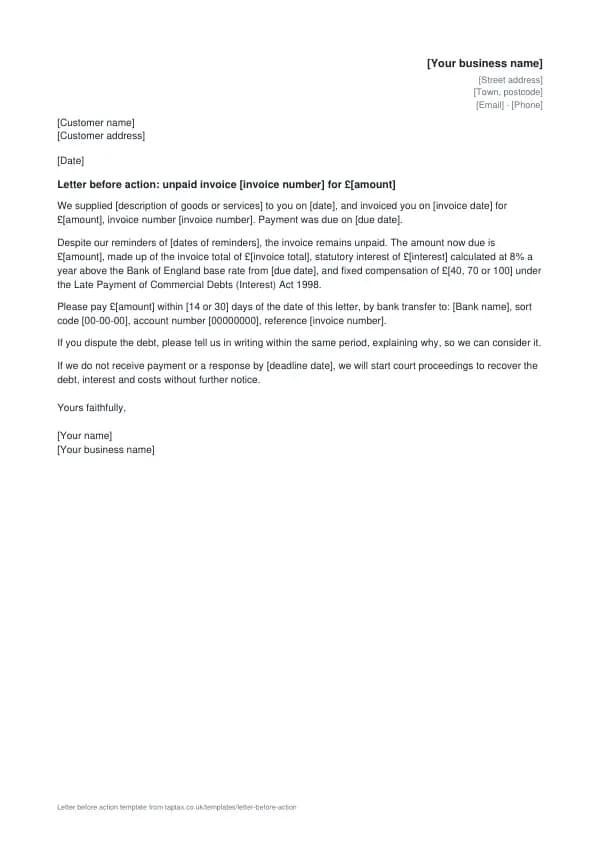
Letter before action: unpaid invoice [invoice number] for £[amount]
We supplied [description of goods or services] to you on [date], and invoiced you on [invoice date] for £[amount], invoice number [invoice number]. Payment was due on [due date].
Despite our reminders of [dates of reminders], the invoice remains unpaid. The amount now due is £[amount], made up of the invoice total of £[invoice total], statutory interest of £[interest] calculated at 8% a year above the Bank of England base rate from [due date], and fixed compensation of £[40, 70 or 100] under the Late Payment of Commercial Debts (Interest) Act 1998.
Please pay £[amount] within [14 or 30] days of the date of this letter, by bank transfer to: [Bank name], sort code [00-00-00], account number [00000000], reference [invoice number].
If you dispute the debt, please tell us in writing within the same period, explaining why, so we can consider it.
If we do not receive payment or a response by [deadline date], we will start court proceedings to recover the debt, interest and costs without further notice.
How to fill in the template
- Check the facts: invoice numbers, dates, amounts and every reminder you sent.
- Work out statutory interest and compensation if the debtor is a business.
- Fill in the letter, including the deadline date and your bank details.
- If the debtor is an individual or sole trader, include the information sheet and reply form from the Pre-Action Protocol for Debt Claims and allow 30 days.
- Send it by post and email, and keep proof of sending.
- Diary the deadline, and prepare your claim in case it passes.
Number every letter before action in sequence and never reuse a number, even when a document is cancelled. Numbers make documents easy to find and to match against payments, and they show HMRC and your customers that nothing is missing. For a numbering format, try the invoice number generator.
The pre-action protocol and statutory interest
When a business claims a debt from an individual, including a sole trader, the Pre-Action Protocol for Debt Claims requires a letter before claim with the key details, an information sheet and a reply form, and 30 days to respond. Ignoring it can cost you in court, even if you win. For debts between businesses, the protocol does not apply, but the courts still expect proper warning. Between businesses you can also claim statutory interest at 8% a year above the Bank of England base rate and fixed compensation of £40, £70 or £100 per invoice under the Late Payment of Commercial Debts (Interest) Act 1998; the late payment interest calculator works out both.
Fixed compensation for a late business payment
- Debt up to £999.99£40
- £1,000 to £9,999.99£70
- £10,000 or more£100
Reminder, final demand or letter before action?
A payment reminder letter is polite and assumes an oversight. A final demand letter is firmer and sets a last date. A letter before action is the formal step before court, stating the debt in full and what you will do next. Use them in that order, and never threaten court unless you are prepared to follow through.
After the deadline: small claims
If the deadline passes without payment, you can claim through the county court, online through the Money Claim Online service for straightforward debts. In England and Wales, claims up to £10,000 are normally dealt with on the small claims track, where each side usually bears its own legal costs and the court fee depends on the amount claimed. The guide to small claims for an unpaid invoice walks through each step.
If the customer disputes the debt
A letter before action often brings out the real reason for non-payment. If the customer disputes part of the invoice, respond in writing, deal with the specific points, and invite payment of the undisputed amount straight away. A partial settlement, recorded with a credit note for any agreed reduction, is often better than a court claim over the whole amount. If they offer to pay in instalments, agree the schedule in writing, and reserve the right to claim the balance if a payment is missed.
Scotland and Northern Ireland
The Pre-Action Protocol for Debt Claims is part of the civil procedure rules for England and Wales. Scotland and Northern Ireland have their own courts and procedures: in Scotland, most smaller debts go through the simple procedure in the sheriff court, and in Northern Ireland through the small claims court. A clear written demand before court action is good practice everywhere, but check the local rules on notice and process if your customer is based outside England and Wales.
Common letter before action mistakes
- Skipping the protocol with individual debtors. A sole trader customer is an individual: include the information sheet and reply form and allow 30 days.
- Getting the figures wrong. Check every invoice, payment and interest calculation before you send; errors undermine the letter.
- Threatening court without meaning it. Only send a letter before action if you are ready to issue a claim when the deadline passes.
Checklist before you send it
A quick check of every letter before action before you send it:
- Your details and theirs is on it and correct.
- The amount owed and how it is made up is on it and correct.
- Interest and compensation claimed, if any is on it and correct.
- A clear deadline for payment is on it and correct.
- How to pay is on it and correct.
- What happens if they do not pay is on it and correct.
- For individuals, the protocol documents is on it and correct.
- A copy is saved with your records.
Sending it
Keep a copy of exactly what you sent, and send it in a way you can prove: recorded or signed-for post to the registered or business address, plus email to your usual contact. Stick to the facts, the amounts and the dates. If the customer replies with a dispute or an offer to pay in instalments, answer in writing and keep that correspondence with the letter.
Keep a copy
You must keep your records for at least 5 years after the 31 January submission deadline of the relevant tax year.
Business documents are records, and records have to be kept. Save every letter before action in one place, ideally digitally, so you can find it if a customer or HMRC asks. Making Tax Digital for Income Tax makes digital records compulsory from 6 April 2026 for qualifying income over £50,000, from April 2027 over £30,000 and from April 2028 over £20,000; check your date with the MTD requirement checker.
Download the letter before action template
The letter comes as an editable Word document for Word or Google Docs, and as a PDF to read through first. Fill in the bracketed details, keep a copy, and send it in a way you can evidence later, such as recorded delivery or email with a read receipt.
Related documents in the same family: the payment reminder letter template, final demand letter template and overdue invoice email template. All of them follow the same numbering and record-keeping rules, and each page explains what that document must show.
If you would rather not manage documents by hand, a TapTax account, free to start, keeps your invoices, receipts and bank transactions together and files your Making Tax Digital quarterly updates to HMRC.
Tools for this
Related guides and definitions
Frequently asked questions
How long do I have to give before going to court?
For an individual, including a sole trader, 30 days under the debt pre-action protocol. For a company, 14 days is commonly allowed.
Can I add interest to an unpaid invoice?
Between businesses, yes: statutory interest at 8% above base rate plus £40, £70 or £100 fixed compensation per invoice.
Does a letter before action have to be sent by post?
There is no fixed rule, but sending it by post and email, and keeping proof, avoids any argument that it was not received.
Invoice, get paid, stay ready for HMRC.
TapTax creates and sends your invoices, tracks which ones are paid and files your quarterly updates to HMRC. Start on the free plan, no card needed.
Get started freeSources
The rules on this page come from official guidance.