
Overdue invoice email
template
Ready-to-send emails for overdue invoices: a friendly nudge, a firm follow-up and a final notice.
Download the overdue invoice email template
Free, with no sign-up. Replace the words in square brackets with your own details.
Email is where most chasing happens, and a well-written email gets paid faster than a vague one. The key is a subject line that names the invoice, a short body with every detail needed to pay, and a specific date. This template is the first email in the sequence, with the wording for the second and third below, so you can send the right one at the right time without starting from scratch.
- Overdue invoice email
- An email reminding a customer that an invoice is overdue, giving the details and asking for payment by a date. Most businesses use a short sequence of emails, escalating in tone.
When to use a overdue invoice email
Send the first overdue email a day or two after the due date. Send the second, firmer one about a week later if there is no reply or payment, ideally after a phone call. Send the third, a final notice, a week after that, then move to a final demand letter by post and email. If the customer replies with a query at any point, deal with it before chasing further.
What a overdue invoice email must show
| What it shows | Why it matters |
|---|---|
| A subject line naming the invoice number and amount | Easy to find and hard to ignore |
| The invoice number, date, amount and due date | Everything needed to identify it |
| A direct request to pay by a specific date | A clear next step |
| Bank details and a payment reference, or a payment link | Makes paying immediate |
| The invoice attached as a PDF | In case it was lost |
| A line inviting queries | Surfaces problems early |
| Your name and direct contact details | Makes it personal |
The letter
The template's wording, with the parts to fill in shown in square brackets. Keep it factual, and change anything that does not fit your situation.
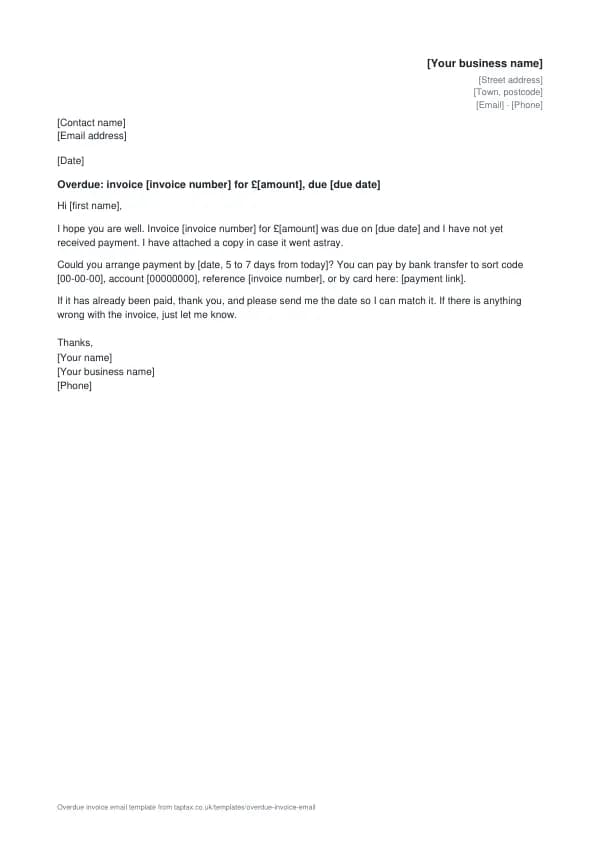
Overdue: invoice [invoice number] for £[amount], due [due date]
Hi [first name],
I hope you are well. Invoice [invoice number] for £[amount] was due on [due date] and I have not yet received payment. I have attached a copy in case it went astray.
Could you arrange payment by [date, 5 to 7 days from today]? You can pay by bank transfer to sort code [00-00-00], account [00000000], reference [invoice number], or by card here: [payment link].
If it has already been paid, thank you, and please send me the date so I can match it. If there is anything wrong with the invoice, just let me know.
How to fill in the template
- Check the invoice is unpaid and the contact is right.
- Put the invoice number and amount in the subject line.
- Fill in the invoice details and a new date to pay by.
- Add bank details and a payment link if you have one.
- Attach the invoice PDF and send from your own address.
- Diary the next step if the date passes without payment.
Number every overdue invoice email in sequence and never reuse a number, even when a document is cancelled. Numbers make documents easy to find and to match against payments, and they show HMRC and your customers that nothing is missing. For a numbering format, try the invoice number generator.
The second and third emails
Second email (about a week later), subject "Second reminder: invoice [number], now [X] days overdue": "I emailed on [date] about invoice [number] for £[amount], due on [date]. It is now [X] days overdue. Please pay by [date], or call me today if there is a problem." Third email (a week after that), subject "Final notice: invoice [number]": "Despite my emails of [dates], invoice [number] remains unpaid. Unless it is paid by [date], I will claim statutory interest and compensation under the Late Payment of Commercial Debts (Interest) Act 1998 and send a formal letter before action." Use the statutory interest line only for business customers.
Fixed compensation for a late business payment
- Debt up to £999.99£40
- £1,000 to £9,999.99£70
- £10,000 or more£100
Email or letter?
Email is fastest for reminders, and most customers pay from email. For a final demand or letter before action, send a letter as well, by post with proof of sending, because you may need to show a court that it was received.
Subject lines that work
The subject line decides whether the email is opened. Include the invoice number, amount and "overdue" or the due date: "Overdue: invoice INV-0412 for £860, due 5 March" can be found in a search and acted on without opening another email. Avoid vague subjects such as "Quick question" or "Following up", which are easy to ignore and hard to find later.
Making it easy to pay
Every chasing email should let the customer pay in under a minute: bank details and reference in the body, and a card or instant payment link if you offer one. Attach the invoice as a PDF, not a link to a portal they have to log in to. The easier it is to pay, the more likely it happens the day the email arrives.
Who to send it to
Send reminders to the person who pays invoices, which is often not your day-to-day contact. At larger customers, that is accounts payable, and they may need a purchase order number on the invoice before they can pay. Copy your usual contact so they can chase internally. If you do not know who pays, ask when you first invoice.
Automating the sequence
Invoicing software can send reminders automatically at set points after the due date. That saves time and makes chasing consistent. Personalise the templates, send from your own name, and pause automation for any customer with an open query, so you are not chasing an invoice they are disputing. Review automated reminders weekly.
Worked example
A copywriter's £860 invoice to a marketing agency is due on the 5th. On the 7th, they send the first email with the invoice attached and ask for payment by the 12th. No reply. On the 13th, they call, reach accounts payable, and learn a purchase order number is missing. They reissue the invoice with the PO number that day, and it is paid on the 20th in the agency's weekly run. The second and third emails were never needed.
Keeping a record
Keep every chasing email, sent and received, with the invoice. If the debt goes further, you will need to show when you chased and what the customer said. A simple note in your records of each email and call, with the date and outcome, is enough, and makes the final demand and any letter before action quick to prepare.
Common overdue invoice email mistakes
- Vague subject lines. Name the invoice, the amount and that it is overdue.
- No payment details in the email. Include bank details and a link so the customer can pay at once.
- Chasing the wrong person. Find out who pays invoices and send it to them.
Checklist before you send it
A quick check of every overdue invoice email before you send it:
- A subject line naming the invoice number and amount is on it and correct.
- The invoice number, date, amount and due date is on it and correct.
- A direct request to pay by a specific date is on it and correct.
- Bank details and a payment reference, or a payment link is on it and correct.
- The invoice attached as a PDF is on it and correct.
- A line inviting queries is on it and correct.
- Your name and direct contact details is on it and correct.
- A copy is saved with your records.
Sending it
Keep a copy of exactly what you sent, and send it in a way you can prove: recorded or signed-for post to the registered or business address, plus email to your usual contact. Stick to the facts, the amounts and the dates. If the customer replies with a dispute or an offer to pay in instalments, answer in writing and keep that correspondence with the letter.
Keep a copy
You must keep your records for at least 5 years after the 31 January submission deadline of the relevant tax year.
Business documents are records, and records have to be kept. Save every overdue invoice email in one place, ideally digitally, so you can find it if a customer or HMRC asks. Making Tax Digital for Income Tax makes digital records compulsory from 6 April 2026 for qualifying income over £50,000, from April 2027 over £30,000 and from April 2028 over £20,000; check your date with the MTD requirement checker.
Download the overdue invoice email template
The letter comes as an editable Word document for Word or Google Docs, and as a PDF to read through first. Fill in the bracketed details, keep a copy, and send it in a way you can evidence later, such as recorded delivery or email with a read receipt.
Related documents in the same family: the letter before action template, payment reminder letter template and final demand letter template. All of them follow the same numbering and record-keeping rules, and each page explains what that document must show.
If you would rather not manage documents by hand, a TapTax account, free to start, keeps your invoices, receipts and bank transactions together and files your Making Tax Digital quarterly updates to HMRC.
Tools for this
Related guides and definitions
Frequently asked questions
How do I write an overdue invoice email?
Name the invoice and amount in the subject, give the invoice details and due date, ask for payment by a specific date, include payment details, and attach the invoice.
How often should I chase an overdue invoice?
A common sequence is a first email a day or two after the due date, a second a week later, and a final notice a week after that.
When should I move from email to a letter?
For a final demand or letter before action, send a letter by post as well as email, keeping proof of sending.
Invoice, get paid, stay ready for HMRC.
TapTax creates and sends your invoices, tracks which ones are paid and files your quarterly updates to HMRC. Start on the free plan, no card needed.
Get started freeSources
The rules on this page come from official guidance.