
Spa
receipt template
Sessions, day passes, treatments and memberships, with vouchers and bookings receipted.
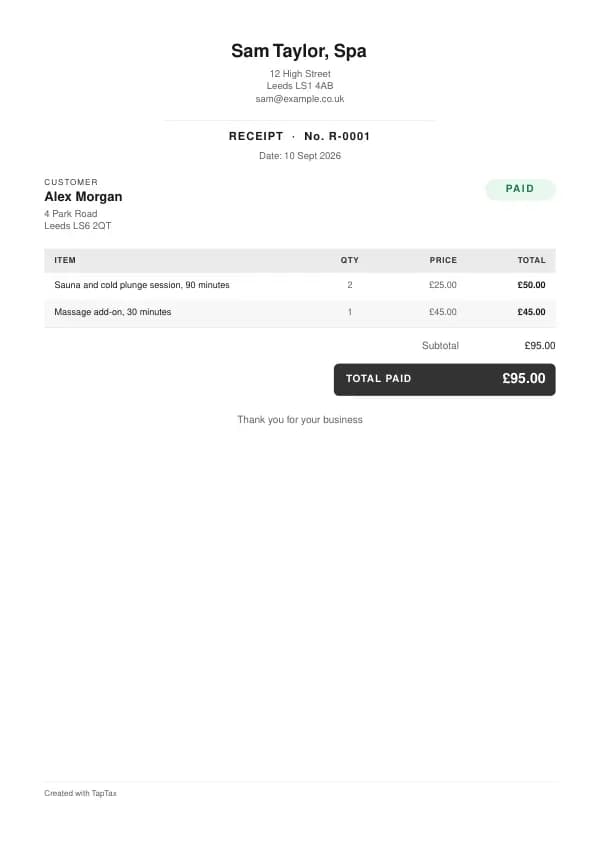
Download the spa receipt template
Free, with no sign-up. Replace the words in square brackets with your own details; the example lines are ready to keep or change.
Opens the free receipt generator with these lines in place. Make a PDF in your own colours, with your logo. Nothing is stored.
Small sauna and spa operators take payments for sessions, day passes, treatments, memberships and gift vouchers, often online in advance. A receipt, not an invoice, is the right document here: the customer pays on the spot, and the receipt confirms it. This free template sets one out properly, with example lines you can keep or replace.
What goes on a spa receipt
List the session or pass, the date and number of guests, treatments added, and memberships or vouchers used.
| Line | Quantity | Price | Amount |
|---|---|---|---|
| Sauna and cold plunge session, 90 minutes | 2 | £25.00 | £50.00 |
| Massage add-on, 30 minutes | 1 | £45.00 | £45.00 |
| Subtotal | £95.00 | ||
| Total paid | £95.00 |
Line by line: Sauna and cold plunge session, 90 minutes, 2 × £25.00 = £50.00; Massage add-on, 30 minutes, 1 × £45.00 = £45.00. The subtotal is £95.00. The example assumes you are not VAT registered, so there is no VAT and the total paid is £95.00. The figures are illustrative, not a price guide, so use your own rates.
A good receipt shows your business name and address, a receipt number, the date of payment, what was bought or done, the amount paid and how it was paid. If you are VAT registered, it also shows your VAT number and the VAT. That is all a customer needs to prove the payment, and all you need to match it to your records. The guide to invoices and receipts explains when each is the right document.
Number receipts in one sequence, such as R-0001, R-0002, and never reuse a number. A numbered receipt can be found again when a customer asks for a copy, and an unbroken sequence shows that every sale is in your records. Card readers and booking apps often number receipts for you; if you also write receipts by hand, keep a separate sequence for those.
How sauna and spa operators price their work
Per session or day pass, with memberships, group bookings and treatment add-ons.
Your receipt should reflect the price list the customer saw, line by line, so there is never a question about how the total was reached. The profit margin calculator and markup calculator help set prices that cover your costs.
Agree this before you start
Set out booking, cancellation and health rules, and membership terms, before people pay.
When to give a receipt
At booking for online sales; at the visit for walk-ins.
Give the receipt at the moment of payment, printed, emailed or sent by text from your card reader. If a business customer needs to pay later rather than on the spot, send an invoice instead with the free invoice generator.
VAT on spa receipts
Sauna and spa access is standard-rated for a VAT-registered operator, as are treatments; gift vouchers for your own services are taxed when sold.
Hair and beauty treatments and retail products are standard-rated at 20% once you are VAT registered, and cosmetic treatments do not qualify for the medical exemption. A gift voucher for your own treatments is usually a single-purpose voucher, with the VAT due when you sell it rather than when it is redeemed. Below £90,000 of turnover you do not register, and your receipts show no VAT.
Registration is compulsory when taxable turnover over any rolling 12 months passes £90,000, or when you expect to pass it in the next 30 days alone. The VAT registration checker keeps count, and the VAT calculator works out the VAT inside a price.
Who pays sauna and spa operators, and how
Clients pay at the end of the appointment, so a receipt, not an invoice, is the document you issue. Many use a card terminal or booking app that sends an automatic receipt; that is fine as long as it shows your business name, the date, the treatment and the amount. If you rent a chair in someone else's salon, the receipt should carry your name, not the salon's.
In London, saunas and massage are special treatments that may need a borough licence; elsewhere, check your council's rules.
Consent, patch tests and client records
Treatments that touch the skin, eyes or hair come with a duty of care, and your records are how you show you met it. Keep a consultation form for each client with the date, relevant medical questions and their answers, and the date and result of any patch test. Record the products and colours used, which also makes the next appointment easier. These records are separate from your receipts and should never appear on them, but both should be kept together for each client, digitally if you can. Insurers for beauty professionals often require exactly these records before they will cover a claim, so the habit protects your business as well as your clients.
When a customer asks for an invoice
Sometimes a customer, usually one buying for their business, asks for an invoice rather than a receipt. If they have already paid, a receipt is the right document; if they are paying later, for example a salon booking a party or a company ordering on account, send an invoice with a due date and your bank details, then a receipt, or a PAID invoice, once the money arrives. The free invoice generator makes either in a minute, and invoice vs receipt explains the difference in detail.
Deposits and cancellations
Online bookings are paid in advance.
Booking deposits for long appointments are common and reduce no-shows. Put your deposit and cancellation policy in your booking confirmation, and show the deposit on the final receipt so the client sees what is left to pay.
Taking payment
Online in advance or card on arrival.
Whatever the payment method, the amount on the receipt must match the money you actually received. Card payments arrive in your bank as batches, net of fees, so keep the card reader's own report alongside your receipts. The fees are an allowable expense; the sale is income at the full price.
Receipts for business customers
Some customers buy for their business and need your receipt as evidence for their own expenses. For them, the receipt must show your business name and address, the date, what was supplied and the amount, and, if you are VAT registered, your VAT number and the VAT, so they can reclaim it. A VAT-registered business may give a simplified VAT invoice for sales of £250 or less including VAT; above that, a business customer who asks is entitled to a full VAT invoice, which the invoice generator can make.
Refunds and gift vouchers
When you give a refund, record it with its own receipt or a note against the original, showing the date, the amount and why. The refund reduces your income; it does not erase the original sale. Gift vouchers need care too: a voucher that can only be used for your own services is a single-purpose voucher, and if you are VAT registered the VAT is due when you sell the voucher, not when it is redeemed. Keep a list of vouchers sold and used, and show the voucher on the receipt when a client pays with one.
Paper or digital receipts
Paper or digital, both are valid. Card readers and booking apps can email or text a receipt, which saves paper and gives you a searchable record, but check the wording they use: the receipt should carry your business name, not the app's, and the service you provided, not a generic "payment". For larger or unusual sales, a proper receipt from this template is clearer. Under Making Tax Digital, your records must be digital, so a system that keeps each sale automatically saves you typing later.
Common spa receipt mistakes
- Online booking income unreconciled. Match booking platform payouts to bookings, net of fees.
- Memberships without terms. State renewal and cancellation terms.
- Vouchers untracked. Record every voucher sold and redeemed.
- Showing VAT when you are not VAT registered. Only a registered business can charge VAT. If you are not registered, the receipt shows the price with no VAT.
- Throwing away your copies. Your receipt copies are the evidence for your income if HMRC asks.
Checklist before you hand it over
Run through this before every receipt goes out. Each point is a reason receipts get queried:
- The receipt number is the next in your sequence.
- Your business name and address are on it, and your VAT number if you are registered.
- The date is the date the customer paid.
- Each item or treatment is listed with its price, and any deposit or voucher is shown as already paid.
- The total matches the money you actually took, and the payment method is noted.
- A copy is saved with your records.
Keep a copy of every receipt
You must keep your records for at least 5 years after the 31 January submission deadline of the relevant tax year.
Every receipt you issue is a record of income. Keep a copy of each one, digital is fine, along with the payments that settle them. From 6 April 2026, sole traders with qualifying income over £50,000 must keep digital records and send HMRC quarterly updates under Making Tax Digital, with the threshold falling to £30,000 from April 2027 and £20,000 from April 2028. The MTD requirement checker tells you when it applies to you, and how long to keep invoices covers the retention rules.
Income thresholds that change your paperwork
- Trading allowance£1,000
- MTD from April 2028£20,000
- MTD from April 2027£30,000
- MTD from April 2026£50,000
- VAT registration£90,000
Download the spa receipt template
The template comes in four forms. The Word version opens in Microsoft Word, Google Docs and Pages: replace the words in square brackets and save. The Excel version opens in Excel, Google Sheets and Numbers, and works as a calculator, so each line, the subtotal and the total update as you type. The PDF is ready to print. Or skip the download and fill it in online with the free receipt generator, which opens with these spa lines already in place and makes a PDF in your own colours, with your logo.
When a template stops being enough, a TapTax account, free to start, creates and sends your invoices, tracks which are paid, and files your quarterly updates to HMRC from the same records. Our guide for sauna and spa operators covers the tax side: expenses, National Insurance and Making Tax Digital.
Tools for this
Related guides and definitions
Frequently asked questions
What should a spa receipt include?
Your business name and address, a unique receipt number, the date, the customer's name, each item or treatment with its price, the total, and your VAT number and the VAT if you are VAT registered.
Do sauna and spa operators charge VAT?
Only if VAT registered, above £90,000 of turnover.
When should a spa send a receipt?
At booking online, or at the visit for walk-ins.
Is this spa receipt template free?
Yes. Download it in Word, Excel or PDF, or fill it in online with the free receipt generator. There is no sign-up, and nothing you type is stored.
Invoice, get paid, stay ready for HMRC.
TapTax creates and sends your invoices, tracks which ones are paid and files your quarterly updates to HMRC. Start on the free plan, no card needed.
Get started freeSources
The rules on this page come from official guidance.