
Tiler
invoice template
Wall and floor tiling by area or job, with preparation, adhesives and grout itemised.
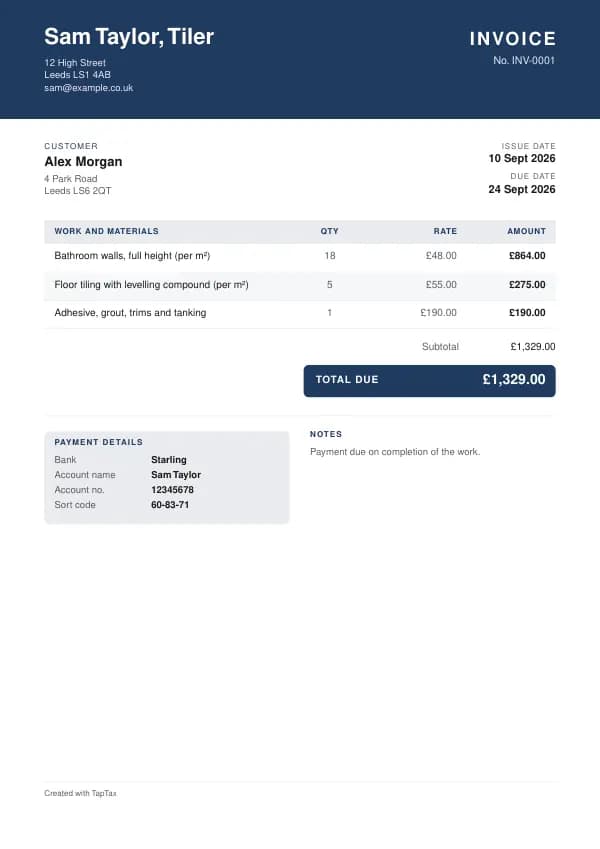
Download the tiler invoice template
Free, with no sign-up. Replace the words in square brackets with your own details; the example lines are ready to keep or change.
Opens the free invoice generator with these lines in place. Make a PDF in your own colours, with your logo. Nothing is stored.
Tilers invoice for bathrooms, kitchens and floors, usually priced by the area tiled plus the preparation the surface needed. This free template sets out a tiler invoice the way customers expect to see it, with example lines you can keep or replace.
What goes on a tiler invoice
Give each area and the work: tile walls to full height, floor tiling with levelling, splashback. Show the square metres, the preparation (tanking, boarding, levelling compound), the adhesive and grout, and say whether the customer supplied the tiles.
| Line | Quantity | Price | Amount |
|---|---|---|---|
| Bathroom walls, full height (per m²) | 18 | £48.00 | £864.00 |
| Floor tiling with levelling compound (per m²) | 5 | £55.00 | £275.00 |
| Adhesive, grout, trims and tanking | 1 | £190.00 | £190.00 |
| Subtotal | £1,329.00 | ||
| Total due | £1,329.00 |
Line by line: Bathroom walls, full height (per m²), 18 × £48.00 = £864.00; Floor tiling with levelling compound (per m²), 5 × £55.00 = £275.00; Adhesive, grout, trims and tanking, 1 × £190.00 = £190.00. The subtotal is £1,329.00. The example assumes you are not VAT registered, so there is no VAT and the total due is £1,329.00. The figures are illustrative, not a price guide, so use your own rates.
Whatever the job, a UK invoice must carry the basics GOV.UK lists: a unique invoice number, your name or business name and an address, your customer's name and address, a clear description of what you are charging for, the date the work was done and the date of the invoice, the amounts, any VAT, and the total owed. The template has a place for each, and the guide to what a UK invoice must include explains the rules behind them.
Number invoices in one unbroken sequence, such as INV-0001, INV-0002 and so on, and never reuse a number, even for a cancelled invoice. The invoice number generator suggests a format and works out your next number.
How tilers price their work
Tiling is usually priced per square metre, with larger or natural stone tiles at a higher rate, and a minimum charge for small areas. Preparation and removal of old tiles are extras.
Whatever the model, write it on the invoice as the customer agreed it: the unit (hour, day, job, item), the quantity and the rate on each line. A customer who can see how a total was built pays faster than one who has to ask. If you are working out what to charge in the first place, the day rate calculator works back from the income you want, and the markup calculator shows what you keep on anything you buy in.
Agree this before you start
Agree the areas and square metres, who supplies the tiles and how many spares, the layout and pattern, trims and edging, removal of old tiles, and what preparation is included. Large-format and natural stone tiles need specific adhesives; agree who pays for them.
When to send a tiler invoice
Invoice on completion, after grouting and a check with the customer, or in two parts on large jobs.
The sooner an invoice goes out, the sooner it is paid: the payment clock starts when the customer receives it. Send it by email as a PDF on the day the work is finished, and the guide to sending an invoice covers what to put in the email.
VAT on tiler invoices
Tiling in existing homes is standard-rated; tiling during the construction of a new dwelling is zero-rated.
Most repair, maintenance and improvement work on existing buildings is standard-rated at 20% once you are VAT registered. The exceptions that matter to tilers are construction work on a brand new home, which is zero-rated, the renovation of a home that has been empty for two years or more, which is charged at 5%, and certain energy-saving materials installed in homes, which are zero-rated until 31 March 2027. VAT Notice 708 sets out each case, and the rate belongs on the invoice line it applies to.
You must register for VAT when your taxable turnover over any rolling 12 months goes above £90,000, or you expect it to in the next 30 days alone. The VAT registration checker tracks where you are, and invoicing without a VAT number explains what an unregistered invoice looks like.
CIS: when a contractor pays you
The Construction Industry Scheme applies when you work for a contractor, such as a main builder or developer, rather than directly for a homeowner. The contractor deducts 20% from the labour part of each payment if you are registered for CIS, 30% if you are not, and nothing if you hold gross payment status, and pays it to HMRC as an advance on your tax. Materials you supplied are not deducted, so show labour and materials as separate lines. Each month the contractor gives you a payment and deduction statement; keep them all, because they are how you claim the deductions back against your tax bill.
Tiling is a construction operation, so CIS applies to work for contractors and developers.
The CIS calculator shows what you receive after the deduction, and CIS invoice requirements sets out the invoice layout contractors expect.
The domestic reverse charge
If you and the contractor are both VAT registered and the work falls under CIS, the VAT domestic reverse charge usually applies: you do not charge VAT, and the contractor accounts for it to HMRC instead. The invoice must still show the VAT rate and amount and carry wording such as "Reverse charge: customer to account to HMRC for the VAT". It does not apply to work for the end user, such as a homeowner or a business having its own premises improved. The reverse charge checker walks through each condition, and reverse charge invoice wording gives the exact text.
Working for homeowners
Much of the work tilers do is for households, and a homeowner is a consumer, not a business. If you agree the job in the customer's home or at a distance (by phone, email or online), the Consumer Contracts Regulations usually give them 14 days to cancel. If they ask you to start within that time, they pay for the work done up to a cancellation, so note the request on your quote and on the invoice.
Deposits, stages and cancellations
A deposit for materials is reasonable when you supply the tiles.
Larger jobs are commonly split into a deposit to secure the booking and pay for materials, stage payments as the work reaches agreed points, and a final balance on completion. On commercial contracts the customer may hold back a retention, often 3% to 5%, until a defects period ends; put the retention and its release date on the invoice so it is not forgotten.
Payment terms for tilers
Payment is normally due on completion for domestic work.
If you agree no terms with a business customer, the law sets payment at 30 days after they receive the invoice or the work, whichever is later. Agreed terms between businesses can run to 60 days, or longer only where that is fair to both sides. When a business pays late, the Late Payment of Commercial Debts (Interest) Act 1998 lets you claim interest at 8% a year above the Bank of England base rate plus fixed compensation, which the late payment interest calculator works out. These rights do not apply to invoices sent to private individuals, so for household customers your own terms matter even more.
Fixed compensation for a late business payment
- Debt up to £999.99£40
- £1,000 to £9,999.99£70
- £10,000 or more£100
Getting paid faster
Three details decide how quickly most invoices are paid. First, your bank details on the invoice itself: account name, sort code and account number, with the invoice number as the payment reference so you can match the money when it lands. Second, a clear due date rather than "payment on receipt", which customers read as "whenever". Third, a polite reminder the day after the due date, then again at 7 and 14 days. A card payment link on the invoice helps with household customers, who are more likely to pay straight away if it takes one tap. The 30-day payment terms guide and invoice payment terms explain which terms to choose.
If a customer disputes the invoice
Most disputes are about scope: the customer thought something was included that you did not. Respond in writing, point to what was agreed, and separate the part in dispute from the rest, which should be paid on time. If only part of an invoice is questioned, a credit note for that part lets the undisputed amount be settled now. If a business customer still will not pay, a formal letter before action usually does it; after that, in England and Wales, the small claims track of the county court handles claims up to £10,000. The guides to invoice disputes and small claims for an unpaid invoice walk through each step.
Common tiler invoicing mistakes
- Not measuring the areas on the invoice. Square metres make a tiling price transparent.
- Ignoring customer-supplied tile shortages. Agree who pays for a second visit when tiles run out.
- Leaving preparation off the quote. Levelling and tanking can double the time; price them up front.
- Showing VAT when you are not VAT registered. You can only charge VAT with a VAT number, and adding it anyway is an offence. If you are not registered, your invoice shows a total with no VAT line.
- Editing an invoice after sending it. Correct a mistake with a credit note and a new invoice, so your records and your customer's match. The guide to correcting an invoice shows how.
Checklist before you send it
Run through this before every invoice goes out. Each point is a reason invoices get paid late:
- The invoice number is the next in your sequence and has never been used.
- The customer's name and address are right, with their purchase order or reference if they use one.
- Each line shows what was done, the quantity, the unit and the rate.
- The subtotal and total add up, and VAT appears only if you are VAT registered.
- The invoice date, a due date and your bank details are on it.
- A copy is saved with your records before you press send.
Keep a copy of every invoice
You must keep your records for at least 5 years after the 31 January submission deadline of the relevant tax year.
Every invoice you issue is a record of income. Keep a copy of each one, digital is fine, along with the payments that settle them. From 6 April 2026, sole traders with qualifying income over £50,000 must keep digital records and send HMRC quarterly updates under Making Tax Digital, with the threshold falling to £30,000 from April 2027 and £20,000 from April 2028. The MTD requirement checker tells you when it applies to you, and how long to keep invoices covers the retention rules.
Download the tiler invoice template
The template comes in four forms. The Word version opens in Microsoft Word, Google Docs and Pages: replace the words in square brackets and save. The Excel version opens in Excel, Google Sheets and Numbers, and works as a calculator, so each line, the subtotal, the VAT and the total update as you type. The PDF is ready to print. Or skip the download and fill it in online with the free invoice generator, which opens with these tiler lines already in place and makes a PDF in your own colours, with your logo.
When a template stops being enough, a TapTax account, free to start, creates and sends your invoices, tracks which are paid, and files your quarterly updates to HMRC from the same records. Our guide for tilers covers the tax side: expenses, National Insurance and Making Tax Digital.
Tools for this
Related guides and definitions
Frequently asked questions
What should a tiler invoice include?
Your business name and address, a unique invoice number, the date, the customer's name, each piece of work with its price, the total, and your VAT number and the VAT if you are VAT registered.
Do tilers charge VAT?
Only once registered, above £90,000 of turnover; tiling existing homes is then 20%.
Does CIS apply to tilers?
Yes, when a contractor pays you: they deduct 20% from labour if you are registered. Homeowners do not.
When should a tiler send an invoice?
On completion once the tiles are grouted and checked, or in two stages on large jobs.
Is this tiler invoice template free?
Yes. Download it in Word, Excel or PDF, or fill it in online with the free invoice generator. There is no sign-up, and nothing you type is stored.
Invoice, get paid, stay ready for HMRC.
TapTax creates and sends your invoices, tracks which ones are paid and files your quarterly updates to HMRC. Start on the free plan, no card needed.
Get started freeSources
The rules on this page come from official guidance.