
Statement of account
template
A statement listing a customer's invoices, payments and credits, with the balance and how overdue it is.
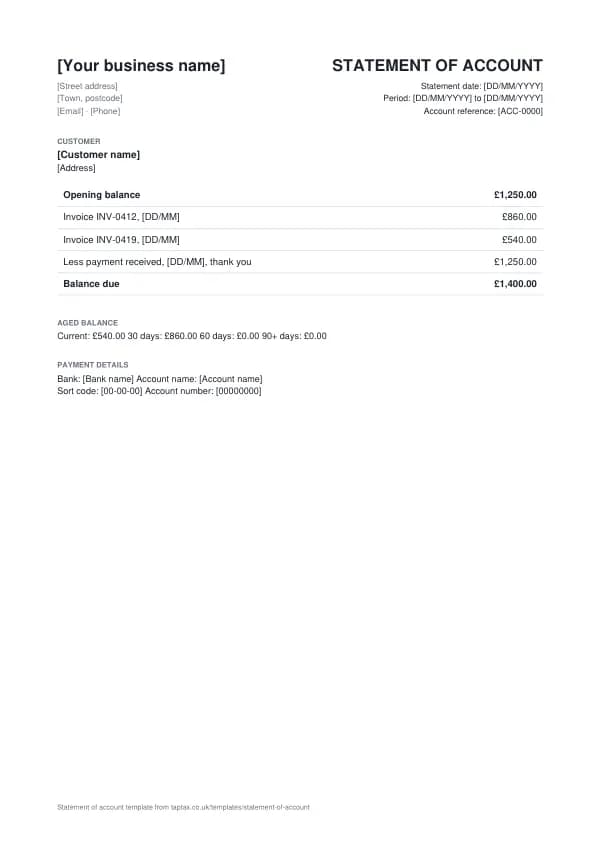
Download the statement of account template
Free, with no sign-up. Replace the words in square brackets with your own details.
Customers with several invoices lose track of what they owe, and so do suppliers. A statement of account puts everything on one page: the opening balance, each invoice and payment, the closing balance, and which amounts are overdue. Sent monthly, it prompts payment without a chasing letter, and catches missing payments and misallocations early. This template follows that standard layout.
- Statement of account
- A summary sent by a supplier to a customer showing every invoice, payment and credit note on their account over a period, and the balance outstanding at the end, often split by how long each amount has been owed.
When to use a statement of account
Send a statement of account monthly to any customer who buys on credit and has more than one invoice a month: trade customers, contractors, retailers you supply, and regular clients. Send one on request too, for example when a customer's auditors ask them to confirm balances. If a single invoice is overdue, a payment reminder letter is more direct; if several are, a statement shows the full picture.
What a statement of account must show
| What it shows | Why it matters |
|---|---|
| The words "Statement of account", the statement date and period | Identifies the statement |
| Your details and the customer's, with their account reference | Who is owed and who owes |
| The opening balance | Where the period started |
| Each invoice, credit note and payment, with date, number and amount | The transactions in the period |
| The closing balance | What is owed now |
| An aged breakdown: current, 30, 60 and 90+ days | Shows what is overdue |
| Payment details and a contact for queries | Makes it easy to pay or resolve differences |
An example statement of account
The template comes filled in with example lines like these, so you can see how each part works before replacing them with your own.
| Line | Amount |
|---|---|
| Opening balance | £1,250.00 |
| Invoice INV-0412, [DD/MM] | £860.00 |
| Invoice INV-0419, [DD/MM] | £540.00 |
| Less payment received, [DD/MM], thank you | £1,250.00 |
| Balance due | £1,400.00 |
How to fill in the template
- Start from the closing balance on the last statement.
- List every invoice, credit note and payment in the period, in date order.
- Work out the closing balance.
- Split the balance by age: current, 30, 60 and 90+ days.
- Add your payment details and a contact for queries.
- Send it on the same day each month.
Number every statement of account in sequence and never reuse a number, even when a document is cancelled. Numbers make documents easy to find and to match against payments, and they show HMRC and your customers that nothing is missing. For a numbering format, try the invoice number generator.
Using statements to get paid
A statement is not a demand, but it is one of the most effective ways to get paid. Customers' accounts teams often pay from statements, especially where they have missed an invoice. Send statements on a fixed day, early in the month, and highlight overdue amounts. If a business customer pays late, you can claim statutory interest at 8% above the Bank of England base rate and fixed compensation of £40, £70 or £100 per invoice under the late payment legislation. Showing that on the statement, even as a note, often speeds things up.
Fixed compensation for a late business payment
- Debt up to £999.99£40
- £1,000 to £9,999.99£70
- £10,000 or more£100
Statement of account or invoice?
An invoice charges for a specific sale. A statement summarises invoices already sent, with payments and credits, and charges nothing new. Never include a new charge on a statement without an invoice behind it.
Aged debt analysis
Splitting the balance by age tells both sides where the problem is. "Current" means not yet due; "30 days" means invoices between one and 30 days overdue, and so on, or by invoice date, depending on your convention. Use one convention consistently, and state it. Anything in the 60- and 90-day columns deserves a phone call, not just a statement. Reviewing your own aged debt report monthly shows which customers are slowing down before it becomes a problem.
Resolving differences
When a customer's records disagree with your statement, the cause is usually a missing invoice, a payment allocated to the wrong invoice, or a credit note one side has not recorded. Ask the customer to send their statement of your account, or a list of what they think is open, and compare line by line. Resolve each difference in writing, and issue credit notes or corrected allocations as needed, so next month's statement agrees.
Balance confirmations
Auditors and lenders sometimes ask customers to confirm balances with suppliers, and a statement is the standard evidence. Respond promptly to confirmation requests, using the statement as at the date requested. If you are asking customers to confirm balances, send a statement with a short request to reply confirming or listing differences.
Statements and credit control
Statements are one part of a simple credit control routine: invoice promptly, send a reminder a few days before the due date, send a statement monthly, phone about anything over 30 days overdue, then send a final demand and, if needed, a letter before action. A predictable routine gets paid faster than occasional, urgent chasing.
Worked example
A wholesaler's customer starts the month owing £1,250, which it pays on the 10th. During the month the wholesaler issues INV-0412 for £860, due on the 5th of the following month but now overdue, and INV-0419 for £540, not yet due. The statement shows the opening balance, the two invoices, the payment and a closing balance of £1,400, split into £540 current and £860 in the 30-day column. The customer's accounts team spots that INV-0412 was never entered in their system, and pays it within a week.
Statements for consumers
If you supply consumers on credit, such as regular tutoring or gardening billed monthly, a short statement each month keeps things clear. Keep it simple: the invoices, payments and balance. Statutory late payment interest does not apply to consumers, so any interest must be in your agreed terms and be fair. A friendly statement with a payment link is usually enough.
Automating statements
Most invoicing and accounting software can produce statements for every customer with a balance in one run, and email them on a set day. Check the run before it goes: a statement showing a payment not yet allocated, or an invoice that was cancelled, causes confusion. Send statements from an address customers can reply to, and include a named contact. If a customer has a nil balance, there is no need to send one, unless they ask for a statement for their own records or auditors.
Interest shown on statements
If you are claiming statutory interest and compensation from a business customer, you can show them on the statement as separate lines, with the invoice they relate to and the dates. Show them as a claim, not as part of the invoice total, and send a separate letter setting out the calculation. Keep the underlying invoices unchanged, so the statement stays reconcilable with your sales records.
Common statement of account mistakes
- Adding new charges on a statement. Every charge needs an invoice first.
- Irregular timing. Send statements on the same day each month so customers expect them.
- Ignoring differences. Resolve them in writing, or they will return every month.
Checklist before you send it
A quick check of every statement of account before you send it:
- The words "Statement of account", the statement date and period is on it and correct.
- Your details and the customer's, with their account reference is on it and correct.
- The opening balance is on it and correct.
- Each invoice, credit note and payment, with date, number and amount is on it and correct.
- The closing balance is on it and correct.
- An aged breakdown: current, 30, 60 and 90+ days is on it and correct.
- Payment details and a contact for queries is on it and correct.
- A copy is saved with your records.
Sending it
Email the statement of account as a PDF with a short, specific message: the document number, the amount, and what you need the reader to do. Address it to whoever processes it, often an accounts team, and copy your usual contact if that helps. File the sent PDF with its number in the file name, so you can find it in seconds if there is ever a question.
Keep a copy
You must keep your records for at least 5 years after the 31 January submission deadline of the relevant tax year.
Business documents are records, and records have to be kept. Save every statement of account in one place, ideally digitally, so you can find it if a customer or HMRC asks. Making Tax Digital for Income Tax makes digital records compulsory from 6 April 2026 for qualifying income over £50,000, from April 2027 over £30,000 and from April 2028 over £20,000; check your date with the MTD requirement checker.
Download the statement of account template
Download it as a Word document, an Excel workbook or a PDF, whichever suits the way you work. The Word file opens in Google Docs too, and the Excel file in Google Sheets.
Related documents in the same family: the remittance advice template. All of them follow the same numbering and record-keeping rules, and each page explains what that document must show.
If you would rather not manage documents by hand, a TapTax account, free to start, keeps your invoices, receipts and bank transactions together and files your Making Tax Digital quarterly updates to HMRC.
Tools for this
Related guides and definitions
Frequently asked questions
What is a statement of account?
A summary of a customer's invoices, payments and credits over a period, with the balance owed.
How often should I send a statement?
Monthly, on a fixed day, to customers who buy on credit.
Is a statement of account a demand for payment?
Not in itself, but it shows what is owed and overdue, and often prompts payment.
Invoice, get paid, stay ready for HMRC.
TapTax creates and sends your invoices, tracks which ones are paid and files your quarterly updates to HMRC. Start on the free plan, no card needed.
Get started freeSources
The rules on this page come from official guidance.