
Remittance advice
template
A remittance advice listing the invoices a payment covers, with any deductions, so the supplier can match it first time.
Download the remittance advice template
Free, with no sign-up. Replace the words in square brackets with your own details.
A single bank transfer often pays several invoices, less a credit note or a deduction. Without a remittance advice, the supplier has to guess which invoices are settled, and their records drift out of line with yours. A remittance advice tells them exactly what the payment covers. This template lists each invoice, any deductions, and the total paid, in the format accounts teams use.
- Remittance advice
- A note sent by a customer to a supplier when making a payment, listing the invoices being paid, any credit notes or deductions applied, the amount, the date and the payment reference.
When to use a remittance advice
Send a remittance advice whenever you pay a supplier an amount that covers more than one invoice, or that differs from an invoice total: a CIS deduction, a credit note set off, a disputed line held back, or an early payment discount taken. Send it by email on the day of payment. Suppliers can ask for them too: if a customer regularly pays lump sums, ask them to send a remittance advice with each payment so you can allocate it correctly.
What a remittance advice must show
| What it shows | Why it matters |
|---|---|
| The words "Remittance advice", and the date of payment | Identifies the payment |
| Your name as the payer, and the supplier's name | Who paid whom |
| Each invoice being paid, with its number, date and amount | Lets the supplier allocate the payment |
| Any credit notes applied or deductions made, with the reason | Explains any difference |
| The total paid | Must match the bank payment |
| The payment method and reference | So the supplier can find it on their statement |
| A contact for queries | Speeds up any questions |
An example remittance advice
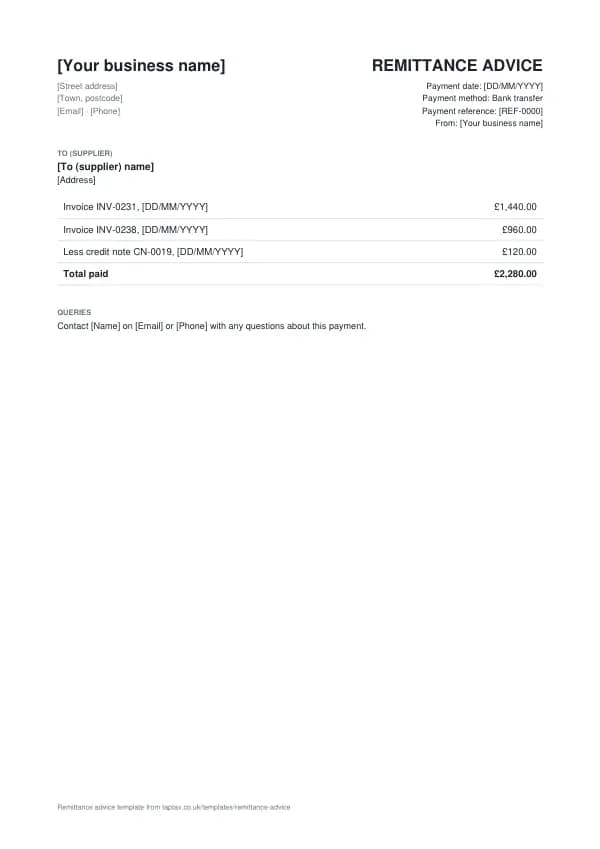
The template comes filled in with example lines like these, so you can see how each part works before replacing them with your own.
| Line | Amount |
|---|---|
| Invoice INV-0231, [DD/MM/YYYY] | £1,440.00 |
| Invoice INV-0238, [DD/MM/YYYY] | £960.00 |
| Less credit note CN-0019, [DD/MM/YYYY] | £120.00 |
| Total paid | £2,280.00 |
How to fill in the template
- List each invoice you are paying, with its number, date and amount.
- Add any credit notes applied or deductions made, with a reason.
- Check the total matches the amount you are sending.
- Add the payment date, method and the reference you used.
- Email it to the supplier's accounts address on the day of payment.
- Keep a copy with the invoices you paid.
Number every remittance advice in sequence and never reuse a number, even when a document is cancelled. Numbers make documents easy to find and to match against payments, and they show HMRC and your customers that nothing is missing. For a numbering format, try the invoice number generator.
Deductions and holdbacks
When you pay less than an invoice total, the remittance advice is where you say why. Common reasons are a credit note already issued, a CIS deduction for construction work, an early payment discount taken under the invoice terms, or a disputed item held back pending resolution. Deducting an amount without explanation, or without a basis in the contract, is one of the quickest ways to damage a supplier relationship and can leave you owing statutory interest. If you are withholding because of a dispute, say which line, why, and that the rest is being paid, and raise the dispute separately in writing.
Fixed compensation for a late business payment
- Debt up to £999.99£40
- £1,000 to £9,999.99£70
- £10,000 or more£100
Remittance advice or receipt?
A remittance advice is sent by the payer to say what a payment covers. A receipt is sent by the supplier to confirm the payment arrived. The two often cross in the post: the remittance says "we have paid these invoices" and the receipt says "we have received it".
Invoice redirection fraud
Criminals intercept emails or impersonate suppliers to tell customers that bank details have changed, so the next payment goes to them. Before paying to new or changed bank details, always confirm them by phone using a number you already hold, not one from the email. A remittance advice sent after payment will not stop fraud, but it does tell a genuine supplier quickly what you paid and where, which can reveal a problem while the money may still be recoverable. Treat any urgent request to change payment details with suspicion.
Remittances with CIS deductions
Contractors paying subcontractors under the Construction Industry Scheme deduct tax from the labour part of each payment. The remittance advice should show the invoice total, the CIS deduction and the net paid, and the contractor must also give the subcontractor a CIS payment and deduction statement for each tax month. The remittance helps the subcontractor match the payment; the statement is what they use for their tax return.
Allocating payments as a supplier
When a customer's payment arrives, use the remittance advice to mark the right invoices as paid in your records. If the payment does not match, ask the customer before allocating, because paying the oldest invoice first is not always what they intended, and misallocation leads to confused statements. For customers who never send remittances, ask them to include invoice numbers in the payment reference, or send a statement of account regularly so differences are spotted quickly.
Automated remittances
Many accounting and banking systems send remittance advices automatically when a payment run is made, by email from a no-reply address. If you receive one, check that it matches the money in your account before relying on it, because fake remittance emails are sometimes used to persuade suppliers to release goods. If you send them automatically, make sure they come from an address your suppliers recognise and can reply to.
Worked example
A shop owes a wholesaler £1,440 on INV-0231 and £960 on INV-0238, and holds a £120 credit note, CN-0019, for damaged stock. They pay £2,280 by bank transfer with reference REF-0415 and email a remittance advice listing the two invoices, the credit note deducted, and the total. The wholesaler matches the payment to both invoices and the credit note in one step, and the shop's account shows a nil balance on their next statement, with no phone calls needed.
Keeping remittance records
Keep your remittance advices with the invoices and payment records they relate to. For the payer, they show exactly which liabilities each payment cleared; for the supplier, they support the allocation of income. Both are part of your business records, which should be kept for at least five years after the 31 January submission deadline of the relevant tax year.
Remittances for sole traders paying suppliers
Even a one-person business pays suppliers: wholesalers, subcontractors, software providers and landlords. Sending a short remittance advice when you pay several invoices at once takes a minute and saves the phone calls that follow a lump-sum payment nobody can match. Many banking apps let you add a reference of up to 18 characters, which is enough for one invoice number but not several, so the remittance email carries the detail. Keep your copy with the invoices as your record of what was settled.
Common remittance advice mistakes
- Deducting without explanation. Say which invoice, how much and why, or expect a call from the supplier.
- A total that does not match the payment. Check the remittance against the bank transfer before sending.
- Paying new bank details without checking. Confirm changes by phone on a number you already hold.
Checklist before you send it
A quick check of every remittance advice before you send it:
- The words "Remittance advice", and the date of payment is on it and correct.
- Your name as the payer, and the supplier's name is on it and correct.
- Each invoice being paid, with its number, date and amount is on it and correct.
- Any credit notes applied or deductions made, with the reason is on it and correct.
- The total paid is on it and correct.
- The payment method and reference is on it and correct.
- A contact for queries is on it and correct.
- A copy is saved with your records.
Sending it
Email the remittance advice as a PDF with a short, specific message: the document number, the amount, and what you need the reader to do. Address it to whoever processes it, often an accounts team, and copy your usual contact if that helps. File the sent PDF with its number in the file name, so you can find it in seconds if there is ever a question.
Keep a copy
You must keep your records for at least 5 years after the 31 January submission deadline of the relevant tax year.
Business documents are records, and records have to be kept. Save every remittance advice in one place, ideally digitally, so you can find it if a customer or HMRC asks. Making Tax Digital for Income Tax makes digital records compulsory from 6 April 2026 for qualifying income over £50,000, from April 2027 over £30,000 and from April 2028 over £20,000; check your date with the MTD requirement checker.
Download the remittance advice template
Download it as a Word document, an Excel workbook or a PDF, whichever suits the way you work. The Word file opens in Google Docs too, and the Excel file in Google Sheets.
Related documents in the same family: the statement of account template. All of them follow the same numbering and record-keeping rules, and each page explains what that document must show.
If you would rather not manage documents by hand, a TapTax account, free to start, keeps your invoices, receipts and bank transactions together and files your Making Tax Digital quarterly updates to HMRC.
Tools for this
Related guides and definitions
Frequently asked questions
What is a remittance advice?
A note from a customer to a supplier listing the invoices a payment covers, any deductions, and the total paid.
Is a remittance advice required?
No, but it makes allocating payments much easier, especially where one payment covers several invoices or includes deductions.
What is the difference between a remittance advice and a receipt?
The payer sends a remittance advice; the supplier sends a receipt confirming payment arrived.
Invoice, get paid, stay ready for HMRC.
TapTax creates and sends your invoices, tracks which ones are paid and files your quarterly updates to HMRC. Start on the free plan, no card needed.
Get started freeSources
The rules on this page come from official guidance.