
CIS payment and deduction statement
template
The monthly statement a contractor must give each subcontractor after making a CIS deduction.
Download the CIS payment and deduction statement template
Free, with no sign-up. Replace the words in square brackets with your own details.
If you pay subcontractors under the Construction Industry Scheme and make deductions, you must give each subcontractor a payment and deduction statement within 14 days of the end of each tax month. It is the subcontractor's proof of the tax taken, which they claim against their own tax bill. This template sets out every figure the statement should show, in the order HMRC's guidance lists them.
- CIS payment and deduction statement
- A written statement a contractor gives a subcontractor for each tax month in which a CIS deduction was made, showing the payment, the materials, the amount liable to deduction and the tax deducted.
When to use a CIS payment and deduction statement
Use this template when you are a contractor under CIS, including a builder who takes on subcontractors, and you have made a deduction from a payment to a subcontractor. The tax month runs from the 6th of one month to the 5th of the next, so a statement for the month ending 5 June must reach the subcontractor by 19 June. One statement can cover all payments to that subcontractor in the month. You do not need to give a statement to subcontractors paid gross, although many contractors send one anyway as a record. Many sole traders who hire other trades are contractors for CIS without realising it, so check before paying a subcontractor.
What a CIS payment and deduction statement must show
| What it shows | Why it matters |
|---|---|
| Your name and employer's reference (the CIS reference) | Identifies the contractor to HMRC |
| The tax month the statement covers (ending on the 5th) | Matches your monthly return |
| The subcontractor's name and UTR | Links the deduction to their tax record |
| The verification number, if you deducted at the higher 30% rate | Shows HMRC could not match the subcontractor |
| The gross amount paid, excluding VAT | The starting figure |
| The cost of materials | Not subject to the deduction |
| The amount liable to deduction and the amount deducted | The tax taken, which the subcontractor claims back |
An example CIS payment and deduction statement
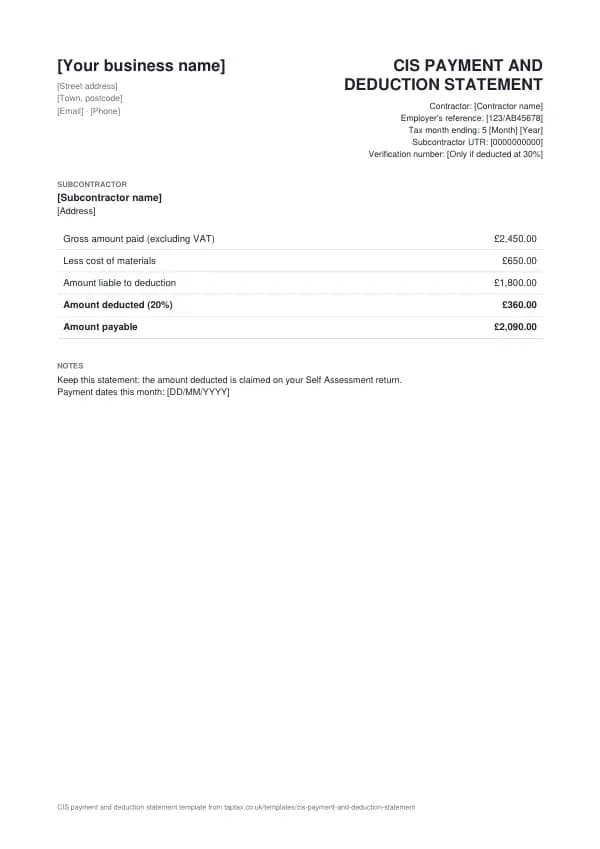
The example follows a £2,450 payment with £650 of materials, deducted at 20%.
| Line | Amount |
|---|---|
| Gross amount paid (excluding VAT) | £2,450.00 |
| Less cost of materials | £650.00 |
| Amount liable to deduction | £1,800.00 |
| Amount deducted (20%) | £360.00 |
| Amount payable | £2,090.00 |
How to fill in the template
- Add your name, employer's reference and the tax month ending on the 5th.
- Add the subcontractor's name and UTR, and the verification number if you deducted 30%.
- Enter the gross amount paid in the month, excluding VAT.
- Take off the cost of materials to reach the amount liable to deduction.
- Show the deduction and the amount paid.
- Send it within 14 days of the end of the tax month and keep a copy with your monthly return.
Give each CIS payment and deduction statement its own number in a single sequence, and never reuse one. A number lets you and your customer refer to the document without confusion, and an unbroken sequence shows your records are complete. The invoice number generator suggests a format that stays tidy for years.
Your monthly return and payment
Contractors file a CIS monthly return by the 19th of every month, covering payments to subcontractors in the tax month that ended on the 5th, and pay the deductions to HMRC by the 22nd if paying electronically. You must file a return even if no subcontractors were paid, unless you have told HMRC the scheme is inactive. Late returns attract a penalty of £100, increasing the longer the return is late. The payment and deduction statements should match the return exactly, because both HMRC and the subcontractor will rely on them.
CIS deduction rates
- Not registered for CIS30%
- Registered and verified20%
- Gross payment status0%
Statement or invoice?
The subcontractor's CIS invoice asks to be paid; this statement confirms what was paid and deducted. The subcontractor uses the statement, not their invoice, to claim the deduction, so a missing or wrong statement costs them money. Keep the two tied together by quoting the invoice numbers on the statement.
Verifying subcontractors first
Before paying a subcontractor for the first time, verify them with HMRC online, using their name, UTR and National Insurance number or company number. HMRC tells you whether to deduct at 20%, 30% or nothing. If they cannot be matched, deduct at 30% and put the verification number HMRC gives you on the statement. You usually do not need to verify a subcontractor again if you have included them on a monthly return in the current or previous two tax years.
Working out the figures
Start from the gross payment for the month, excluding VAT. Take off the direct cost of materials, plant hire, fuel used on the job (not for travel), prefabrication costs and the CITB levy, where the subcontractor paid for them. The rest is the amount liable to deduction. Multiply it by the rate HMRC gave you. Ask for evidence of materials costs if the invoice does not make them clear; if you cannot tell, the safe course is to treat the whole payment as labour. The CIS calculator does the arithmetic.
Who counts as a contractor
You are a mainstream contractor if you pay subcontractors for construction work, and a deemed contractor if your business spends more than £3 million on construction in any 12 months even though construction is not your trade. A sole trader builder who takes on a plasterer or electrician for part of a job is a contractor for that payment and must register as one. Paying a homeowner's job through you does not change that: if you pay a subcontractor, CIS applies to the payment.
Getting the statement to the subcontractor
Statements can be given on paper or electronically, as long as the subcontractor agrees and can keep a copy. Many contractors email a PDF on the same day they file the monthly return. Send one statement per subcontractor per tax month, covering every payment in that month, and quote the invoice numbers it covers so the subcontractor can reconcile it. If you make a mistake, issue a corrected statement and correct the monthly return too.
Records to keep
Keep copies of every statement, the verification details for each subcontractor, and the invoices and payment records behind them, for at least three years after the end of the tax year they relate to. HMRC compliance checks on contractors focus on whether subcontractors were verified correctly, whether deductions match the returns, and whether materials were genuinely excluded, so tidy records make a check short.
Common CIS payment and deduction statement mistakes
- Sending statements late or not at all. Subcontractors need them within 14 days of the tax month end to claim their deductions.
- Deducting from VAT or materials. Only the labour part is liable; VAT and direct materials costs are excluded.
- Figures that do not match the monthly return. HMRC and the subcontractor both rely on them; correct both together.
Checklist before you send it
Before a CIS payment and deduction statement goes out, check it against the list of what it must show:
- Your name and employer's reference (the CIS reference) is on it and correct.
- The tax month the statement covers (ending on the 5th) is on it and correct.
- The subcontractor's name and UTR is on it and correct.
- The verification number, if you deducted at the higher 30% rate is on it and correct.
- The gross amount paid, excluding VAT is on it and correct.
- The cost of materials is on it and correct.
- The amount liable to deduction and the amount deducted is on it and correct.
- A copy is saved with your records.
Sending it
Send the CIS payment and deduction statement as a PDF attached to an email, not as an editable file. In the email, say what it is, its number, the amount and any date that matters, so the reader can act without opening the attachment. Send it to the person or inbox that deals with it, which for a business is often an accounts address rather than the person you worked with, and keep a copy of the email and the PDF together in your records.
Keep a copy
You must keep your records for at least 5 years after the 31 January submission deadline of the relevant tax year.
Keep a copy of every CIS payment and deduction statement you issue or receive, digital is fine, with the payments that relate to it. From 6 April 2026, sole traders and landlords with qualifying income over £50,000 must keep digital records and send HMRC quarterly updates under Making Tax Digital, falling to £30,000 from April 2027 and £20,000 from April 2028. The MTD requirement checker shows when it applies to you, and how long to keep invoices covers retention.
Download the CIS payment and deduction statement template
The template comes as a Word document for Word, Google Docs and Pages, an Excel workbook for Excel and Google Sheets, and a print-ready PDF. Replace the words in square brackets with your own details.
Related documents in the same family: the CIS invoice template. All of them follow the same numbering and record-keeping rules, and each page explains what that document must show.
A TapTax account, free to start, creates and sends invoices, tracks which are paid, keeps receipts and bills with your records, and files your quarterly updates to HMRC from the same data.
Tools for this
Related guides and definitions
Frequently asked questions
When must I give a CIS payment and deduction statement?
Within 14 days of the end of each tax month in which you made a deduction. For the month ending 5 June, that is by 19 June.
What goes on a CIS payment and deduction statement?
Your name and employer's reference, the tax month, the subcontractor's name and UTR, the gross amount, materials, the amount liable to deduction and the amount deducted, plus a verification number if you deducted 30%.
Do I need a statement for gross payment subcontractors?
No, because nothing is deducted, although sending one is good practice.
Invoice, get paid, stay ready for HMRC.
TapTax creates and sends your invoices, tracks which ones are paid and files your quarterly updates to HMRC. Start on the free plan, no card needed.
Get started freeSources
The rules on this page come from official guidance.