
CIS invoice
template
A subcontractor invoice that splits labour from materials, so the contractor deducts CIS from the right amount.
Download the CIS invoice template
Free, with no sign-up. Replace the words in square brackets with your own details.
Under CIS, a contractor takes 20% (or 30% if you are not registered) off the labour part of each payment and passes it to HMRC as an advance on your tax. The deduction is worked out from what your invoice says, so an invoice that lumps labour and materials together can cost you money until you claim it back. This template keeps labour, materials and VAT apart, shows your UTR, and reads the way contractors' accounts teams expect.
- CIS invoice
- An invoice from a subcontractor to a contractor under the Construction Industry Scheme (CIS). It shows labour and materials separately, because the contractor deducts tax only from the labour part before paying.
When to use a CIS invoice
Use a CIS invoice for any construction work you do as a subcontractor for a contractor registered for CIS, whether that is a main contractor on a site, a developer, or a business that spends more than £3 million on construction in 12 months. CIS covers most building work: site preparation, alterations, repairs, decorating, demolition and installing systems such as heating and lighting. It does not cover work for a private homeowner, professional services such as architecture and surveying, or the delivery of materials without installation. If you are VAT registered, most CIS work between VAT-registered businesses also falls under the domestic reverse charge, so the invoice needs the reverse charge wording too.
What a CIS invoice must show
| What it shows | Why it matters |
|---|---|
| Your name, trading address and Unique Taxpayer Reference (UTR) | The contractor verifies you with HMRC using your UTR |
| The contractor's name and address | Who is paying and deducting |
| A unique invoice number and the invoice date | Identifies the invoice and the tax month |
| Labour shown separately from materials | CIS is deducted from labour only |
| The cost of materials you bought for the job | Not subject to the deduction; keep the receipts |
| VAT, or the reverse charge statement if it applies | VAT is never subject to the CIS deduction |
| The total, and the amount you expect after the deduction | Makes the payment easy to check |
An example CIS invoice
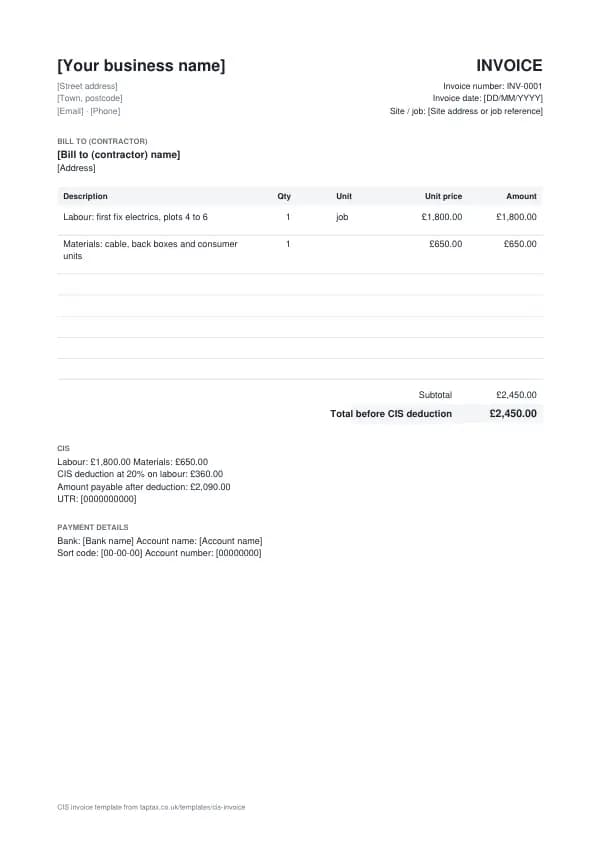
The template comes filled in with example lines like these, so you can see how each part works before replacing them with your own.
| Line | Quantity | Price | Amount |
|---|---|---|---|
| Labour: first fix electrics, plots 4 to 6 | 1 job | £1,800.00 | £1,800.00 |
| Materials: cable, back boxes and consumer units | 1 | £650.00 | £650.00 |
| Subtotal | £2,450.00 | ||
| Total before CIS deduction | £2,450.00 |
Line by line: Labour: first fix electrics, plots 4 to 6, 1 job × £1,800.00 = £1,800.00; Materials: cable, back boxes and consumer units, 1 × £650.00 = £650.00. The subtotal is £2,450.00, which is also the total before cis deduction because no VAT is charged. The figures are illustrative; replace them with your own.
How to fill in the template
- Add your name, address and UTR, and the contractor's details.
- Describe the labour for the period, with the site or job reference.
- List materials you bought for the job separately, at cost.
- Add VAT, or the reverse charge statement if it applies.
- Show the deduction you expect and the amount payable.
- Keep the materials receipts and file the contractor's monthly statement with the invoice when it arrives.
Number every CIS invoice in sequence and never reuse a number, even when a document is cancelled. Numbers make documents easy to find and to match against payments, and they show HMRC and your customers that nothing is missing. For a numbering format, try the invoice number generator.
What CIS is deducted from
The deduction applies to the labour part of the payment. The contractor leaves out VAT, the cost of materials you bought for the job, equipment you hired for the job (plant hire), fuel used on the job other than for travelling, the cost of manufacturing or prefabricating materials, and the CITB levy. Anything else, including travel and subsistence you charge to the contractor, counts as labour. The rate is 20% for registered subcontractors, 30% if you are not registered or HMRC cannot verify you, and nothing if you have gross payment status. Deductions are an advance on your Income Tax and National Insurance, claimed back through your Self Assessment return.
CIS deduction rates
- Not registered for CIS30%
- Registered and verified20%
- Gross payment status0%
CIS invoice or payment and deduction statement?
You send the CIS invoice to ask to be paid. The contractor sends you a payment and deduction statement after paying you, showing what was deducted. The invoice is your figure; the statement is theirs and is what you use on your tax return, so check the two match every month.
Registering as a subcontractor
Register for CIS as a subcontractor with HMRC before you start work, using your UTR, so contractors can verify you at 20% rather than 30%. You need to be registered for Self Assessment first. If you set up as a limited company or partnership the rules are similar, with the company's UTR. Once registered, give each new contractor your name, UTR and National Insurance number so they can verify you. If a contractor deducts 30%, it is usually because their verification could not match you, so check they have your details exactly as HMRC has them.
Gross payment status
With gross payment status, contractors pay you without any deduction, which helps cash flow. You must pass three tests: a business test (you do construction work in the UK and run your business through a bank account), a turnover test (for a sole trader, at least £30,000 of net construction turnover, excluding VAT and materials, in the last 12 months), and a compliance test (your tax returns and payments, including VAT, have been on time). HMRC reviews status regularly and can remove it after late returns or payments, so staying on top of deadlines matters.
Claiming the deductions back
CIS deductions are credited against your tax bill on your Self Assessment return. Add up the deductions on every payment and deduction statement for the tax year (6 April to 5 April) and enter the total in the self-employment section. If the deductions are more than your tax and Class 4 National Insurance, HMRC repays the difference. Keep every monthly statement: if a contractor made a deduction but did not report it to HMRC, the statements are your evidence, and HMRC will need them to credit you.
Materials, receipts and evidence
Only materials you actually paid for are excluded from the deduction, at cost, so keep the receipts. If you add a mark-up to materials, the mark-up is labour for CIS purposes. Contractors can ask for evidence of materials costs, and HMRC can check them later. Where the contractor supplies the materials, leave them off your invoice altogether. The CIS calculator shows the deduction and the amount you should receive for any mix of labour and materials.
Invoicing a homeowner instead
CIS does not apply to work for private homeowners, even when the same job would be CIS work for a contractor. Invoice homeowners with a normal invoice, charge VAT in the usual way if you are registered, and leave out the CIS section. The domestic reverse charge does not apply either, because a homeowner is the end user. Getting this wrong confuses the customer and can mean the tax on the job is misreported.
Common CIS invoice mistakes
- Combining labour and materials into one figure. The contractor may then deduct from the whole amount; always show them separately.
- Adding a mark-up to materials and calling it materials. The mark-up counts as labour and is subject to the deduction.
- Not keeping the monthly statements. They are how you prove your deductions when you claim them back.
Checklist before you send it
A quick check of every CIS invoice before you send it:
- Your name, trading address and Unique Taxpayer Reference (UTR) is on it and correct.
- The contractor's name and address is on it and correct.
- A unique invoice number and the invoice date is on it and correct.
- Labour shown separately from materials is on it and correct.
- The cost of materials you bought for the job is on it and correct.
- VAT, or the reverse charge statement if it applies is on it and correct.
- The total, and the amount you expect after the deduction is on it and correct.
- A copy is saved with your records.
Sending it
Email the CIS invoice as a PDF with a short, specific message: the document number, the amount, and what you need the reader to do. Address it to whoever processes it, often an accounts team, and copy your usual contact if that helps. File the sent PDF with its number in the file name, so you can find it in seconds if there is ever a question.
Keep a copy
You must keep your records for at least 5 years after the 31 January submission deadline of the relevant tax year.
Business documents are records, and records have to be kept. Save every CIS invoice in one place, ideally digitally, so you can find it if a customer or HMRC asks. Making Tax Digital for Income Tax makes digital records compulsory from 6 April 2026 for qualifying income over £50,000, from April 2027 over £30,000 and from April 2028 over £20,000; check your date with the MTD requirement checker.
Download the CIS invoice template
Download it as a Word document, an Excel workbook or a PDF, whichever suits the way you work. The Word file opens in Google Docs too, and the Excel file in Google Sheets. The Excel totals are live formulas.
Related documents in the same family: the CIS payment and deduction statement template. All of them follow the same numbering and record-keeping rules, and each page explains what that document must show.
If you would rather not manage documents by hand, a TapTax account, free to start, keeps your invoices, receipts and bank transactions together and files your Making Tax Digital quarterly updates to HMRC.
Tools for this
Related guides and definitions
Frequently asked questions
What should a CIS invoice include?
Your name, address and UTR, the contractor's details, labour and materials shown separately, VAT or the reverse charge wording, and the total.
Is CIS deducted from materials?
No. The contractor deducts only from the labour part, after taking off VAT, materials, plant hire and certain other costs.
What rate of CIS will be deducted?
20% if you are registered and verified, 30% if you are not registered, and nothing if you have gross payment status.
Invoice, get paid, stay ready for HMRC.
TapTax creates and sends your invoices, tracks which ones are paid and files your quarterly updates to HMRC. Start on the free plan, no card needed.
Get started freeSources
The rules on this page come from official guidance.