
Delivery note
template
A delivery note that lists what was delivered and gets it signed for, without prices.
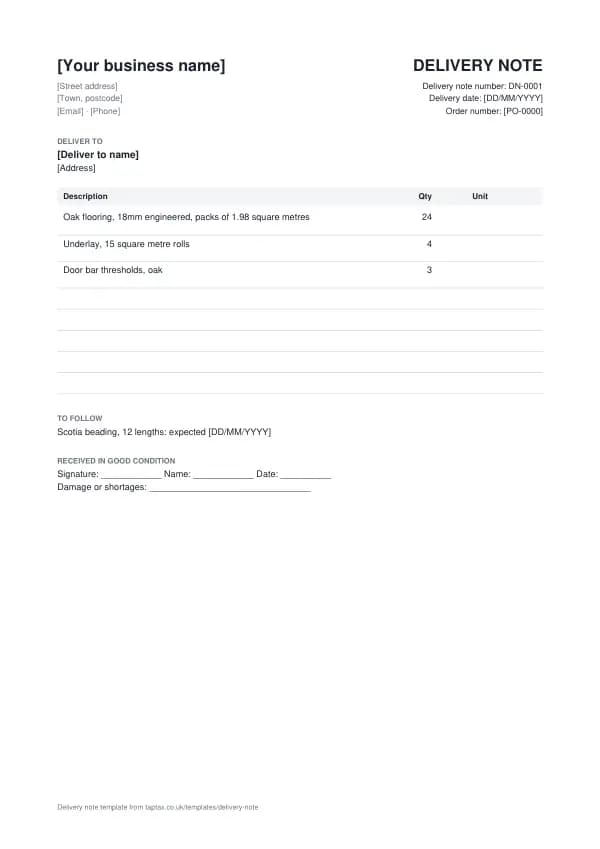
Download the delivery note template
Free, with no sign-up. Replace the words in square brackets with your own details.
A signed delivery note is your proof that the goods reached the customer, in the quantity and condition stated. If the customer later says an item was missing or damaged, it is the first document anyone asks for. It also lets the customer check the delivery against their order before signing. This template lists items and quantities, leaves prices off, and has space for a signature, name and date.
- Delivery note
- A document that goes with a delivery, listing the goods and quantities, for the customer to check and sign. It usually shows no prices, and it is the proof that the goods arrived.
When to use a delivery note
Use a delivery note whenever you deliver goods to a customer: building materials to site, stock to a shop, furniture to a home, or orders to a business. Send it with the goods, get it signed on arrival, and keep a copy. For part deliveries, list what was delivered and what is still to come. Then invoice for what was delivered, quoting the delivery note number. If a courier delivers for you, their proof of delivery does a similar job, but a delivery note in the box still helps the customer check the contents.
What a delivery note must show
| What it shows | Why it matters |
|---|---|
| The words "Delivery note", a number and the delivery date | Identifies the delivery |
| Your details and the customer's, with the delivery address | Who sent and where it went |
| The customer's order or purchase order number | Links the delivery to the order |
| Each item with description and quantity | What was delivered |
| Items still to follow, for part deliveries | Avoids confusion over missing items |
| Space for the recipient's signature, printed name and date | Proof of delivery |
| A line for noting damage or shortages | Captures problems at the door |
An example delivery note
The template comes filled in with example lines like these, so you can see how each part works before replacing them with your own.
| Item | Quantity |
|---|---|
| Oak flooring, 18mm engineered, packs of 1.98 square metres | 24 |
| Underlay, 15 square metre rolls | 4 |
| Door bar thresholds, oak | 3 |
How to fill in the template
- Create the delivery note from the order, with the order number.
- List every item and quantity being sent.
- Note anything still to follow on a part delivery.
- Send two copies with the goods.
- Ask the recipient to check, note any problems, and sign one copy.
- Keep the signed copy and invoice for what was delivered.
Number every delivery note in sequence and never reuse a number, even when a document is cancelled. Numbers make documents easy to find and to match against payments, and they show HMRC and your customers that nothing is missing. For a numbering format, try the invoice number generator.
Risk, ownership and delivery
For sales to consumers, the Consumer Rights Act 2015 says the goods remain at the trader's risk until they come into the physical possession of the consumer, or someone they have named to receive them. If goods are lost or damaged in transit, it is your problem, and a signed delivery note is how you show the goods arrived safely. For business customers, when risk and ownership pass depends on your contract terms or Incoterms; a signed delivery note is still your evidence of what arrived and when. Include a retention of title clause in your business terms if you want to keep ownership until you are paid.
Income thresholds that change your paperwork
- Trading allowance£1,000
- MTD from April 2028£20,000
- MTD from April 2027£30,000
- MTD from April 2026£50,000
- VAT registration£90,000
Delivery note or invoice?
A delivery note records what was delivered, usually without prices. An invoice charges for it. The customer checks the delivery note on arrival, then matches the invoice to it before paying. Keeping them separate means the person receiving goods does not need to see prices.
Checking and signing
Ask the recipient to check the delivery against the note before signing, counting packages at least, and inspecting for visible damage. If they cannot check fully, they can sign "unchecked" or note the number of packages, which protects both sides. Any damage or shortage should be written on the note at the time. Photograph the delivery in place if the goods are valuable. A note signed "received in good condition" without comment is strong evidence against a later claim.
Part deliveries
When an order is delivered in stages, give each delivery its own note listing what was sent, and show what remains outstanding. Invoice only what has been delivered, or follow your agreed terms for staged billing. The customer can then match each invoice to a delivery note, and nothing is paid for twice or missed.
Delivery notes and VAT
For VAT, the basic tax point for goods is usually when they are sent to or collected by the customer, or made available to them. If you issue a VAT invoice within 14 days of that date, the invoice date becomes the tax point instead. The delivery note date is therefore important evidence of the basic tax point. A delivery note is not a VAT invoice, and the customer cannot reclaim VAT on it.
Electronic proof of delivery
Many businesses now capture signatures on a phone or tablet, with a photo and GPS location. That is as good as paper, and easier to store and search. Make sure the electronic record shows the same details as a paper note: items, quantities, recipient's name, date and time, and any comments. Email the customer a copy straight away.
Worked example
A flooring supplier delivers 24 packs of oak flooring, 4 rolls of underlay and 3 thresholds to a fitter's site, with the scotia beading to follow. The site manager counts the packs, notes one damaged pack on the note, and signs. The supplier invoices for 23 packs, the underlay and thresholds, sends a replacement pack with the beading, and invoices those on delivery. When the customer's accounts team matches the invoices, every figure agrees with a signed delivery note.
Keeping delivery notes
Keep signed delivery notes with the invoices they relate to. They support your sales records, prove the tax point for VAT, and answer customer queries months later. For business records, that means at least five years after the 31 January submission deadline of the relevant tax year, and longer if a delivery is the subject of a dispute.
Collections and click and collect
When a customer collects goods from you, the same principle applies: list what they take, and ask them to sign. For trade counters and click and collect, a printed collection note or a signature on a screen does the job. Collection is also relevant to VAT, because the basic tax point for goods is when they are collected or made available to the customer.
Common delivery note mistakes
- No signature on delivery. Without one, proving the goods arrived is much harder.
- Invoicing for items not yet delivered. Invoice what the delivery notes show, unless your terms say otherwise.
- Prices on the delivery note. Keep prices on the invoice; the note is for checking quantities.
Checklist before you send it
A quick check of every delivery note before you send it:
- The words "Delivery note", a number and the delivery date is on it and correct.
- Your details and the customer's, with the delivery address is on it and correct.
- The customer's order or purchase order number is on it and correct.
- Each item with description and quantity is on it and correct.
- Items still to follow, for part deliveries is on it and correct.
- Space for the recipient's signature, printed name and date is on it and correct.
- A line for noting damage or shortages is on it and correct.
- A copy is saved with your records.
Sending it
Email the delivery note as a PDF with a short, specific message: the document number, the amount, and what you need the reader to do. Address it to whoever processes it, often an accounts team, and copy your usual contact if that helps. File the sent PDF with its number in the file name, so you can find it in seconds if there is ever a question.
Keep a copy
You must keep your records for at least 5 years after the 31 January submission deadline of the relevant tax year.
Business documents are records, and records have to be kept. Save every delivery note in one place, ideally digitally, so you can find it if a customer or HMRC asks. Making Tax Digital for Income Tax makes digital records compulsory from 6 April 2026 for qualifying income over £50,000, from April 2027 over £30,000 and from April 2028 over £20,000; check your date with the MTD requirement checker.
Download the delivery note template
Download it as a Word document, an Excel workbook or a PDF, whichever suits the way you work. The Word file opens in Google Docs too, and the Excel file in Google Sheets.
Related documents in the same family: the job sheet template, work order template and timesheet template. All of them follow the same numbering and record-keeping rules, and each page explains what that document must show.
If you would rather not manage documents by hand, a TapTax account, free to start, keeps your invoices, receipts and bank transactions together and files your Making Tax Digital quarterly updates to HMRC.
Tools for this
Related guides and definitions
Frequently asked questions
What is a delivery note?
A document sent with goods, listing items and quantities, which the customer signs to confirm delivery.
Should a delivery note show prices?
Usually not. Prices go on the invoice, and the delivery note is for checking the goods.
Is a delivery note proof of delivery?
Yes, once signed by the recipient, especially if it records the date and any problems.
Invoice, get paid, stay ready for HMRC.
TapTax creates and sends your invoices, tracks which ones are paid and files your quarterly updates to HMRC. Start on the free plan, no card needed.
Get started freeSources
The rules on this page come from official guidance.