
Expenses recharge invoice
template
An invoice to recharge travel, materials and other costs to a client, with the right VAT on each.
Download the expenses recharge invoice template
Free, with no sign-up. Replace the words in square brackets with your own details.
The free invoice generator makes a finished PDF with your details, logo and colours. Nothing is stored.
Charging clients for expenses is routine, but the VAT often catches people out. Most recharged costs are part of your own supply, so a VAT-registered business charges VAT on them at the standard rate, even when the original cost had no VAT, such as a train ticket. Only genuine disbursements, costs you pay purely as the client's agent, are outside the scope of VAT. This template separates the two and lists each cost clearly.
- Expenses recharge invoice
- An invoice that passes costs you incurred on a client's behalf, such as travel, accommodation, materials or fees, on to the client, either on their own or alongside your fee.
When to use a expenses recharge invoice
Use an expenses recharge invoice when your agreement lets you charge the client for costs: travel and accommodation for a consultant, materials bought for a job, courier costs, printing, or fees paid to third parties such as the Land Registry or a court. You can put expenses on the same invoice as your fee or on a separate one. Keep receipts for every cost, because clients often ask for them, and HMRC may too.
What a expenses recharge invoice must show
| What it shows | Why it matters |
|---|---|
| A unique invoice number, date and due date | Identifies the invoice |
| Your details and the client's | Who is billing and who pays |
| Each expense with its date, description and amount | So each cost can be checked |
| Recharges separated from disbursements | They are treated differently for VAT |
| VAT on recharges if you are registered | Recharges are part of your supply |
| Any mark-up or handling fee, if agreed | Shown openly |
| A note that receipts are attached or available | Supports every figure |
An example expenses recharge invoice
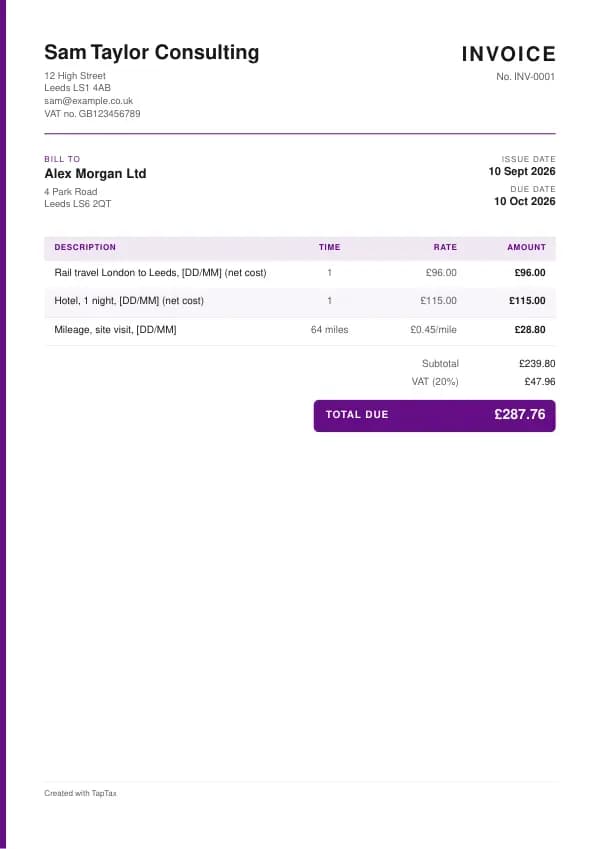
The template comes filled in with example lines like these, so you can see how each part works before replacing them with your own.
| Line | Quantity | Price | Amount |
|---|---|---|---|
| Rail travel London to Leeds, [DD/MM] (net cost) | 1 | £96.00 | £96.00 |
| Hotel, 1 night, [DD/MM] (net cost) | 1 | £115.00 | £115.00 |
| Mileage, site visit, [DD/MM] | 64 miles | £0.45 | £28.80 |
| Subtotal | £239.80 | ||
| VAT at 20% | £47.96 | ||
| Total due | £287.76 |
Line by line: Rail travel London to Leeds, [DD/MM] (net cost), 1 × £96.00 = £96.00; Hotel, 1 night, [DD/MM] (net cost), 1 × £115.00 = £115.00; Mileage, site visit, [DD/MM], 64 miles × £0.45 = £28.80. The subtotal is £239.80, VAT at 20% adds £47.96, and the total due is £287.76. The figures are illustrative; replace them with your own.
How to fill in the template
- Keep a receipt for every cost you intend to recharge.
- List each expense with its date, description and amount.
- If you are VAT registered, use the net cost where you reclaimed the VAT, then add VAT on the recharge.
- Show genuine disbursements separately, outside the scope of VAT.
- Add any agreed mark-up or handling fee openly.
- Attach the receipts and send it with, or after, your fee invoice.
Number every expenses recharge invoice in sequence and never reuse a number, even when a document is cancelled. Numbers make documents easy to find and to match against payments, and they show HMRC and your customers that nothing is missing. For a numbering format, try the invoice number generator.
Recharges and disbursements for VAT
A recharge is a cost you incur in making your own supply to the client: your travel, hotels, meals, materials and phone costs. It is part of the value of your supply, so a VAT-registered business charges VAT on it at the rate of the main supply, usually 20%, even if the original cost carried no VAT, such as rail fares or postage. A disbursement for VAT is a payment you make purely as the client's agent, for something the client receives and is responsible for, such as a statutory fee. It is outside the scope of VAT if all HMRC's conditions are met: the client must have authorised it, it must be the client's liability, shown separately on your invoice at cost, and you must not reclaim VAT on it.
UK VAT rates
- Standard rate20%
- Reduced rate5%
- Zero rate0%
Recharges or disbursements?
Your own travel to a client's site is a recharge: part of your service, with VAT. A court or Land Registry fee you paid for the client is usually a disbursement: passed on at cost, outside the scope of VAT. HMRC's guidance on costs or disbursements passed to customers sets out the conditions.
Worked example
A VAT-registered consultant pays a £96 rail fare (no VAT), a £138 hotel bill including £23 VAT, and a £45 Land Registry fee for the client. On the recharge invoice: rail £96 and hotel £115 (net, since the consultant reclaims the £23) are recharges, subject to 20% VAT, adding £42.20. The Land Registry fee is a disbursement, shown separately at £45 with no VAT. The client pays £298.20 in total. If the consultant were not VAT registered, they would recharge the gross costs with no VAT added.
Mileage
Recharging mileage at an agreed rate per mile, such as 45p, is common. For VAT, mileage recharged to a client is part of your supply and carries VAT if you are registered. For your own tax, the mileage you charge a client is income, and your actual motoring costs or the simplified mileage rate are your expense. Do not confuse the rate you charge the client with HMRC's approved mileage rates, which cap tax-free payments to employees and the simplified expenses deduction for sole traders.
Mark-ups and handling fees
You can add a mark-up to expenses if the client agreed, especially on materials, where your time sourcing them has a cost. Show it openly, either within the price or as a handling fee line. Some clients, particularly public bodies and large companies, reimburse expenses only at cost and require receipts, so check their expenses policy before the work starts.
Expenses in your tax return
For Income Tax, expenses you recharge are both income (the amount the client pays you) and a cost (what you spent), so they usually net out. Record both. Costs that would not be allowable for you, such as client entertaining, remain non-deductible even if you recharge them, while the recharge is still income. Keeping expenses on separate lines makes this easy to track in your records and on your Self Assessment return.
Agreeing expenses in advance
Set out in your quote or contract which expenses are recharged, at what rate, and whether any need prior approval, such as flights or hotels above a set amount. Clients who know the rules approve invoices quickly; clients who are surprised by expenses dispute them. For long projects, recharge expenses monthly rather than letting them build up to a large sum at the end.
Common expenses recharge invoice mistakes
- Not adding VAT to recharged travel. Recharges are part of your supply, so VAT applies if you are registered.
- Treating your own costs as disbursements. Disbursements are only costs paid as the client's agent, meeting HMRC's conditions.
- Recharging the gross cost after reclaiming VAT. Use the net cost, then add VAT on the recharge.
Checklist before you send it
A quick check of every expenses recharge invoice before you send it:
- A unique invoice number, date and due date is on it and correct.
- Your details and the client's is on it and correct.
- Each expense with its date, description and amount is on it and correct.
- Recharges separated from disbursements is on it and correct.
- VAT on recharges if you are registered is on it and correct.
- Any mark-up or handling fee, if agreed is on it and correct.
- A note that receipts are attached or available is on it and correct.
- A copy is saved with your records.
Sending it
Email the expenses recharge invoice as a PDF with a short, specific message: the document number, the amount, and what you need the reader to do. Address it to whoever processes it, often an accounts team, and copy your usual contact if that helps. File the sent PDF with its number in the file name, so you can find it in seconds if there is ever a question.
Keep a copy
You must keep your records for at least 5 years after the 31 January submission deadline of the relevant tax year.
Business documents are records, and records have to be kept. Save every expenses recharge invoice in one place, ideally digitally, so you can find it if a customer or HMRC asks. Making Tax Digital for Income Tax makes digital records compulsory from 6 April 2026 for qualifying income over £50,000, from April 2027 over £30,000 and from April 2028 over £20,000; check your date with the MTD requirement checker.
Download the expenses recharge invoice template
Download it as a Word document, an Excel workbook or a PDF, whichever suits the way you work. The Word file opens in Google Docs too, and the Excel file in Google Sheets. The Excel totals are live formulas. Or fill it in online with the free invoice generator, which makes a finished PDF with your details, in your colours.
Related documents in the same family: the deposit invoice template, interim invoice template, stage payment invoice template, final invoice template and retainer invoice template. All of them follow the same numbering and record-keeping rules, and each page explains what that document must show.
If you would rather not manage documents by hand, a TapTax account, free to start, keeps your invoices, receipts and bank transactions together and files your Making Tax Digital quarterly updates to HMRC.
Tools for this
Related guides and definitions
Frequently asked questions
Do I charge VAT on recharged expenses?
If you are VAT registered, usually yes: recharges are part of your supply and carry VAT at the rate of the main supply, even if the original cost had none.
What is a disbursement for VAT?
A payment made purely as the client's agent, for something the client receives, shown separately at cost, which meets HMRC's conditions. It is outside the scope of VAT.
Can I add a mark-up to expenses?
Yes, if the client agreed. Show it openly.
Invoice, get paid, stay ready for HMRC.
TapTax creates and sends your invoices, tracks which ones are paid and files your quarterly updates to HMRC. Start on the free plan, no card needed.
Get started freeSources
The rules on this page come from official guidance.