
Plumber
invoice template
Call-outs, labour and parts on separate lines, with CIS and reverse charge wording built in.
Download the plumber invoice template
Free, with no sign-up. Replace the words in square brackets with your own details; the example lines are ready to keep or change.
Opens the free invoice generator with these lines in place. Make a PDF in your own colours, with your logo. Nothing is stored.
Plumbers invoice for everything from a single call-out to a full bathroom, often to a homeowner one day and a main contractor the next. Below is a ready-made plumber invoice template, with worked example lines, the VAT and payment rules that apply, and the mistakes that most often delay payment.
What goes on a plumber invoice
Break the job into the call-out or first hour, further labour, and the parts you fitted. Name the parts (a 15mm isolation valve, a thermostatic mixer, 3 metres of 22mm copper) rather than writing "materials", and put the property address on the invoice if it differs from the customer's.
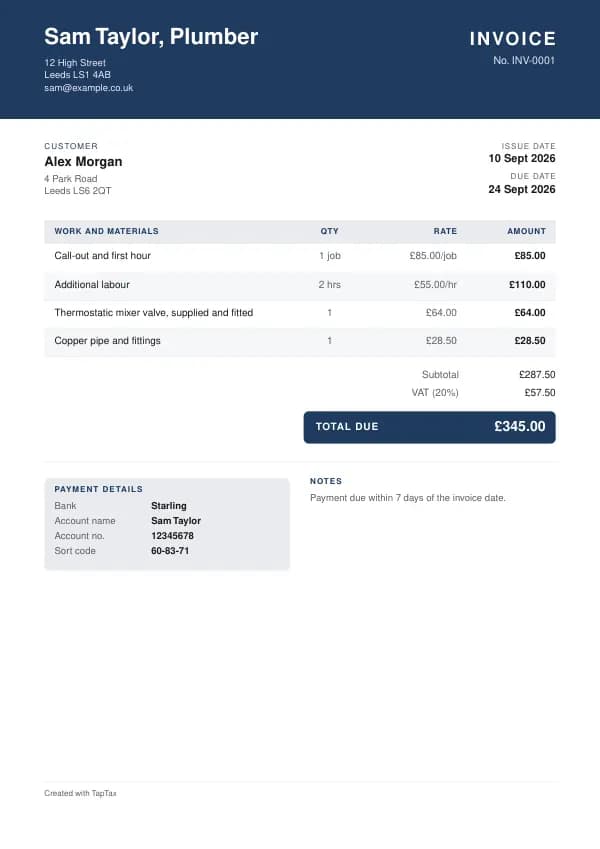
| Line | Quantity | Price | Amount |
|---|---|---|---|
| Call-out and first hour | 1 job | £85.00 | £85.00 |
| Additional labour | 2 hours | £55.00 | £110.00 |
| Thermostatic mixer valve, supplied and fitted | 1 | £64.00 | £64.00 |
| Copper pipe and fittings | 1 | £28.50 | £28.50 |
| Subtotal | £287.50 | ||
| VAT at 20% | £57.50 | ||
| Total due | £345.00 |
Line by line: Call-out and first hour, 1 job × £85.00 = £85.00; Additional labour, 2 hours × £55.00 = £110.00; Thermostatic mixer valve, supplied and fitted, 1 × £64.00 = £64.00; Copper pipe and fittings, 1 × £28.50 = £28.50. The subtotal is £287.50. VAT at 20% adds £57.50, so the total is £345.00. The figures are illustrative, not a price guide, so use your own rates.
The legal minimum is the same for every trade. GOV.UK says an invoice needs a unique number, your business name and address, the customer's name and address, a description of the work, the supply date and invoice date, the amount charged, VAT if you charge it, and the total due. This template lays each of those out for plumbers; for the detail, read what a UK invoice must include.
Give each invoice the next number in a single sequence and never reuse one. A cancelled invoice keeps its number and is cancelled with a credit note. If you want a format that stays tidy for years, try the invoice number generator.
How plumbers price their work
Most plumbers charge a call-out fee that includes the first hour, then an hourly rate, with parts at cost plus a markup. Bigger jobs, such as a bathroom refit or a system upgrade, are usually quoted as a fixed price, with any extras agreed in writing before they are done. Emergency and out-of-hours work carries a higher rate that should be on your price list.
Keep the pricing visible. Each line should show the quantity, the unit and the rate, so the customer can match it to the quote. To set rates that cover your costs and your tax, try the day rate calculator; for materials and stock you resell, the profit margin calculator shows the margin you really make.
Agree this before you start
Before any job bigger than a repair, agree in writing the price or rate, what is included, how unexpected problems (a corroded valve, a hidden leak, a failed pipe inside a wall) will be priced, who supplies the parts, and when payment is due. For heating and bathroom installs, agree the payment stages and the date you will test and hand over. A short written quote, even an email, turns most invoice disputes into a two-minute conversation.
When to send a plumber invoice
Invoice a repair on the day, ideally before you leave, and take payment by card or bank transfer there and then. For fixed-price projects, invoice each agreed stage as it is reached and the balance on completion, once the customer has seen the work tested.
An invoice sent on the day tends to be paid on time; one sent weeks later tends to be paid weeks later. Email it as a PDF and keep a copy. The invoice due date calculator shows exactly when payment falls due under your terms.
VAT on plumber invoices
Plumbing repairs and servicing are standard-rated. Installing a qualifying heat pump or solar thermal system in a home is zero-rated until 31 March 2027, but replacing a gas boiler is not an energy-saving installation, so it stays at 20%. Adaptations for a disabled customer, such as a level-access shower, can be zero-rated when the customer gives you a written eligibility declaration.
Once registered, plumbers charge 20% on most work. Two reliefs come up often: the zero rate for installing qualifying energy-saving materials in residential homes, which runs until 31 March 2027, and the zero rate for work on a new dwelling. VAT Notice 708/6 lists which materials qualify, and anything outside the list is standard-rated.
Registration is compulsory once taxable turnover in the last 12 months passes £90,000, or when you expect to pass it within the next 30 days. Check your position with the VAT registration checker; until then, see invoicing without a VAT number.
CIS: when a contractor pays you
CIS covers the installation of systems in buildings, so it applies whenever a contractor pays you for that work. The deduction comes off the labour only, at 20% when you are registered, which is why the invoice shows materials separately. HMRC's CIS 340 guide is explicit that repairing, servicing or maintaining a system, or replacing parts of one, is not an installation and falls outside the scheme. Jobs for a householder are outside CIS entirely: a homeowner is never a contractor.
On CIS jobs, plumbers are often paid on an applied-for basis: you submit an application for payment, and the contractor pays against it with the deduction taken. Make your invoice match the application line for line.
The CIS calculator shows what you receive after the deduction, and CIS invoice requirements sets out the invoice layout contractors expect.
The domestic reverse charge
When both sides are VAT registered and the job is reportable under CIS, the customer, not you, usually pays the VAT to HMRC under the domestic reverse charge. Your invoice shows the VAT that would have been due and a note that the reverse charge applies, but leaves it out of the total. End users, such as homeowners and businesses improving their own premises, pay VAT in the normal way. Check each case with the reverse charge checker and copy the invoice wording.
Working for homeowners
When the customer is a household rather than a business, consumer law sets the ground rules. A job agreed in someone's home, or by phone or online, normally carries a 14-day cancellation right under the Consumer Contracts Regulations. Starting earlier is fine when the customer asks, but record that request in writing, and bill only for work done if they later cancel.
Deposits, stages and cancellations
Deposits are normal for bathroom and heating installations, usually enough to cover the fittings you order for that customer. Small repairs are paid on completion.
Ask for a deposit when you have to buy equipment for a specific customer, and invoice the balance once the system is commissioned and handed over. Small repairs are simplest paid on the day, by card or bank transfer, with the invoice sent before you leave.
Payment terms for plumbers
Domestic customers usually pay on the day or within 7 days; contractors often work to 30-day terms or their own monthly payment cycle.
Between businesses, the default when nothing is agreed is 30 days from receipt of the invoice or the work, whichever comes later, and agreed terms should not normally exceed 60 days. Late business payers owe statutory interest at 8% above Bank Rate plus fixed compensation per invoice; the late payment interest calculator does the sums. Private individuals are not covered by that Act, so agree your terms with them in writing before the work starts.
Fixed compensation for a late business payment
- Debt up to £999.99£40
- £1,000 to £9,999.99£70
- £10,000 or more£100
Getting paid faster
Put everything the customer needs to pay on the invoice: your bank name, account name, sort code and account number, and the reference to use, normally the invoice number. Give a due date, not just "on receipt". Then follow a routine: a reminder the day after the due date, another a week later, and a firmer letter after two weeks. Most late payment is disorganisation, not refusal, and a routine fixes it. Invoice payment terms compares the common options, and the due date calculator turns them into a date.
If a customer disputes the invoice
When a customer queries an invoice, reply quickly and in writing, quote the quote or agreement, and ask them to pay the part they accept while you resolve the rest. A credit note can settle a partial dispute cleanly. Unpaid after reminders? Send a letter before action with a final date; in England and Wales, claims up to £10,000 can then go to the small claims track. Invoice disputes and small claims for an unpaid invoice have the detail.
Common plumber invoicing mistakes
- Writing "materials" as one lump. A customer who can see each part and its price rarely queries the invoice, and on CIS work the materials must be separate from labour anyway.
- Forgetting the Gas Safe or certificate details. If you issued a gas safety certificate or building regulations notification, quote its number, so the customer has one document to file.
- Charging VAT on a heat pump install at 20%. Qualifying installs in homes are zero-rated until 31 March 2027; overcharging costs you the job next time.
- Leaving out the due date. "Payment due within 14 days" or a date on the invoice gives you something to chase against. Without one, business customers default to 30 days.
- Losing track of what is unpaid. Chase on the day after the due date, not a month later; the guide to chasing an unpaid invoice has the wording.
Checklist before you send it
A quick check before sending saves a chase later:
- The invoice number is the next in your sequence and has never been used.
- The customer's name and address are right, with their purchase order or reference if they use one.
- Each line shows what was done, the quantity, the unit and the rate.
- The subtotal and total add up, and VAT appears only if you are VAT registered.
- The invoice date, a due date and your bank details are on it.
- A copy is saved with your records before you press send.
Keep a copy of every invoice
You must keep your records for at least 5 years after the 31 January submission deadline of the relevant tax year.
Your invoices are the evidence behind the income on your tax return, so keep a copy of every one. Making Tax Digital for Income Tax makes that digital: from 6 April 2026 for qualifying income over £50,000, from April 2027 over £30,000, and from April 2028 over £20,000, with quarterly updates to HMRC. Check your start date with the MTD requirement checker.
Download the plumber invoice template
Download it as a Word document for Word or Google Docs, as an Excel workbook whose totals are live formulas, or as a print-ready PDF. Prefer to fill it in on screen? The free invoice generator opens pre-filled with the example plumber lines, lets you choose a template and colour, and makes a finished PDF in a minute, with nothing stored.
For the tax side of the trade, from allowable expenses to Making Tax Digital, read the self-employed plumber tax guide. A TapTax account, free to start, keeps your invoices and records together and files your quarterly updates to HMRC.
Tools for this
Related guides and definitions
Frequently asked questions
What should a plumber invoice include?
Your business name and address, a unique invoice number, the date, the customer's name, each piece of work with its price, the total, and your VAT number and the VAT if you are VAT registered.
Do plumbers charge VAT?
Only if you are VAT registered, which is compulsory above £90,000 of turnover. Most plumbing work is then 20%, with 0% for qualifying heat pump installs in homes and for certain adaptations for disabled customers.
Does CIS apply to plumbers?
When you install a system (heating, water, sanitation) for a contractor, yes: they deduct 20% from your labour, or 30% if you are not registered. Repairs and servicing, and any work for homeowners, are outside CIS.
When should a plumber send an invoice?
On the day for call-outs and repairs, ideally before leaving the property. For fixed-price projects, at each agreed stage and on completion.
Is this plumber invoice template free?
Yes. Download it in Word, Excel or PDF, or fill it in online with the free invoice generator. There is no sign-up, and nothing you type is stored.
Invoice, get paid, stay ready for HMRC.
TapTax creates and sends your invoices, tracks which ones are paid and files your quarterly updates to HMRC. Start on the free plan, no card needed.
Get started freeSources
The rules on this page come from official guidance.